💡 Key Takeaways
- New tax regime is default for FY 2026-27 under Section 202 of the Income-tax Act, 2025.
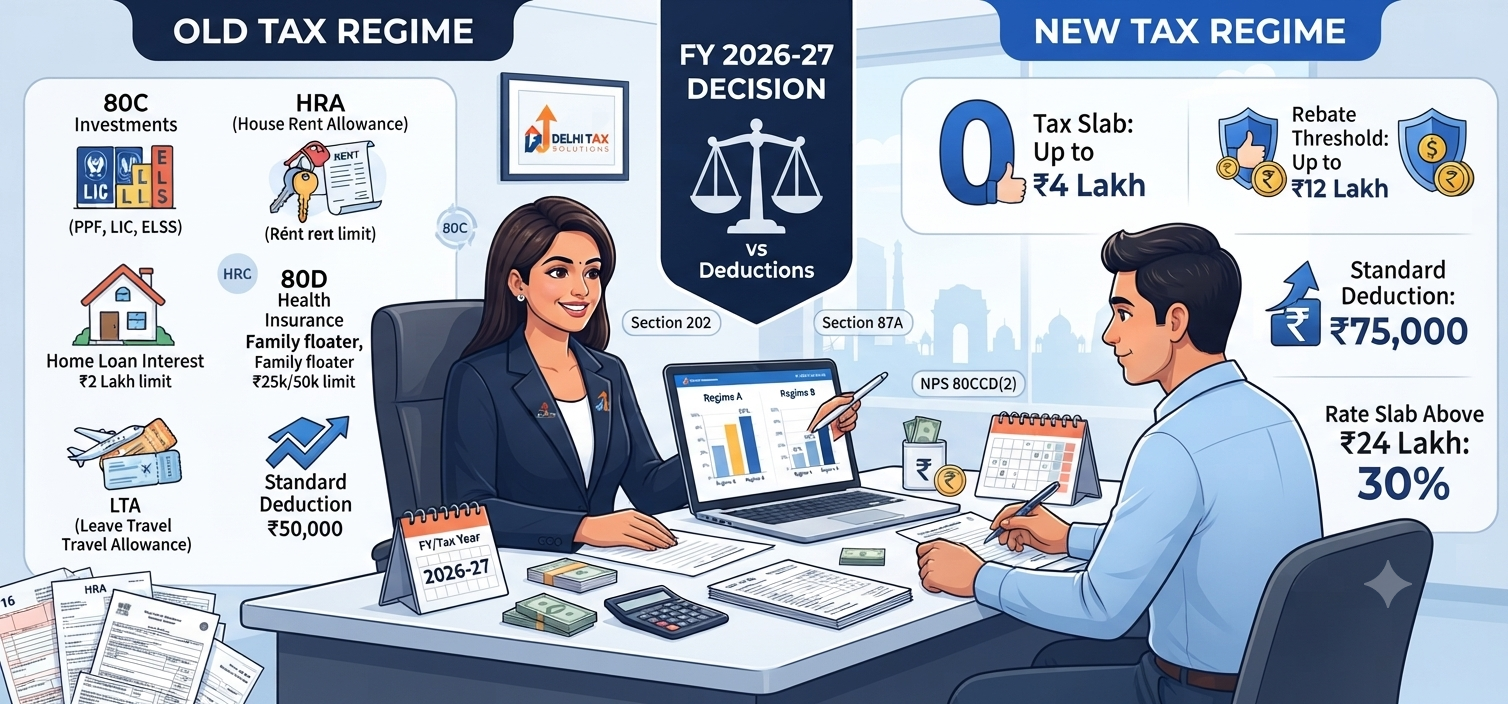
- New regime: nil tax up to ₹4 lakh, rising in slabs to 30% above ₹24 lakh.
- Salaried taxpayers pay zero tax up to ₹12.75 lakh after standard deduction and rebate.
- Old regime keeps ₹80C, HRA and home loan deductions but taxes income above ₹10 lakh at 30%.
- Business/professional taxpayers need Form 10-IEA to opt out of the new regime.
Every rupee you save on tax this year depends on one choice: old regime or new. For Tax Year 2026-27, the new tax regime is the automatic default when you log in to file your return. But “default” doesn’t mean “best for you.” The old vs new tax regime FY 2026-27 decision comes down to one question — how much are you claiming in deductions?
This guide compares the exact slab rates, rebate limits, and deductions under both regimes for Tax Year 2026-27, so you can pick the one that actually lowers your tax bill.
What Is the Old vs New Tax Regime for FY 2026-27?
The new tax regime, governed by Section 202 of the Income-tax Act, 2025, offers lower slab rates starting at nil up to ₹4 lakh but blocks most deductions. The old tax regime keeps higher slab rates — nil only up to ₹2.5 lakh — but lets you claim Section 80C, HRA, and home loan interest. For FY 2026-27, the new regime applies by default unless you actively opt out.
How Do the Two Regimes Actually Differ?
The core trade-off hasn’t changed since the new regime launched: rate versus relief.
The New Regime’s Approach
The new regime ignores how you spend or invest your money. It offers concessional rates upfront in exchange for giving up almost all exemptions, including House Rent Allowance and Section 80C.
The Old Regime’s Approach
The old regime rewards documented savings. If you have home loan interest, rent receipts for HRA exemption, or investments under Section 80C to 80U, it can still work out cheaper.
Why the Distinction Matters for FY 2026-27
Since the Income Tax Act 2025 replaced the 1961 Act, the terminology also shifted — this filing season is officially called Tax Year 2026-27, not Assessment Year.
Tax Slab Comparison: New Regime vs Old Regime FY 2026-27
Here is the verified slab structure for Tax Year 2026-27, confirmed against the Finance Bill 2026 and the Income-tax Act, 2025.
| Income Slab | Old Tax Regime | New Tax Regime (Section 202) |
|---|---|---|
| ₹0 – ₹2.5 Lakh | NIL | NIL up to ₹4 Lakh |
| ₹2.5 Lakh – ₹4 Lakh | 5% | |
| ₹4 Lakh – ₹5 Lakh | 5% | 5% |
| ₹5 Lakh – ₹8 Lakh | 20% | 5% |
| ₹8 Lakh – ₹10 Lakh | 20% | 10% |
| ₹10 Lakh – ₹12 Lakh | 30% | 10% |
| ₹12 Lakh – ₹16 Lakh | 30% | 15% |
| ₹16 Lakh – ₹20 Lakh | 30% | 20% |
| ₹20 Lakh – ₹24 Lakh | 30% | 25% |
| Above ₹24 Lakh | 30% | 30% |
Note: 4% Health and Education Cess applies on top of tax in both regimes. Senior citizens (60+) get a nil threshold of ₹3 lakh, and super senior citizens (80+) get ₹5 lakh, under the old regime only.
⚡ Quick Summary
If your income sits between ₹5 lakh and ₹12 lakh and you have few deductions, the new regime almost always wins on rate alone.
Rebate and Standard Deduction: The ₹12.75 Lakh Number Explained
The headline “zero tax up to ₹12.75 lakh” claim comes from two provisions stacking together, not one single exemption.
The Rebate on Total Income up to ₹12 Lakh
Under the new regime, resident individuals with total taxable income up to ₹12 lakh get a rebate of up to ₹60,000, bringing their tax liability to nil. Some official commentary attributes this rebate to Section 202 itself, while other analysis places it under Section 156(2)(a) of the Income-tax Act, 2025 — we’re flagging this section-number ambiguity rather than guessing, and recommend confirming the exact citation with the Income Tax Department portal before quoting it in any filing.
Standard Deduction Adds ₹75,000 More
Salaried employees and pensioners also get a standard deduction of ₹75,000 under the new regime. Stack that on top of the ₹12 lakh rebate threshold, and a salaried taxpayer’s effective tax-free ceiling becomes ₹12.75 lakh.
Old Regime Rebate Stays Smaller
The old regime’s rebate under Section 87A remains capped at total income up to ₹5 lakh, with a maximum rebate of ₹12,500 — unchanged for FY 2026-27.
What Deductions Do You Lose in the New Regime?
Choosing Section 202 means giving up the tools that made the old regime attractive for decades.
Deductions You Can No Longer Claim
Section 80C (PPF, ELSS, LIC, home loan principal), Section 80D health insurance premiums, HRA, LTA, and Section 24(b) home loan interest on a self-occupied property are all barred under the new regime.
What Still Survives
Employer contributions to NPS under Section 80CCD(2) and the ₹75,000 standard deduction remain available even in the new regime.
When the Old Regime Still Wins
If your combined 80C, HRA, and home loan interest claims exceed roughly ₹3–3.5 lakh, run the numbers — the old regime frequently comes out cheaper for higher earners with a mortgage. Confirm your exact standard deduction eligibility before you decide.
How Do You Opt Out of the New Regime? (Form 10-IEA)
Because the new regime is the default, switching to the old one requires an active step — and the process differs by income type.
Salaried Employees
If you have no business or professional income, you simply select the old regime option while filing ITR-1 or ITR-2 through the ITR e-filing process. You can switch back and forth every year.
Business and Professional Taxpayers
If you file ITR-3 or ITR-4, you must submit Form 10-IEA before the ITR filing deadline to opt out. Once you switch back to the new regime, you generally get only one further opportunity to opt out again in your lifetime — so plan the decision carefully, and check the latest procedural rules on the Ministry of Corporate Affairs and Income Tax Department portals if you also run a registered business entity.
The old vs new tax regime FY 2026-27 decision isn’t about which one is “better” in general — it’s about your specific deduction total. Under ₹3 lakh in claims, the new regime’s lower slabs and ₹12.75 lakh effective exemption usually win. Above that, especially with a home loan and HRA in the mix, the old regime can still save you more.
Don’t file on autopilot this year. Government policy on rebates and section numbers is still settling under the new Act — see the Press Information Bureau for the latest official clarifications. Talk to a Delhi Tax Solutions expert to get a CA-verified regime comparison run against your actual salary slip and investment proofs before you file.
Frequently Asked Questions (FAQs)
Q: How much salary is tax-free under the new tax regime for FY 2026-27?
A: A salaried individual can earn up to ₹12.75 lakh with zero tax liability under the new regime for Tax Year 2026-27. This figure comes from combining the ₹12 lakh rebate threshold for total taxable income with the ₹75,000 standard deduction available to salaried employees and pensioners. Non-salaried taxpayers without the standard deduction get zero tax only up to ₹12 lakh, not ₹12.75 lakh, since they cannot claim that additional deduction.
Q: Can I switch between the new and old tax regime every year?
A: Salaried individuals with no business or professional income can switch between the old and new tax regime every single financial year simply by selecting their preference while filing ITR-1 or ITR-2. However, taxpayers with business or professional income who file ITR-3 or ITR-4 face stricter rules: they must file Form 10-IEA to opt out, and once they return to the new regime after opting out, they typically get only one further chance to switch back in their lifetime.
Q: Is HRA exempt under the new tax regime for FY 2026-27?
A: No, House Rent Allowance is not exempt under the new tax regime for FY 2026-27. Taxpayers who select the default Section 202 framework must forgo HRA exemptions entirely, regardless of whether they live in a metro city like Delhi or a non-metro location. To claim HRA and reduce taxable salary using rent receipts, a taxpayer must actively opt for the old tax regime while filing their return.
Q: What is the difference between the old and new tax regime slab rates for FY 2026-27?
A: The old regime taxes income at nil up to ₹2.5 lakh, 5% up to ₹5 lakh, 20% up to ₹10 lakh, and 30% above that. The new regime under Section 202 of the Income-tax Act, 2025 taxes income at nil up to ₹4 lakh, then progressively at 5%, 10%, 15%, 20%, 25%, and finally 30% above ₹24 lakh. The new regime’s wider, lower brackets mean middle-income earners typically pay less tax under it than under the old structure, before factoring in deductions.
Q: Which deductions can I still claim if I opt for the new tax regime?
A: Under the new tax regime, taxpayers can still claim the ₹75,000 standard deduction for salaried employees and pensioners, along with employer contributions to the National Pension System under Section 80CCD(2). However, popular deductions like Section 80C investments (PPF, ELSS, life insurance), Section 80D health insurance premiums, HRA exemption, and Section 24(b) home loan interest on a self-occupied property are all disallowed once you choose the default new regime for Tax Year 2026-27.
About this article: Researched using official government sources (Income Tax Department, Finance Bill 2026) and Delhi Tax Solutions’ in-house tax advisory team. Last updated September 2026. This article is for general informational purposes and is not a substitute for personalised professional tax advice. Rebate section numbering under the Income-tax Act, 2025 is still being finalised in public commentary — confirm exact citations with your CA before filing.
