Complete Guide to Start-up Registration and DPIIT Recognition in India
Starting a startup in India involves two distinct steps. First, you must establish a recognized legal structure—such as a Private Limited Company, Limited Liability Partnership (LLP), or registered Partnership Firm. Second, you can apply for formal recognition from the Department for Promotion of Industry and Internal Trade (DPIIT) under the flagship Startup India initiative.
DPIIT recognition carries zero government fees and unlocks transformative benefits: a potential 3-year corporate income tax holiday, self-certification under labor and environment laws, fast-tracked patent examination with fee rebates, exemptions from angel tax, and priority access to government-backed seed funding.
At Delhi Tax Solutions, we guide founders seamlessly through both stages: selecting the optimal corporate entity, handling state and MCA incorporation, drafting a compelling innovation statement, and submitting a query-free application on the official portal.

Who Is Eligible for DPIIT Startup Recognition? (2026 Rules)
The rules were updated by the DPIIT notification of 4 February 2026 (G.S.R. 108(E)). All conditions must be met:
| Criteria | Regular Startup | Deep Tech Startup |
|---|---|---|
| Entity type | Private Limited Company, LLP, Registered Partnership Firm, or Cooperative Society (including multi-state) | Same |
| Age of entity | Up to 10 years from incorporation or registration | Up to 20 years |
| Annual turnover | Not more than ₹200 crore in any financial year since incorporation | Not more than ₹300 crore |
| Nature of business | Working towards innovation, development or improvement of products, processes or services, or a scalable business model with high potential for jobs or wealth creation | Based on new scientific or engineering knowledge, with high R&D spend, significant novel IP and long development timelines |
| Not allowed | An entity formed by splitting up or reconstructing an existing business | Same |
Sole proprietorships cannot apply directly. They must first convert into an eligible structure. Once the age or turnover limit is crossed, startup status ends.
Which Structure Should a Startup Choose?
| Feature | Private Limited Company | LLP | Registered Partnership Firm |
|---|---|---|---|
| DPIIT recognition | Yes | Yes | Yes |
| Income tax holiday (tax exemption) | Yes, with Inter-Ministerial Board certificate | Yes, with Inter-Ministerial Board certificate | No |
| Raising equity funding / ESOPs | Easy | Difficult | Not possible |
| Owners' liability | Limited | Limited | Unlimited |
| Compliance level | High | Moderate | Low |
| Best for | Product and tech startups planning to raise funds | Service and professional startups | Small, closely held ventures |
For most funded startups, a Private Limited Company is the usual choice. (Link Private Limited Company Registration and LLP Registration.)
Benefits of DPIIT Startup Recognition
| Benefit | Details |
|---|---|
| Income tax holiday | 100% deduction of profits from the eligible business for any 3 consecutive years out of the first 10 years. Only for Private Limited Companies and LLPs, and only with an Inter-Ministerial Board certificate (applied separately). |
| Angel tax | Abolished with effect from 1 April 2025, so share premium raised from investors is no longer taxed under the angel tax provision. |
| Self-certification | Self-certify compliance under specified labour and environment laws, with limited routine inspections. |
| Patent and trademark support | Reduced government fees and fast-tracked patent examination for recognised startups. |
| Public procurement | Relaxed prior experience and turnover requirements and EMD exemption in many government tenders (including GeM). |
| Funding access | Eligible for government-backed schemes such as the Fund of Funds for Startups, seed funding through approved incubators and credit guarantee schemes, subject to each scheme’s conditions. |
| Easier exit | A faster winding-up route under the Insolvency and Bankruptcy Code, subject to conditions. |
| Credibility | Official recognition builds trust with investors, incubators and large customers. |
Government schemes and their conditions change from time to time. We check the latest applicable schemes for your startup.
Startup Tax Holiday: What You Should Know
The income tax holiday was earlier available under Section 80-IAC of the Income Tax Act, 1961. Under the Income-tax Act, 2025, it is covered by Section 140, applicable from tax year 2026-27. Key points:
- Who can apply: Only DPIIT-recognised Private Limited Companies and LLPs, incorporated on or after 1 April 2016 and before 1 April 2030.
- What you get: 100% deduction of profits from the eligible business for 3 consecutive years of your choice within the first 10 years.
- Separate approval needed: Recognition alone is not enough. You must get a certificate from the Inter-Ministerial Board (IMB), which looks at innovation, scalability and your financials.
- Turnover limit applies: The tax law prescribes a turnover limit for claiming the deduction. We confirm the current limit against the latest law before we file.
- Truthful filing matters: If the certificate was obtained with false information, it can be revoked and treated as never issued.
- Takes time: The IMB review is a separate process and can take several weeks to a few months.
Not every startup qualifies or needs the tax holiday. We tell you honestly whether it makes sense for you.
Step-by-Step Startup Registration Process
Step 1: Choose Your Business Structure We advise whether a Private Limited Company, LLP or partnership firm suits your plans, funding needs and tax goals.
Step 2: Incorporate Your Entity We register your company or LLP with the MCA, or your partnership firm with the Registrar of Firms, and obtain PAN, TAN and your bank account setup.
Step 3: Protect Your Brand (Recommended) Search and file your trademark and book a matching domain name before you start marketing.
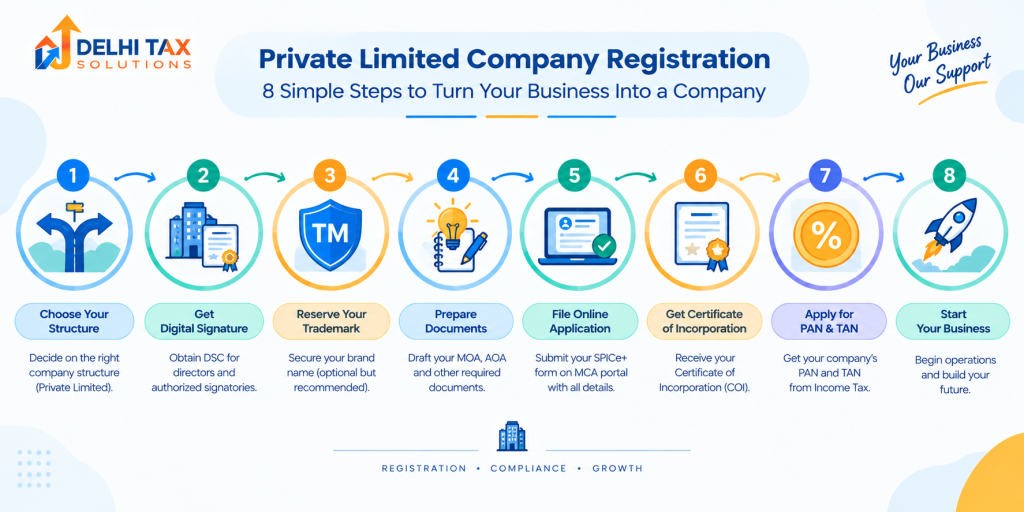
Step 4: Prepare the Innovation Statement DPIIT looks for innovation or scalability. We help you write a short, clear statement that covers the problem you solve, how your solution is different, your technology or process, your market and your growth plan. A weak or generic statement is the most common reason for delays and rejections.
Step 5: Apply on the NSWS Portal Recognition is applied for on the National Single Window System (NSWS, nsws.gov.in). We create your account, add the “Registration as a Startup” approval from the Central Approvals section, fill in the entity details and upload your documents. There is no government fee.
Step 6: Receive the Recognition Certificate After DPIIT reviews your application (and answers any query), you can download your recognition certificate. Timelines vary, from a few days to about two weeks, depending on queries.
Step 7: Apply for the Tax Holiday (Optional) If you qualify, we prepare the application to the Inter-Ministerial Board with the required financial statements, CA certificates and supporting evidence.
Step 8: Complete Other Registrations GST, Udyam (MSME), PF/ESI if applicable, and any sector-specific licences. (Link “GST Registration” and “MSME Udyam Registration”.)
Documents Required
For DPIIT Recognition
- Certificate of Incorporation (company or LLP) or Registration Certificate and Partnership Deed (partnership firm)
- PAN of the entity
- Innovation statement (short PDF, usually 1 to 2 pages)
- Details of directors / partners / authorised representative with ID and contact details
- Turnover details for each financial year since incorporation
- Optional but helpful: recommendation letter from a recognised incubator or angel / VC fund, patent or trademark filing receipts, awards, pitch deck, product demo or customer testimonials
Additional Documents for the Tax Holiday (IMB Application)
- Shareholding pattern and relevant board resolutions
- Income tax return acknowledgements and CA-certified audited financial statements (for the applicable years)
- CA certificates: formation declaration (not formed by splitting or reconstruction) and scalability declaration
- Pitch deck
- IP proof (patents, copyrights, designs), awards and funding proof, if any
- Employment details (including R&D staff, women employees and employees from non-metro areas), if applicable
Staying Compliant After Recognition
| Requirement | Details |
|---|---|
| Entity compliance | Follow the annual ROC, ITR, GST and audit rules of your chosen structure |
| Truthful information | Recognition and tax certificates can be withdrawn if false or misleading information is given |
| Age and turnover limits | Recognition ends once the entity crosses 10 years (20 for deep tech) or the turnover cap of ₹200 crore (₹300 crore for deep tech) |
| Keep your profile updated | Update the portal for changes in address, directors, ownership or business |
Use of funds: A recognised startup should use its funds mainly for core business, innovation, R&D and growth. Unless it is part of your core business, avoid parking funds in assets such as residential or other real estate, loans and advances, shares and securities of other companies, luxury vehicles or jewellery, or other speculative assets.
Why Startup Applications Get Delayed or Rejected
- A generic innovation statement that does not explain what is new or how it scales
- Applying as a sole proprietorship or other ineligible entity
- Turnover or age above the allowed limits
- Entity formed by splitting or reconstructing an existing business
- A traditional business with no innovation or scalability element
- Incorrect or incomplete details (the name, PAN or incorporation date not matching records)
We review your case before filing and tell you honestly if your business is likely to qualify.
Why Choose Delhi Tax Solutions?
- Founder-Friendly Advice: Structure, shareholding and compliance guidance for early-stage founders.
- Strong Application Writing: We present your innovation clearly, which reduces queries.
- Updated 2026 Rules: Our advice follows the latest DPIIT notification and NSWS process.
- Complete Startup Compliance: Incorporation, DPIIT, GST, Udyam, accounting, ROC and ITR under one team.
Frequently Asked Questions
Ready to Launch and Get Recognised?
Talk to Delhi Tax Solutions for a free consultation on startup registration and DPIIT recognition.
Get Started →