
💡 Key Takeaways
- Significant Economic Presence (SEP) taxes foreign companies based on digital and financial interaction rather than physical offices.
- Section 9(1)(i) of the Income-Tax Act treats qualifying SEP as a taxable business connection in India.
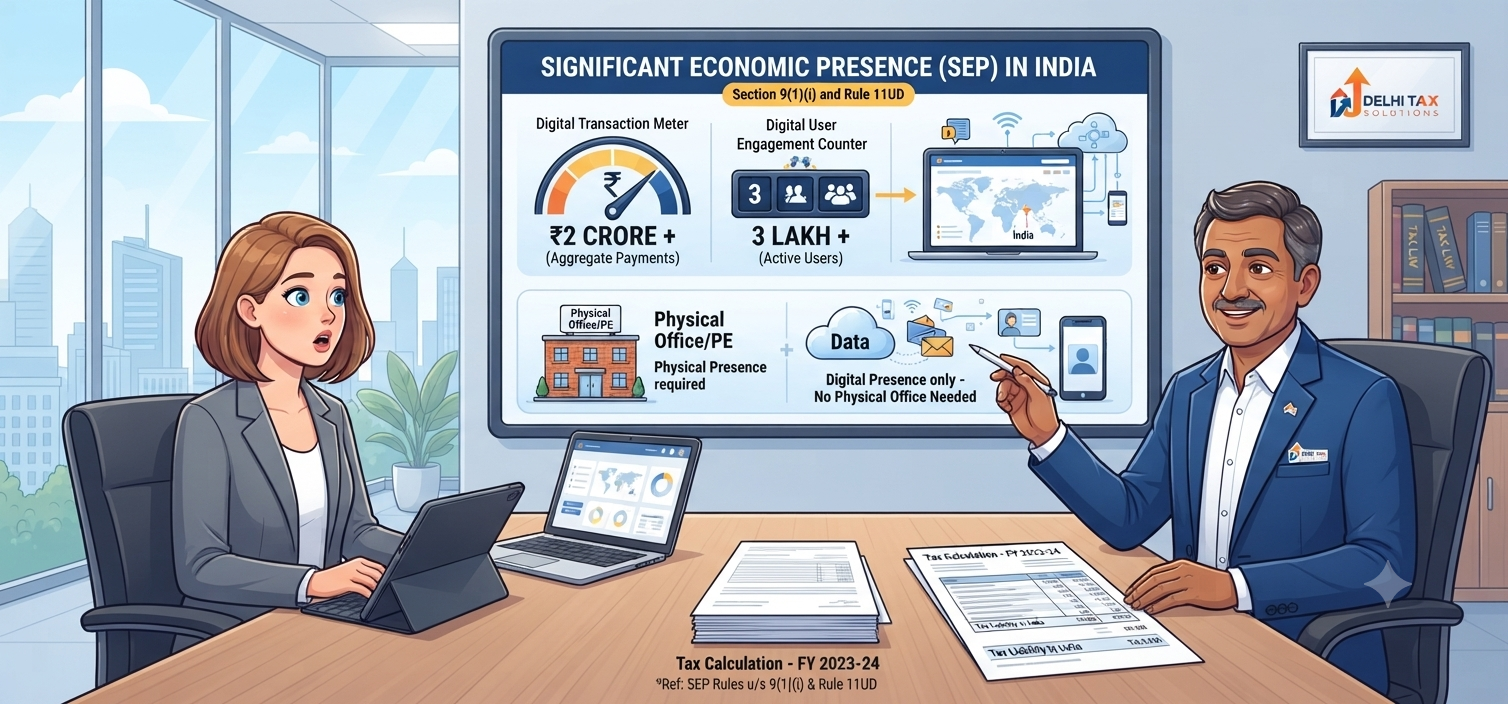
- The monetary threshold is set at aggregate payments exceeding ₹2 crore (₹20 million) during the financial year.
- The user threshold applies when non-residents systematically engage with at least 300,000 users in India.
Global digitization has transformed how multinational corporations generate massive revenues across international borders without establishing brick-and-mortar offices. To capture these digital transactions, the Indian government introduced the Significant Economic Presence tax rules India framework. Mastering these regulations is crucial for foreign enterprises and advisors navigating international taxation. Our expert team at Delhi Tax Solutions breaks down the statutory thresholds, legal implications, and compliance requirements under Section 9(1)(i).
What Is Significant Economic Presence and How Does It Work?
Significant Economic Presence (SEP) is a statutory tax concept introduced under Explanation 2A to Section 9(1)(i) of the Income-Tax Act, 1961, designed to establish a tax nexus for non-resident entities. Historically, India could only tax foreign business profits if the enterprise maintained a physical Permanent Establishment (PE) within the country. According to notifications issued by the Income Tax Department, SEP overrides physical presence requirements by focusing entirely on economic allegiance and consumer interaction. For foreign startups structuring their entry into the Indian market, our guide on Start Business – Delhi Tax Solution offers valuable baseline compliance frameworks.
What Are the Official Monetary and User Thresholds?
The Monetary Transaction Threshold
Under Rule 11UD of the Income-Tax Rules, the monetary threshold is triggered if the aggregate of payments arising from transactions in respect of any goods, services, or property carried out by a non-resident with any person in India exceeds ₹2 crore (₹20 million) during the previous financial year. This includes the provision of downloadable software or digital data.
Regulatory oversight and corporate compliance standards are closely aligned with policies monitored by the Ministry of Corporate Affairs, ensuring transparency for cross-border transactions.
The Digital User Engagement Threshold
Alternatively, an SEP is established if a non-resident systematically and continuously solicits business activities or engages in interaction with at least 300,000 (3 lakh) users in India through digital means. Even free digital services or advertising platforms capturing large Indian audiences fall under this provision.
Tracking these engagement metrics requires robust digital accounting, a practice that intersects with broader regulatory updates such as those discussed in Assessee & Assessment Year Explained.
How Do Non-Resident Digital and E-Commerce Companies Get Taxed?
Attribution of Taxable Profits
Once an SEP is established, the non-resident is deemed to have a business connection in India under Section 9(1)(i). However, the entire global revenue of the foreign entity is not taxed. Only the specific portion of net profits attributable to the economic activities conducted within India is subject to Indian corporate tax rates.
Interaction with Compliance Rules
Foreign firms must accurately segregate their India-sourced revenues from global pools. Accurate reporting avoids automated scrutiny and ensures alignment with guidelines highlighted in ITR Update for AY 2025-26: New Business & Profession Codes Introduced.
Indirect Tax and Operational Overlaps
Digital service providers must also evaluate their indirect tax obligations alongside direct tax rules. Navigating multi-layered indirect taxation requires consulting frameworks outlined in GST – Delhi Tax Solution.
Comparison: Physical Permanent Establishment vs SEP
| Evaluation Parameter | Physical Permanent Establishment (PE) | Significant Economic Presence (SEP) |
|---|---|---|
| Physical Requirement | Requires offices, branches, factories, or agents in India | Zero physical presence or offices required in India |
| Trigger Basis | Physical operational footprint and fixed place of business | Financial transactions (>₹2 crore) or user engagement (>300k users) |
| Core Focus | Brick-and-mortar asset ownership and local operations | Digital interaction, data downloads, and economic allegiance |
Official policy updates published by the Press Information Bureau emphasize that these rules ensure a level playing field between domestic enterprises and tech giants operating remotely.
What Are the Compliance Challenges and Treaty Interactions?
Double Taxation Avoidance Agreements (DTAA)
A significant complexity arises from the interaction between domestic SEP laws and existing bilateral Double Taxation Avoidance Agreements (DTAAs). Many older tax treaties restrict taxation rights to cases where a physical Permanent Establishment exists. Unless bilateral treaties are amended to incorporate SEP norms, foreign entities resident in treaty-partner countries may claim treaty protection.
Data Tracking and Technical Hurdles
Non-resident tech platforms often face tremendous operational challenges in isolating and tracking precise user counts and transaction values originating exclusively from Indian IP addresses and bank accounts. Inaccurate tracking exposes businesses to heavy compliance penalties.
Withholding Tax and TDS Obligations
Indian resident payers making payments to foreign entities meeting SEP thresholds must evaluate withholding tax (TDS) obligations carefully to prevent default notices from the tax department.
Conclusion and Professional CA Guidance
Navigating the complexities of Significant Economic Presence requires vigilance, precise data tracking, and expert interpretation of Section 9(1)(i) thresholds. Whether your enterprise crosses the ₹2 crore payment boundary or engages over 300,000 Indian digital users, maintaining strict compliance is vital. Talk to a Delhi Tax Solutions expert to assess your cross-border tax exposure and secure your filings within 3 days. Looking ahead, digital tax frameworks will continue to evolve, making professional advisory indispensable for international businesses.
Frequently Asked Questions (FAQs)
Q: What is Significant Economic Presence and how does it establish a business connection under Section 9(1)(i)?
A: Significant Economic Presence (SEP) is a statutory concept introduced under Explanation 2A to Section 9(1)(i) of the Income-Tax Act, 1961. It establishes a taxable business connection in India for foreign non-resident entities based on their financial transactions or user engagement within the country, eliminating the traditional requirement for a physical office or branch.
Q: What are the official monetary and user thresholds prescribed by the CBDT for SEP in India?
A: Under Rule 11UD of the Income-Tax Rules, the monetary threshold is triggered if aggregate payments arising from transactions in goods, services, or property (including software downloads) with any person in India exceed ₹2 crore (₹20 million) during the financial year. Alternatively, the user threshold applies if a non-resident systematically interacts with at least 300,000 users in India.
Q: How do non-resident digital and e-commerce companies calculate taxable profits under SEP rules?
A: Once an SEP is established, the non-resident is subject to Indian corporate tax, but only on the portion of net profits that can be reasonably attributed to the economic activities and user interactions generated within India. Companies must maintain meticulous books of accounts to segregate India-sourced revenues from their global earnings accurately.
Q: Are foreign businesses with an SEP in India required to register for GST or file local corporate tax returns?
A: Yes, depending on the nature of their digital supplies and services provided to Indian consumers, foreign businesses may have separate compliance obligations under Goods and Services Tax (GST) laws alongside filing annual corporate income tax returns in India to declare and pay taxes on profits attributed to their Indian Significant Economic Presence.
Q: How does the interaction between Double Taxation Avoidance Agreements (DTAA) and SEP rules affect foreign entities?
A: The application of domestic SEP rules can sometimes conflict with existing bilateral Double Taxation Avoidance Agreements (DTAAs) that restrict taxation rights to physical Permanent Establishments. Foreign entities resident in countries with tax treaties may seek treaty protection unless bilateral protocols are updated to incorporate digital economic presence standards.
Disclaimer: This article is for general informational purposes and is not a substitute for personalised professional tax advice. About this article: Researched using official government sources and Delhi Tax Solutions’ in-house tax advisory team. Last updated September 2026.
