
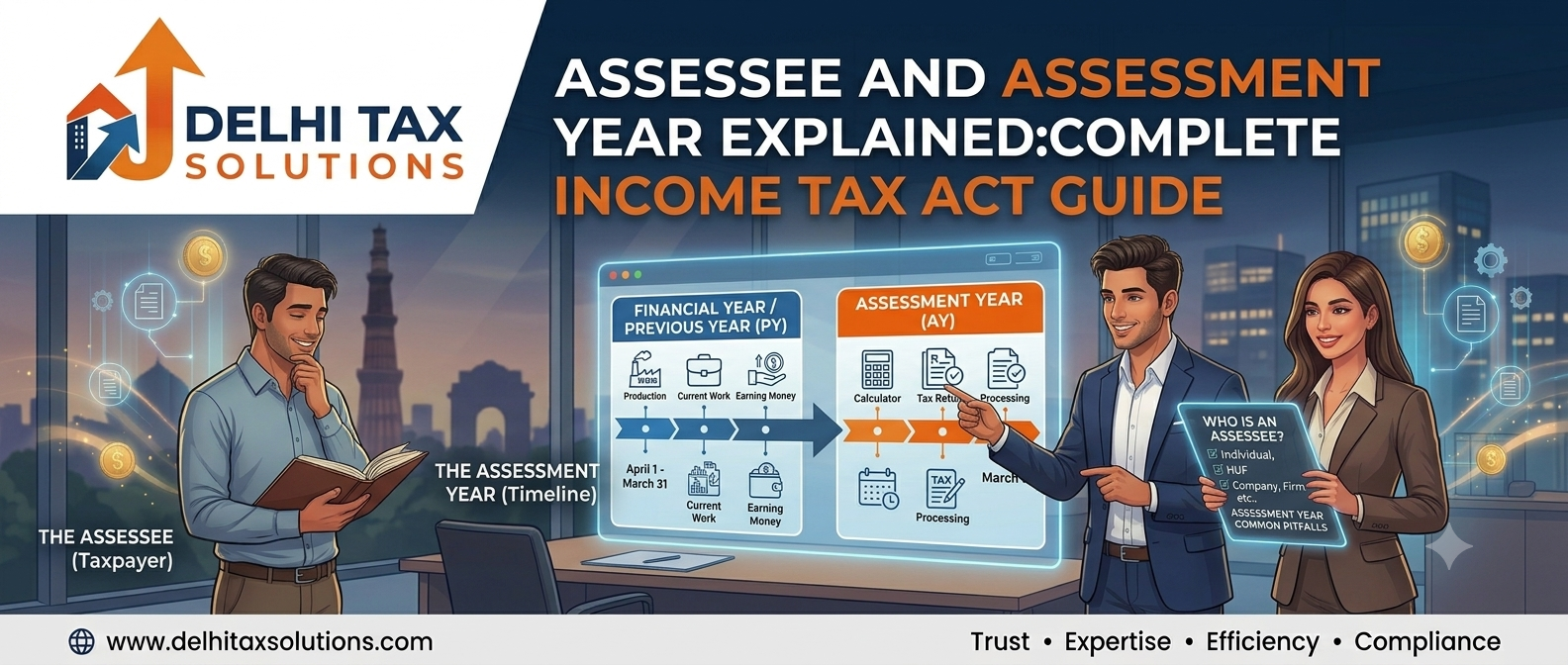
When dealing with the Indian Income Tax Department, small misunderstandings in basic terminology can lead to significant tax filing errors, unexpected notices, or rejected returns. Two of the most foundational—yet frequently confused—terms under the Income Tax Act, 1961 are “Assessee” and “Assessment Year.”
Whether you are filing your first Income Tax Return (ITR) as a salaried professional in Delhi, managing taxes for a private limited company, or handling inherited property, knowing who qualifies as an assessee and how the assessment timeline works is critical for full tax compliance.
At Delhi Tax Solutions (delhitaxsolutions.com), our experts simplify complex tax statutes for individuals, NRIs, and business owners across Delhi NCR. Here is your definitive, high-value guide to Section 2(7) and Section 2(9) of the Income Tax Act, 1961.
1. Who is an “Assessee”? (Section 2(7) of the Income Tax Act)
Under Section 2(7) of the Income Tax Act, 1961, an Assessee is defined as any person by whom any tax or any other sum of money (such as interest, penalty, or fine) is payable under the Act.
However, the definition goes much deeper than just someone paying tax on their own salary or business profit. An individual or entity is legally classified as an assessee if:
- Any proceeding under the Income Tax Act has been initiated against them (for assessment of their income, assessment of fringe benefits, or loss sustained by them).
- They are entitled to a tax refund from the government.
- They are liable to pay tax on another person’s income (e.g., a guardian or legal representative).
Who is Considered a “Person” Under Tax Law?
To understand who can be an assessee, you must look at Section 2(31), which defines a “Person.” An assessee is not strictly a human being. The term includes:
- An Individual (salaried employees, freelancers, sole proprietors).
- A Hindu Undivided Family (HUF).
- A Company (Private Limited, Public Limited, or Foreign Company).
- A Partnership Firm or Limited Liability Partnership (LLP).
- An Association of Persons (AOP) or Body of Individuals (BOI).
- A Local Authority (e.g., Municipal Corporation of Delhi).
- Every Artificial Juridical Person (e.g., universities, deities, public trusts).
2. The 4 Major Categories of Assessees Explained
The Income Tax Department categorizes assessees into four distinct buckets depending on their status, responsibility, and legal obligations:
Category A: Normal Assessee
A Normal Assessee is an individual or business liable to pay tax on income earned or losses incurred directly by them during a financial year. This includes anyone who earns taxable income, pays advance tax, or receives a tax refund.
Category B: Representative Assessee
Under Section 160 of the Income Tax Act, a Representative Assessee is a person designated to pay taxes on behalf of someone else who cannot manage their own tax affairs. Common examples include:
- Guardians or Trustees: Filing tax returns on behalf of a minor child or a mentally incapacitated individual.
- Agents of Non-Residents: An authorized agent or representative in India paying tax on income accruing to a Non-Resident Indian (NRI).
Category C: Deemed Assessee
A Deemed Assessee is a person assigned legal responsibility by tax authorities to fulfill tax obligations on behalf of another entity. The most common scenario occurs upon death:
- Legal Heirs: When a taxpayer passes away, their legal heir becomes a “deemed assessee” for any income earned by the deceased up to the date of death. The legal heir must register on the Income Tax portal as the legal representative to file the final return.
- Trustees of an Estate: Individuals managing assets created under a will or trust.
Category D: Assessee in Default
An Assessee in Default is an individual or entity that fails to comply with statutory obligations mandated by the Income Tax Act. Falling into this category invites severe penalties and legal proceedings.
Common Reasons for Becoming an Assessee in Default:
- TDS Non-Deduction or Non-Payment: An employer who deducts Tax Deducted at Source (TDS) from employee salaries but fails to deposit it with the Central Government within the due date.
- Property Buyers: A buyer purchasing real estate in Delhi NCR valued above ₹50 Lakhs who fails to deduct 1% TDS under Section 194-IA.
- Non-Payment of Advance Tax: Taxpayers whose estimated annual tax liability exceeds ₹10,000 but fail to pay quarterly advance tax installments.
3. What is an “Assessment Year” (AY)? (Section 2(9))
Under Section 2(9) of the Income Tax Act, an Assessment Year (AY) is defined as a period of 12 months starting on April 1st of every year and ending on March 31st of the following calendar year.
The Assessment Year is the period during which the income earned in the Previous Year (PY) / Financial Year (FY) is evaluated, processed, and taxed by the Income Tax Department.
The Core Distinction: Financial Year vs. Assessment Year
To avoid tax filing mistakes, remember this simple rule:
- Financial Year (FY) / Previous Year (PY): The 12-month period in which you actually earn your income.
- Assessment Year (AY): The 12-month period immediately following the financial year, during which you file your tax returns and pay taxes on that earned income.
Financial Year (FY) to Assessment Year (AY) Reference Table
When selecting your tax return forms on the e-filing portal, selecting the correct Assessment Year is vital. Selecting the wrong AY will result in invalid filings or defective return notices.
| Income Earned Period (Financial Year / Previous Year) | Tax Filing Period (Assessment Year) | Standard ITR Due Date (Non-Audit Cases) |
|---|---|---|
| April 1, 2024 – March 31, 2025 (FY 2024-25) | AY 2025-26 | July 31, 2025 |
| April 1, 2025 – March 31, 2026 (FY 2025-26) | AY 2026-27 | July 31, 2026 |
| April 1, 2026 – March 31, 2027 (FY 2026-27) | AY 2027-28 | July 31, 2027 |
4. Exceptions: When Income is Taxed in the Same Year It Is Earned
The general tax rule in India is: Income earned in the Previous Year is taxed in the Assessment Year. However, to prevent tax evasion, the Income Tax Act provides 5 special exceptions where income is assessed and taxed in the exact same financial year it is earned:
- Shipping Business of Non-Residents (Section 172): Non-resident ship owners or charterers carrying passengers, livestock, or goods from Indian ports must pay 7.5% tax on freight earnings before the ship is allowed to depart.
- Persons Leaving India Permanently (Section 174): If an assessing officer believes an individual is leaving India with no intention of returning during the current financial year, their income up to the estimated departure date is taxed immediately.
- Entities Formed for Short Duration or Specific Events (Section 174A): Associations, joint ventures, or bodies formed for a specific project that dissolve within the same year are assessed immediately upon dissolution.
- Persons Likely to Transfer Property to Avoid Tax (Section 175): If tax authorities suspect a taxpayer is attempting to sell, transfer, or conceal assets to evade tax payments, assessment proceedings can begin immediately.
- Discontinued Business or Profession (Section 176): If a business or professional practice is permanently closed, the income earned from the start of the financial year up to the date of closure may be assessed in the same year.
Why Correct Classification Matters for Delhi NCR Taxpayers
At Delhi Tax Solutions, we frequently meet business owners and individual taxpayers who face unnecessary scrutiny due to simple categorization mistakes:
- Selecting the wrong AY on Challan 280: Depositing advance tax or self-assessment tax under the wrong Assessment Year requires time-consuming rectification requests on the portal.
- Ignoring TDS Compliance: Property buyers in Delhi, Noida, and Gurugram purchasing homes valued above ₹50 Lakhs often forget to file Form 26QB and deduct TDS, unknowingly becoming an Assessee in Default with compounding interest charges.
- Estate Settlement Delays: Heirs inheriting property or business assets fail to register as a Deemed Assessee, leading to non-filing penalties against the deceased person’s PAN.
Partner with Delhi Tax Solutions for Hassle-Free Compliance
Navigating the legalities of the Income Tax Act doesn’t have to be overwhelming. Whether you need assistance with ITR filing, registering as a legal representative, responding to tax notices, or optimizing your corporate tax strategy, **Delhi Tax Solutions** is here to deliver complete peace of mind.
Visit us today at delhitaxsolutions.com to schedule a consultation with our experienced tax advisors and chartered accountants.
