
💡 Key Takeaways
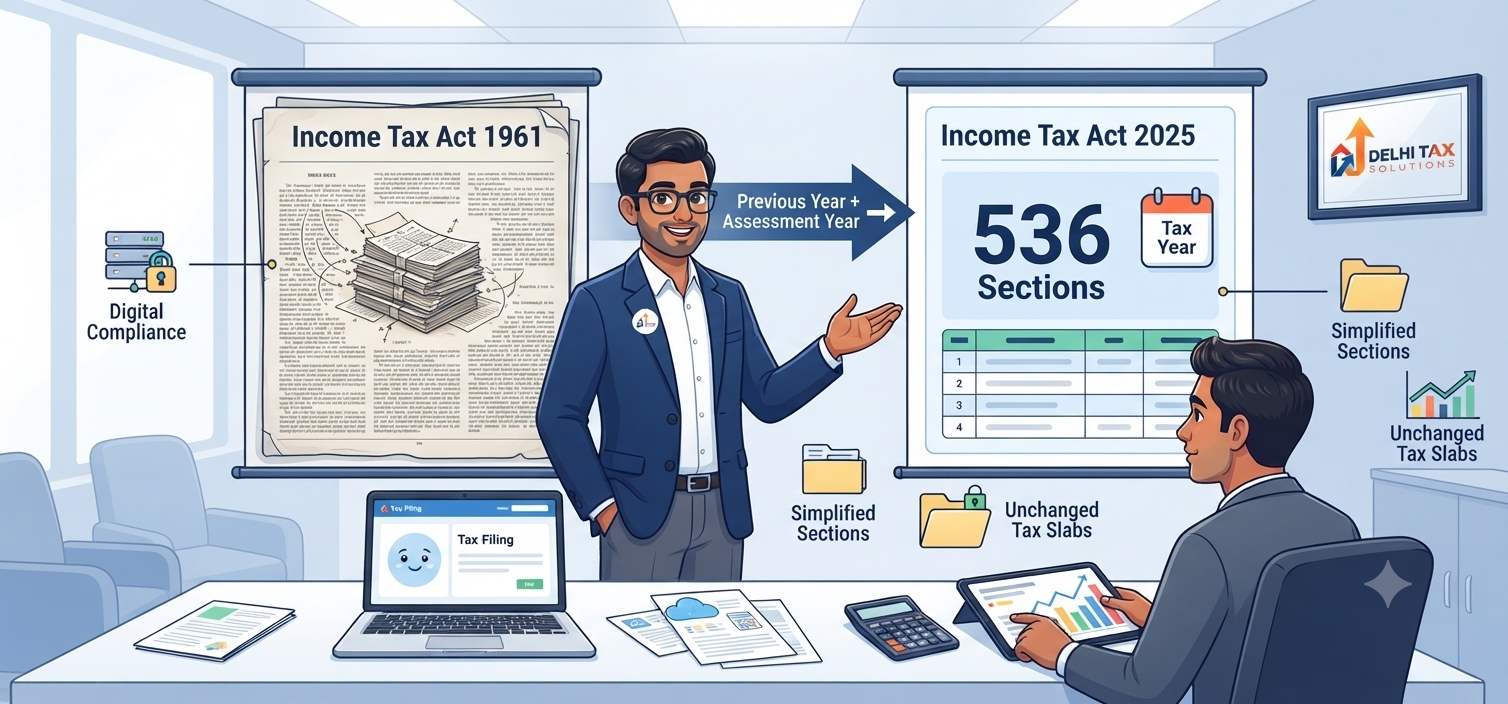
- The Income Tax Act 2025 replaces the 64-year-old 1961 Act starting April 1, 2026.
- Dual terminology of ‘Previous Year’ and ‘Assessment Year’ is merged into a single ‘Tax Year’.
- Tax slab rates and basic exemption limits remain unchanged for individual taxpayers.
- Total sections are reduced from over 800 down to 536 for better legal clarity.
India is experiencing its biggest direct tax overhaul in over six decades. For generations, every salaried worker, business owner, and chartered accountant relied on the rigid provisions of the old 1961 tax legislation. Now, the transition to the modern framework outlined in Income Tax Act 2025 vs 1961: Key Differences Explained alters how citizens compute liabilities. Understanding these updates is crucial for avoiding compliance slip-ups. Our team at Delhi Tax Solutions examines how the new rules reshape filing procedures for individual taxpayers across the country.
What Are the Core Structural Changes in the 2025 Act?
The Income Tax Act 2025 consolidates and restructures direct taxation in India into 536 sections across 23 chapters, replacing the fragmented architecture of the 1961 Act. Designed to simplify tax compliance for new income tax act 2025 individual taxpayers, the statute removes obsolete provisions, adopts clear legal language, and introduces digital-first administrative frameworks. According to announcements by the Income Tax Department, this legislative shift reduces ambiguity and minimizes prolonged tax litigation.
How Does the Unified Tax Year Replace Previous Years?
Elimination of Dual Year Confusion
Under the old 1961 Act, taxpayers constantly battled confusing concepts where income earned in a ‘Previous Year’ was taxed in a subsequent ‘Assessment Year’. The 2025 Act completely eliminates this duality by establishing a single, unified Tax Year. Income earned during FY 2026-27 is assessed directly under Tax Year 2026-27, streamlining annual tax planning.
Seamless Calculation for Salaried Workers
Salaried employees often struggled with timing mismatches when employers deducted tax credits. The unified Tax Year aligns salary credits, TDS deposits, and annual returns into one synchronized timeline. This change also complements foundational principles outlined in our detailed study on Assessee & Assessment Year Explained.
Transition Provisions under Section 536
Section 536 of the new Act contains 22 specific sub-clauses addressing transitional situations. It ensures that pending litigation, historical audits, and past assessments under the 1961 Act proceed without disruption, providing legal certainty for taxpayers during the transition.
What Specific Changes Impact Salaried Employees?
Standardized Payroll and TDS Rules
Salaried professionals face modernized withholding mechanisms under the 2025 Act. Employers must calculate annual income and deduct monthly tax under consolidated provisions. These rules connect directly with corporate compliance guidelines published by the Ministry of Corporate Affairs for business entities.
Expanded HRA and Perquisite Valuations
The new framework expands metro city definitions for House Rent Allowance (HRA) exemptions from 4 cities to 8 cities, offering broader tax relief. Furthermore, gift vouchers and employee perquisites receive updated exemption thresholds, such as an increased ₹15,000 limit for certain festive allowances.
Chapter VIII Deductions Overview
Chapter VI-A from the old Act, which housed popular deductions like Section 80C and 80D, is restructured into Chapter VIII under sections 122 to 154. While section numbers change, the core deductions under the new tax act remain accessible for taxpayers opting for the old tax regime.
How Do Tax Rates and Slabs Compare in Old vs New Acts?
Stability of Tax Slab Rates
A primary concern for taxpayers is whether tax rates increased. Official clarifications from the Press Information Bureau confirm that tax slab rates remain unchanged. The government prioritized structural simplification over tax rate hikes, ensuring stability for middle-income earners.
Basic Exemption Limits
The ₹12 lakh annual rebate threshold and progressive slab structures are preserved to protect taxpayer purchasing power. Freelancers and small businesses must update their accounting practices in line with ITR Update for AY 2025-26: New Business & Profession Codes Introduced.
Comparison of Key Frameworks
| Feature | Income Tax Act 1961 | Income Tax Act 2025 |
|---|---|---|
| Total Sections | Over 800 complex sections | Consolidated into 536 sections |
| Timeframe Terminology | Previous Year & Assessment Year | Single unified Tax Year |
| Digital Oversight | Restricted physical & digital records | Expanded cloud & electronic data access |
What Are the Key Features of Digital Compliance?
Faceless Assessments and Digital Audits
The 2025 legislation formalizes paperless tax administration. Tax authorities gain expanded legal authority to examine cloud storage, digital trading accounts, and electronic communications during scrutiny, reinforcing transparency across the direct tax code India ecosystem.
Revised Filing Deadlines
Filing timelines receive practical adjustments. The extended deadlines for filing returns and furnishing audit reports under ITR filing 2026 rules provide taxpayers with adequate breathing room to compile accurate financial data.
Prosecution and Penalty Alignment
Offense and penalty provisions are refined to distinguish between minor filing oversights and deliberate tax evasion. Clearer definitions reduce arbitrary penalties, fostering a trust-based tax environment supported by periodic CBDT circulars income tax notifications.
Conclusion and Professional CA Guidance
Transitioning from the 1961 Act to the Income Tax Act 2025 marks a monumental milestone in India’s fiscal history. By adopting a unified Tax Year, streamlining over 800 sections into 536, and modernizing digital compliance, the government ensures a transparent, less litigious tax ecosystem. Talk to a Delhi Tax Solutions expert to review your individual tax structure and ensure seamless compliance under the new framework. Looking ahead, taxpayers who embrace these structural adjustments early will enjoy frictionless filings and optimized tax savings for years to come.
Frequently Asked Questions (FAQs)
Q: What are the key differences between the old Income Tax Act 1961 and the new Income Tax Act 2025?
A: The Income Tax Act 2025 replaces the 1961 Act with a streamlined structure containing 536 sections instead of over 800. It eliminates obsolete clauses, uses simplified language, introduces a unified Tax Year concept, and expands digital investigative powers for tax authorities while keeping tax slab rates unchanged for individual taxpayers.
Q: How does the new Tax Year concept replace Previous Year and Assessment Year in India?
A: Under the 2025 Act, the dual terms ‘Previous Year’ and ‘Assessment Year’ are merged into a single ‘Tax Year’. For instance, income earned during FY 2026-27 is assessed directly under Tax Year 2026-27, eliminating chronological lag and reducing complexity during income tax return filings.
Q: Did the income tax slab rates change for individual taxpayers under the Income Tax Act 2025?
A: No, income tax slab rates and basic exemption limits have not changed under the 2025 Act. The legislative overhaul focuses entirely on structural simplification, compliance rationalization, and modernization rather than altering tax rates or increasing personal tax burdens.
Q: What happens to pending litigation, proceedings, and notices filed under the repealed Income Tax Act 1961?
A: Section 536 of the Income Tax Act 2025 provides robust transitional provisions and savings clauses. It ensures that all pending assessments, appeals, penalties, and legal proceedings initiated under the 1961 Act continue smoothly without disruption or loss of legal standing.
Q: How do salaried employees calculate tax deductions and exemptions under the new tax act framework?
A: Salaried employees continue to claim standard deductions, HRA, and Chapter VIII deductions (formerly Chapter VI-A) under the new Act. Employers compute TDS based on consolidated provisions under Section 393 and issue updated Form 130 certificates instead of old Form 16 documents.
Disclaimer: This article is for general informational purposes and is not a substitute for personalised professional tax advice. About this article: Researched using official government sources and Delhi Tax Solutions’ in-house tax advisory team. Last updated September 2026.
