
💡 Key Takeaways
- Filing Form 10E online is mandatory before submitting your ITR to claim Section 89(1) relief.
- Section 89(1) protects taxpayers from high tax brackets caused by lump-sum salary arrears.
- Failure to submit Form 10E before your return triggers a defective ITR notice from tax authorities.
- Relief calculations require comparing tax liabilities between the arrear year and receipt year.
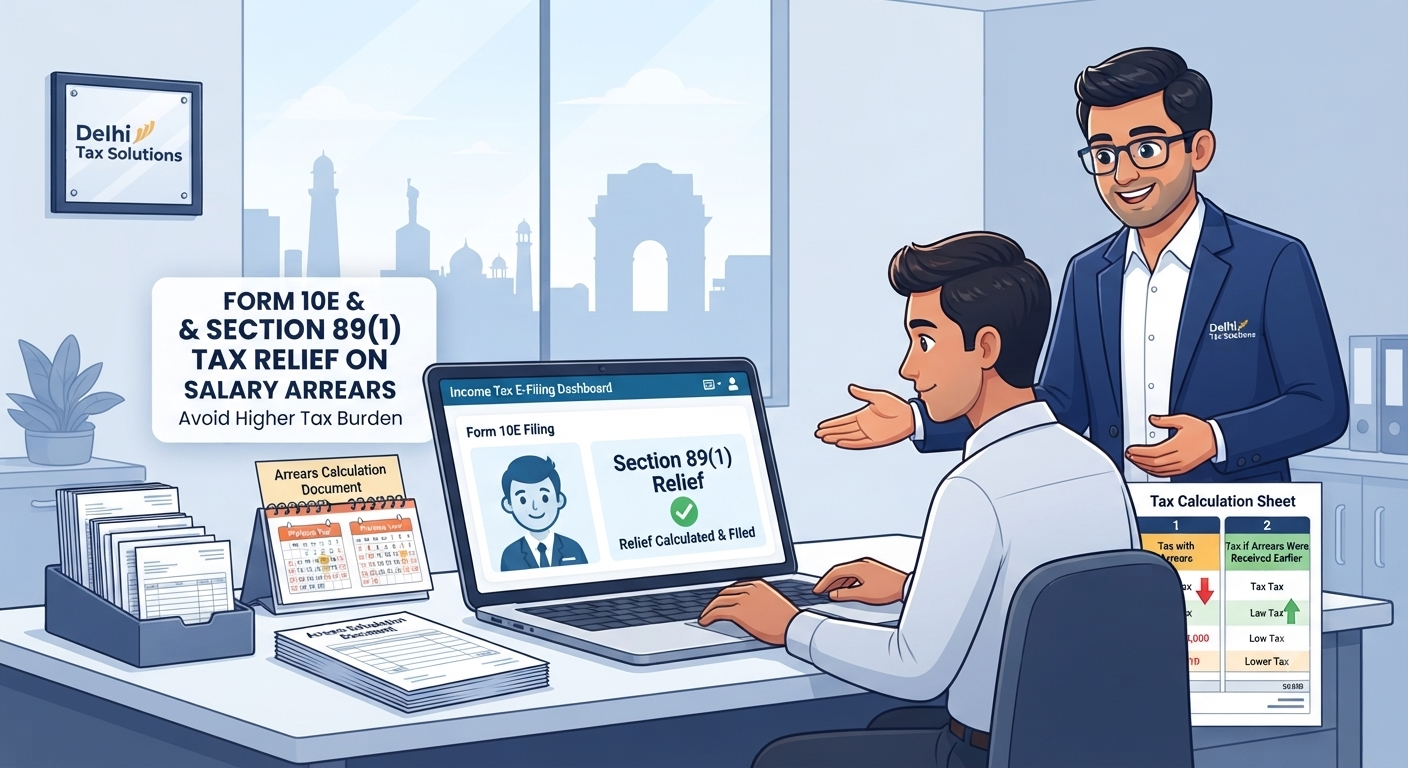
Receiving a lump-sum payout for past salary arrears or delayed increments feels rewarding until you check your tax liability. Because India follows a progressive tax slab system, receiving several years of back-pay in a single financial year pushes your income into a much higher bracket. Fortunately, the Income Tax Act provides legal protection through Section 89(1). Mastering Form 10E tax relief Section 89(1) compliance ensures you keep your hard-earned money instead of paying excessive taxes. Our advisory team at Delhi Tax Solutions outlines the precise calculation methods and e-filing steps required for seamless compliance.
What Is Form 10E and Section 89(1) Tax Relief?
Form 10E is a statutory electronic form required by the Income Tax Department that taxpayers must file on the e-filing portal before submitting their Income Tax Return. It serves as formal intimation that you are claiming tax relief under Section 89(1) for salary arrears, gratuity, or past-period compensation received in a lump sum. Without submitting this form, the tax portal cannot reconcile your relief claim, frequently resulting in automated scrutiny or tax demand notices. For broader company payroll structuring insights, review our guide on Start Business – Delhi Tax Solution.
Who Is Eligible to Claim Section 89(1) Relief?
Salaried Employees and Pensioners
Any individual taxpayer who receives salary arrears, advance salary, family pension arrears, or compensation for termination of employment from an employer or former employer can claim this relief. Both salaried professionals and retired pensioners qualify, provided they can substantiate the delayed nature of the payment.
Nature of Arrears Covered
The relief applies specifically to payments that relate to prior financial years but were actually received during the current financial year. This includes judicial pay revisions, delayed promotion increments, and arrears resulting from corporate restructuring. Proper categorization aligns with standards discussed in Assessee & Assessment Year Explained.
Importance of Prior Year Income Matching
To successfully claim relief, you must retrieve your past tax returns and Form 16 documents for the specific years the arrears pertain to. Comparing past taxable income with adjusted arrears is vital for accurate computation. Business owners managing complex payroll taxes can also reference GST – Delhi Tax Solution for overarching financial reporting standards.
How to Calculate Arrears Tax Relief Step-by-Step?
Computing Tax for the Arrear Year
Step one involves calculating what your tax liability would have been in the original financial year if you had received the arrears on time. Add the respective arrear amount to that year’s total taxable income and compute the revised tax payable.
Computing Tax for the Current Year
Step two requires calculating your tax liability for the current financial year with the lump-sum arrears included in your total income. Next, calculate your tax liability for the current year excluding the arrears amount. The difference represents the extra tax burden caused solely by receiving the lump sum.
Comparing Differential Tax Burdens
Section 89(1) relief equals the difference between the extra tax paid in the current year and the total incremental tax calculated across the past years. If the current year tax spike exceeds the past tax adjustment, the difference is granted as direct tax relief.
| Calculation Step | Without Section 89(1) Relief | With Section 89(1) Relief |
|---|---|---|
| Arrears Inclusion | Taxed entirely in current financial year | Distributed across respective arrear years |
| Tax Slab Impact | Pushes income into peak tax brackets | Absorbed smoothly into historical slabs |
| Form 10E Requirement | Not required if no relief is claimed | Mandatory e-filing before submitting ITR |
Official policy updates published by the Press Information Bureau highlight ongoing administrative efforts to digitize and simplify these relief validation checks across all taxpayer profiles.
Step-by-Step Process to File Form 10E Online
Logging into the E-Filing Portal
Access the official tax portal using your PAN credentials. Navigate to the ‘e-File’ menu, select ‘Income Tax Forms’, and click on ‘File Income Tax Forms’. Search for Form 10E, select the correct assessment year, and click ‘Proceed’.
Entering Income and Tax Details
Fill out the relevant annexures based on your payout type. Annexure I is used for salary arrears. Input your total income for each relevant past financial year alongside the arrears received, matching figures reported in corporate filings overseen by the Ministry of Corporate Affairs.
Verification and Submission
Review all entered numerical data against your calculation worksheet. Once verified, authenticate the form using Aadhaar OTP or Electronic Verification Code (EVC). Successful submission generates an acknowledgment number, which you must reference when filing your main ITR.
Common Mistakes and Consequences of Missing Form 10E
Defective ITR Notice under Section 139(9)
The most frequent error taxpayers make is claiming Section 89(1) relief in their ITR without first filing Form 10E. The tax department’s automated algorithms cross-verify submissions and promptly issue a defective return notice under Section 139(9).
Mismatch Between Form 16 and ITR
If your employer deducted TDS on arrears without coordinating Form 10E details, discrepancies arise between your Form 16 and Form 26AS. Resolving these mismatches requires careful reconciliation and adherence to updates noted in ITR Update for AY 2025-26: New Business & Profession Codes Introduced.
Timing Rules and Deadlines
Form 10E must be submitted before you file your Income Tax Return. Submitting the ITR first and attempting to file Form 10E afterward locks the portal, requiring a revised return filing and unnecessary compliance stress.
Conclusion and Professional CA Guidance
Claiming tax relief on salary arrears through Form 10E and Section 89(1) is an effective way to prevent excessive taxation on lump-sum receipts. By calculating your differential tax burden accurately and filing Form 10E prior to your ITR, you eliminate the risk of defective notices. Talk to a Delhi Tax Solutions expert to get your Form 10E and ITR filed accurately within 3 days. Looking ahead, digital tax reconciliation will continue to demand precise compliance from every salaried professional and business entity in India.
Frequently Asked Questions (FAQs)
Q: What is Form 10E and why is it mandatory when claiming Section 89(1) tax relief?
A: Form 10E is a mandatory statutory filing on the Income Tax Department e-filing portal required whenever an individual taxpayer claims tax relief under Section 89(1) for salary arrears, gratuity, or past-period compensation. It provides the tax authorities with detailed calculations proving how lump-sum receipts distorted current-year tax brackets, ensuring valid relief approval during return processing.
Q: Can I claim Section 89(1) tax relief on salary arrears if I file my ITR without submitting Form 10E first?
A: No, filing your ITR and claiming Section 89(1) relief without submitting Form 10E beforehand will trigger an automated defective return notice under Section 139(9). The Income Tax Department requires Form 10E to be successfully submitted on the portal before your ITR can be processed with the claimed tax relief.
Q: How is tax relief on salary arrears calculated under Section 89(1) of the Income Tax Act?
A: Tax relief is calculated by finding the difference between two comparative scenarios. First, you calculate the extra tax paid in the current financial year due to the inclusion of arrears. Second, you calculate what the additional tax would have been if the arrears were taxed in their respective past financial years. The excess current year tax forms your Section 89(1) relief amount.
Q: What happens if my employer already deducted TDS on salary arrears during the current financial year?
A: If your employer deducted TDS on salary arrears without accounting for Section 89(1) relief, the excess tax paid is not lost. You can calculate your correct relief via Form 10E, claim the Section 89(1) deduction in your ITR, and request a rightful income tax refund for the excess TDS deducted by your employer during return processing.
Q: What is the due date for submitting Form 10E on the Income Tax Department e-filing portal?
A: While there is no separate strict statutory deadline independent of ITR filing, Form 10E must be successfully submitted on the e-filing portal before or on the exact date you file your Income Tax Return for that assessment year. Submitting Form 10E after filing your ITR will invalidate your relief claim and require filing a revised return.
Disclaimer: This article is for general informational purposes and is not a substitute for personalised professional tax advice. About this article: Researched using official government sources and Delhi Tax Solutions’ in-house tax advisory team. Last updated September 2026.
