
💡 Key Takeaways
- Cash payments exceeding ₹10,000 in a single day face strict business expense disallowance.
- Rule 6DD provides specific statutory exceptions for unavoidable commercial transactions.
- Agricultural purchases, government payments, and banking holiday settlements enjoy full relief.
- Expert CA oversight ensures compliance and prevents unnecessary tax audit additions.
Managing commercial expenses requires absolute adherence to digital payment mandates under Indian tax statutes. When enterprises disburse funds for daily operations, managing physical currency transactions can trigger severe tax penalties if statutory thresholds are breached. Understanding the legal boundaries safeguarding businesses is essential. Our expert tax advisory team at Delhi Tax Solutions analyzes the crucial exceptions governing cash payments exceeding ₹10,000 to protect your taxable income from unexpected disallowances.
What are exceptions to cash payments exceeding ₹10,000?
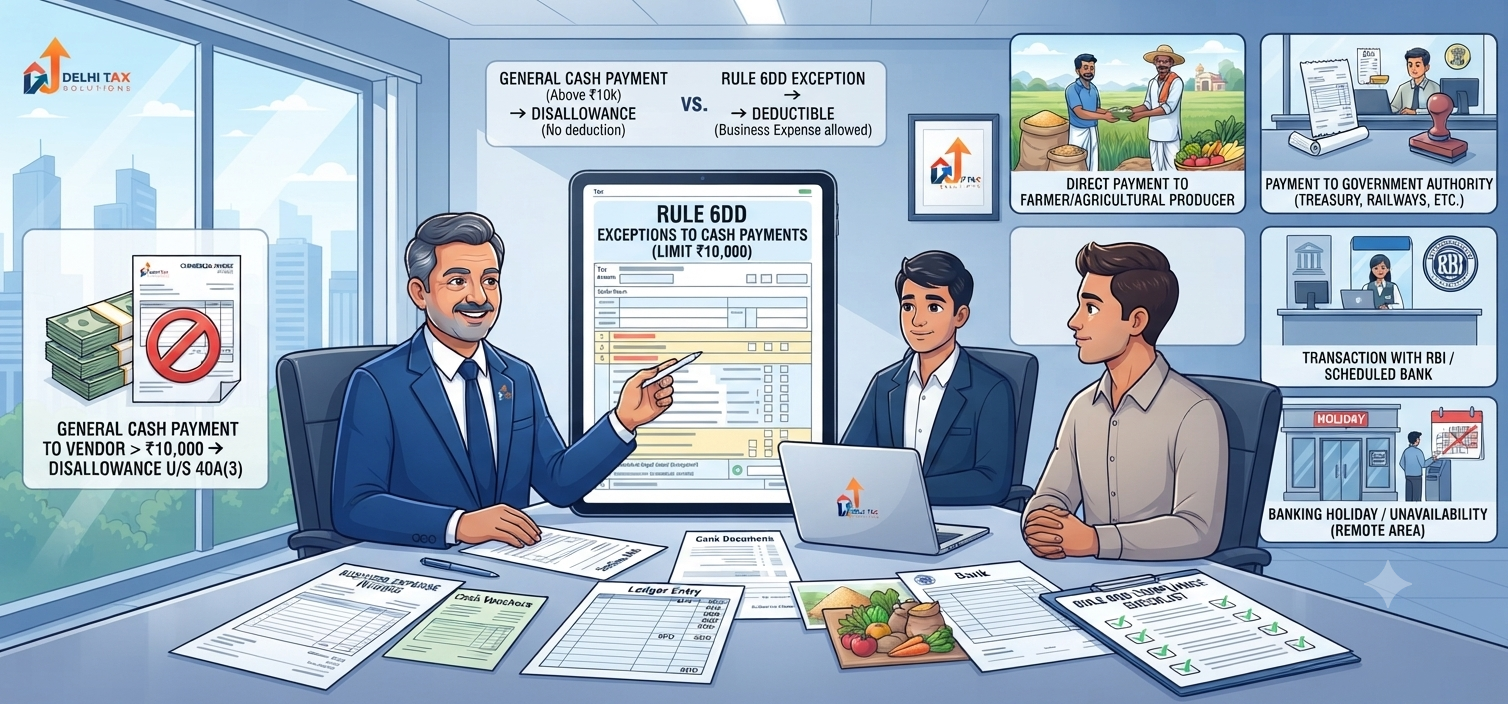
Exceptions to cash payments exceeding ₹10,000 refer to specific statutory reliefs outlined under Rule 6DD of the Income-Tax Rules, where business expense disallowances under tax provisions do not apply. While the Income Tax Department generally disallows cash expenses crossing this daily limit to curb untraceable transactions, exceptional circumstances like banking unavailability or direct producer payments remain fully deductible. For businesses formalizing their initial setup, our guide on Start Business – Delhi Tax Solution provides complete corporate registration assistance.
How do cash transaction restrictions operate under tax law?
The Core Disallowance Principle
Tax regulations mandate that if an assessee incurs any expenditure where aggregate payments made to a person in a single day exceed ₹10,000 in cash, the entire expenditure is disallowed when computing taxable income under business profits.
Preventing Artificial Splitting
Tax authorities strictly penalize attempts to bypass the threshold by splitting a large invoice into multiple smaller cash installments below ₹10,000 on the same day. Auditors examine ledger entries closely during corporate tax filings.
Harmonizing with Regulatory Compliance
Maintaining transparency aligns corporate financial management with broader regulatory frameworks monitored by the Ministry of Corporate Affairs, ensuring that annual financial statements withstand rigorous scrutiny.
What are the primary statutory exemptions under Rule 6DD?
Transactions with Banking Institutions
Payments made directly to the Reserve Bank of India, scheduled commercial banks, cooperative banks, or government credit institutions are fully exempted from cash disallowance rules.
Settlements with Government Bodies
Any disbursement made to the Central or State Government—including statutory tax liabilities, custom duties, or purchases of public goods like scrap from government railways—qualifies for complete exemption.
Agricultural and Rural Producer Relief
Purchases of agricultural produce, dairy items, poultry, fish, or forest products made directly from cultivators, growers, or producers are shielded under Rule 6DD, acknowledging rural cash dependency.
Comparison of Disallowed Expenses versus Permitted Cash Exceptions
| Transaction Category | General Cash Payments (>₹10,000) | Rule 6DD Statutory Exceptions |
|---|---|---|
| Tax Deductibility | 100% disallowed as business expense | Fully allowed as deductible expense |
| Typical Scenario | Commercial vendor payments settled in physical cash | Direct payments to farmers or banking holidays |
| Compliance Risk | High risk of tax addition and penalty during assessment | Low risk if supported by valid source documentation |
Official policy notices published by the Press Information Bureau emphasize that digital adoption remains paramount while safeguarding agrarian livelihoods. Businesses must also manage multi-state tax liabilities through guidelines provided in GST – Delhi Tax Solution.
What are the audit and compliance challenges for cash limits?
Substantiating Unavoidable Circumstances
Claiming exceptions due to banking strikes, store closures, or remote locations requires robust documentary evidence. Tax officers demand concrete proof that banking channels were genuinely inaccessible.
Reconciling Cash Ledgers with ITR Returns
Financial officers must carefully categorize cash disbursements in annual tax audits. Proper reporting prevents discrepancies during assessment cycles, aligning with protocols detailed in Assessee & Assessment Year Explained.
Structuring Multi-Branch Accounting
Coordinating cash expense policies across various operational units demands standardized accounting workflows. Ensuring clarity across all assessment years aligns with reporting frameworks in Income Tax Act 2025 vs 1961: Key Differences Explained.
Conclusion and Professional CA Guidance
Navigating cash payment restrictions and claiming legitimate exceptions requires rigorous adherence to Rule 6DD and tax compliance guidelines. By maintaining thorough documentation and partnering with experienced professionals, businesses can mitigate audit risks and optimize tax liabilities. Talk to a Delhi Tax Solutions expert to review your expense ledgers and secure your corporate filings within 3 days. Strategic tax compliance remains the foundation of robust financial health.
Frequently Asked Questions (FAQs)
Q: What are the core exceptions to cash payments exceeding ₹10,000 under tax laws?
A: Rule 6DD of the Income-Tax Rules provides specific statutory exceptions where cash payments exceeding ₹10,000 in a single day are not disallowed. These include transactions with RBI and scheduled banks, payments to government bodies for taxes or supplies, direct payments to agricultural producers, and disbursements made on days when banking channels are closed due to strikes or national holidays, ensuring practical flexibility for businesses.
Q: How does Rule 6DD apply to business cash transactions above the statutory limit?
A: Rule 6DD acts as a protective shield for taxpayers who incur business expenses in cash exceeding ₹10,000 due to unavoidable commercial realities, logistical constraints, or statutory obligations. Provided the taxpayer maintains verifiable documentary proof, third-party confirmations, and valid invoices, assessing officers cannot disallow these specific payments during annual corporate tax audits.
Q: Are cash payments made to agricultural producers exempt from disallowance?
A: Yes, cash payments exceeding ₹10,000 made directly to cultivators, growers, or producers of agricultural products, forest produce, animal husbandry, dairy, or poultry are fully exempt under Rule 6DD. This statutory provision acknowledges the heavy reliance on physical currency within remote rural and agrarian supply chains across India.
Q: What happens if a business splits a single invoice into multiple cash payments?
A: Splitting a single commercial transaction into multiple cash installments of ₹9,000 or less on the same day to individual payees is considered an artificial evasion of tax disallowance rules. Assessing officers examine invoice numbers and ledger timings closely; aggregated cash disbursements exceeding ₹10,000 in a day remain fully subject to disallowance and tax penalties.
Q: What audit reports must businesses maintain to substantiate cash expenditure exceptions?
A: Businesses must preserve verified cash vouchers, recipient identity proofs, agricultural producer declarations, bank holiday notices, and detailed audit reports under Section 44AB. Maintaining these records ensures that any claimed Rule 6DD exemption withstands scrutiny by the Income Tax Department during annual tax assessments.
Disclaimer: This article is for general informational purposes and is not a substitute for personalised professional tax advice. About this article: Researched using official government sources and Delhi Tax Solutions’ in-house tax advisory team. Last updated September 2026.