💡 Key Takeaways
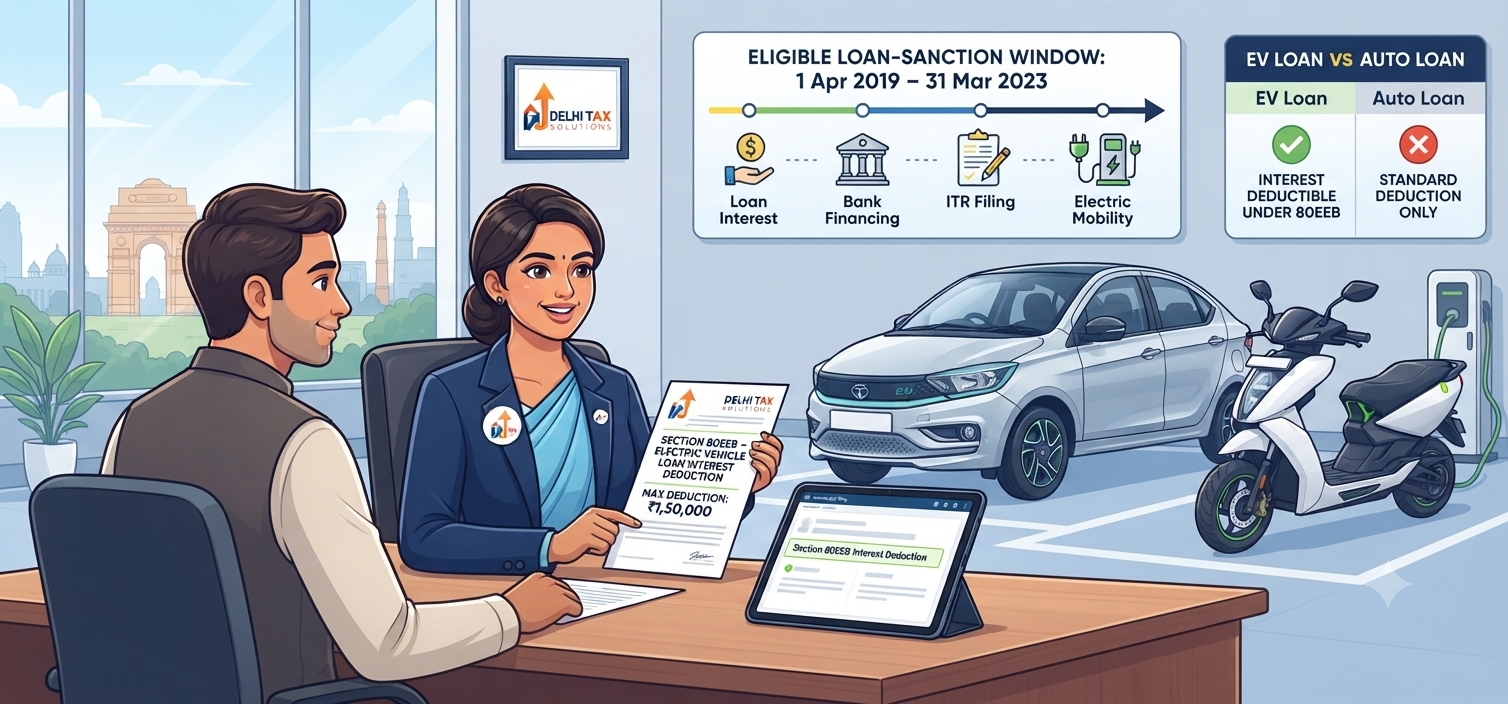
- Claim up to ₹1,50,000 deduction on EV loan interest under Section 80EEB.
- Valid for individual taxpayers financing electric cars or two-wheelers.
- Sanction period must fall between April 1, 2019, and March 31, 2023.
- Works seamlessly with the updated Income Tax Act 2025 vs 1961: Key Differences Explained framework.
Switching to electric mobility in India is no longer just an eco-friendly statement; it is a smart financial strategy backed by government incentives. If you recently financed a zero-emission vehicle, understanding the nuances of the Electric Vehicle Loan Tax Benefit Section 80EEB can save you thousands of rupees in income tax. As urban centers like Delhi-NCR push for greener transportation under national EV policies, knowing how to leverage tax deductions becomes essential for every savvy taxpayer. In this guide, our Chartered Accountant team at Delhi Tax Solutions breaks down the eligibility criteria, deduction limits, and filing procedures under current Indian tax laws.
Section 80EEB EV Loan Deduction: Definition & Limits
Section 80EEB of the Income Tax Act provides a deduction for interest paid on loans taken specifically for the purchase of an electric vehicle. Individual taxpayers can claim a maximum deduction of up to ₹1,50,000 per financial year against their taxable income. This provision was introduced to accelerate EV adoption across private and commercial sectors in India, offering direct financial relief to buyers facing higher upfront vehicle purchase costs compared to internal combustion engine vehicles.
According to guidelines published by the Income Tax Department, this deduction applies exclusively to interest payments, meaning the principal component of your EMI does not qualify. Taxpayers must ensure their loan is sanctioned by a financial institution or Non-Banking Financial Company (NBFC) during the eligible window. For corporate setups exploring broader asset structuring, our guide on Start Business – Delhi Tax Solution outlines how business entities manage vehicle financing.
Who is Eligible to Claim Section 80EEB Deductions?
Individual Taxpayer Criteria
Only individual taxpayers are eligible to claim deductions under Section 80EEB. Hindu Undivided Families (HUF), companies, partnerships, and trusts do not qualify for this specific benefit. Whether you are a salaried professional or a freelancer filing your returns, you can claim this deduction regardless of your employment type.
Loan Sanction Timeline Requirements
To qualify for the deduction, the loan must be sanctioned by an approved financial institution between April 1, 2019, and March 31, 2023. Loans sanctioned outside this statutory window are ineligible for Section 80EEB benefits, making timing a critical factor for tax planning.
Ownership and Usage Scope
The vehicle purchased can be utilized for personal or business purposes. However, if the vehicle is used for business, sole proprietors must evaluate whether claiming interest under business income provisions or Section 80EEB is more advantageous. Proper classification aligns with Assessee & Assessment Year Explained.
Covered Vehicles: Two-Wheelers and Four-Wheelers
Electric Four-Wheelers (Cars and SUVs)
Personal electric cars, utility vehicles, and commercial electric cabs financed via a valid loan qualify fully under Section 80EEB. Popular models adopted across Delhi-NCR qualify as long as they run strictly on battery electric power.
Electric Two-Wheelers (Scooters and Bikes)
Unlike many vehicle subsidies restricted to cars, Section 80EEB explicitly covers electric two-wheelers. This makes financing high-performance electric scooters extremely attractive for daily commuters and delivery executives.
Exclusion of Hybrid Vehicles
Mild hybrids and strong hybrid vehicles that rely on internal combustion engines alongside batteries do not qualify. The statute strictly requires a pure battery-operated electric vehicle (BEV) to meet eligibility standards.
Comparison: Section 80EEB vs Standard Auto Loans
| Feature | Section 80EEB EV Loan | Standard Auto Loan |
|---|---|---|
| Interest Deduction | Up to ₹1,50,000 deductible under Section 80EEB | Zero tax deduction for salaried individuals |
| Eligible Vehicle Type | Strictly Electric Vehicles (EVs) only | Petrol, Diesel, CNG, and Hybrid vehicles |
| Tax Regime Applicability | Available primarily under the old tax regime | Not applicable for personal vehicle interest |
As per updates reported by the Press Information Bureau, government backing for electric mobility continues to expand through complementary schemes like the PM E-Drive initiative, boosting clean energy adoption nationwide.
How to Claim Section 80EEB in Your ITR Filing
Obtaining the Interest Certificate
At the end of the financial year, request a provisional and final interest certificate from your lender. This document breaks down your EMI payments into principal and interest components, serving as core evidence during tax assessments.
Reporting in Income Tax Returns
When filing your Income Tax Return (ITR-1 or ITR-2), navigate to the deductions section under Chapter VI-A and input the exact interest figure under Section 80EEB. Ensure your business income or professional earnings codes match guidelines found in ITR Update for AY 2025-26: New Business & Profession Codes Introduced.
Maintaining Compliance Records
Retain all tax invoices, loan sanction letters, and bank statements for at least six years. In case of automated scrutiny by the tax department, maintaining clean records prevents disallowance of deductions. Businesses handling indirect taxes alongside income tax filings should also maintain robust records as highlighted by GST – Delhi Tax Solution and verified on the GST Portal.
Conclusion and Professional CA Guidance
Claiming the electric vehicle loan tax benefit under Section 80EEB is an exceptional way to lower your tax liability while contributing to a cleaner environment. By verifying your loan sanction dates and keeping precise interest certificates, you can successfully reduce your taxable income by up to ₹1,50,000. Talk to a Delhi Tax Solutions expert to get your ITR filed accurately and optimize your complete tax portfolio today. Looking ahead, tax structures around green energy assets will likely evolve further as India accelerates toward its net-zero emissions targets.
Frequently Asked Questions (FAQs)
Q: What is the maximum tax deduction allowed under Section 80EEB for an electric vehicle loan?
A: Taxpayers can claim a maximum deduction of up to ₹1,50,000 per financial year under Section 80EEB specifically for the interest component paid on a sanctioned electric vehicle loan. This deduction is available over and above other Chapter VI-A deductions such as Section 80C, provided the loan meets all statutory conditions including the April 1, 2019, to March 31, 2023, sanction window mandated by the Income Tax Department.
Q: Are business owners and companies eligible to claim Section 80EEB deductions on commercial EV loans?
A: No, Section 80EEB deductions are strictly restricted to individual taxpayers. Companies, partnership firms, Hindu Undivided Families (HUF), and associations of persons cannot claim this deduction. However, sole proprietors and business owners filing as individuals can claim the deduction if the vehicle loan is sanctioned in their individual name, while businesses may claim vehicle expenses under business income rules.
Q: Can I claim Section 80EEB deductions for a two-wheeler electric scooter or bike loan in India?
A: Yes, Section 80EEB covers both electric four-wheelers (cars and SUVs) and electric two-wheelers (scooters and motorcycles). As long as the vehicle runs purely on a battery electric system and the loan was sanctioned by a recognized financial institution within the eligible timeframe, interest payments qualify for the ₹1,50,000 tax deduction limit.
Q: What are the essential documents required to successfully claim Section 80EEB when filing my ITR?
A: To claim Section 80EEB without hassle during your ITR filing, you must possess the official loan sanction letter issued by the bank or NBFC, the complete repayment schedule, and the annual interest certificate detailing the exact interest paid during the financial year. Keeping these documents handy ensures smooth processing during automated tax department reviews.
Q: Can Section 80EEB tax benefits be claimed alongside housing loan interest deductions under Section 24?
A: Yes, Section 80EEB operates independently of housing loan deductions. An individual taxpayer can simultaneously claim interest deductions on a home loan under Section 24 (up to ₹2,00,000 for self-occupied properties) and electric vehicle loan interest under Section 80EEB (up to ₹1,50,000), provided they satisfy all individual eligibility rules for both provisions.
Disclaimer: This article is for general informational purposes and is not a substitute for personalised professional tax advice. About this article: Researched using official government sources and Delhi Tax Solutions’ in-house tax advisory team. Last updated September 2026.
