
💡 Key Takeaways
- Employer-funded medical treatments for specified critical illnesses qualify for complete tax exemption under Section 17(2).
- Rule 3 of the Income-Tax Rules outlines strict valuation and hospital accreditation criteria for tax relief.
- Reimbursements for treatments in approved government or specialized hospitals are exempt from perquisite tax.
- Meticulous record-keeping, including medical bills and certified doctor prescriptions, is mandatory for claiming exemptions.
Salaried individuals facing unexpected health crises often rely on financial support provided by their employers. Understanding how the perquisite valuation exemption critical medical treatments framework operates under Indian tax law can save employees from steep tax liabilities. When companies finance expensive hospital bills or critical medical procedures, those financial benefits are technically classified as taxable perquisites unless specific statutory exemptions apply. Our expert advisory team at Delhi Tax Solutions breaks down the exact compliance requirements, Rule 3 guidelines, and documentation standards necessary to claim these valuable tax reliefs.
What Is Perquisite Valuation Exemption for Critical Treatments?
Perquisite valuation exemption for critical medical treatments refers to the statutory relief under Section 17(2) of the Income-Tax Act, 1961, which excludes employer-paid medical expenses for specified severe illnesses from being added to an employee’s taxable income. Under official guidelines issued by the Income Tax Department, when an employer directly pays or reimburses medical treatment costs incurred by an employee or their family members in approved hospitals, that financial benefit escapes perquisite taxation entirely. For employers and startups structuring comprehensive compensation packages, our insights on Start Business – Delhi Tax Solution provide foundational corporate compliance support.
How Does Rule 3 Govern Medical Perquisite Valuations?
The Statutory Foundation of Rule 3
Rule 3 of the Income-Tax Rules, 1962, sets the legal machinery for valuing various employee perquisites, including medical benefits. While routine medical allowances are fully taxable, medical treatments undertaken in specialized hospitals receive preferential tax exclusion. The rule dictates how hospitals must be certified and how expenditure is reported by employers during annual filings.
Employer Expenditure and Facility Rules
If treatment occurs in a hospital maintained by the employer, the value of the medical facility is generally exempt from tax. Similarly, if the employer reimburses medical bills for treatments listed under statutory disease schedules in recognized hospitals, the entire sum is excluded from taxable perquisites, a standard monitored alongside corporate disclosures governed by the Ministry of Corporate Affairs.
Impact on Annual Salary Structures
Properly categorizing these medical benefits prevents erroneous tax deductions at source (TDS) by employers. Ensuring alignment with updated reporting codes requires reviewing official updates like those outlined in ITR Update for AY 2025-26: New Business & Profession Codes Introduced.
Which Critical Medical Treatments Qualify for Full Tax Exemption?
Specified Critical Illnesses
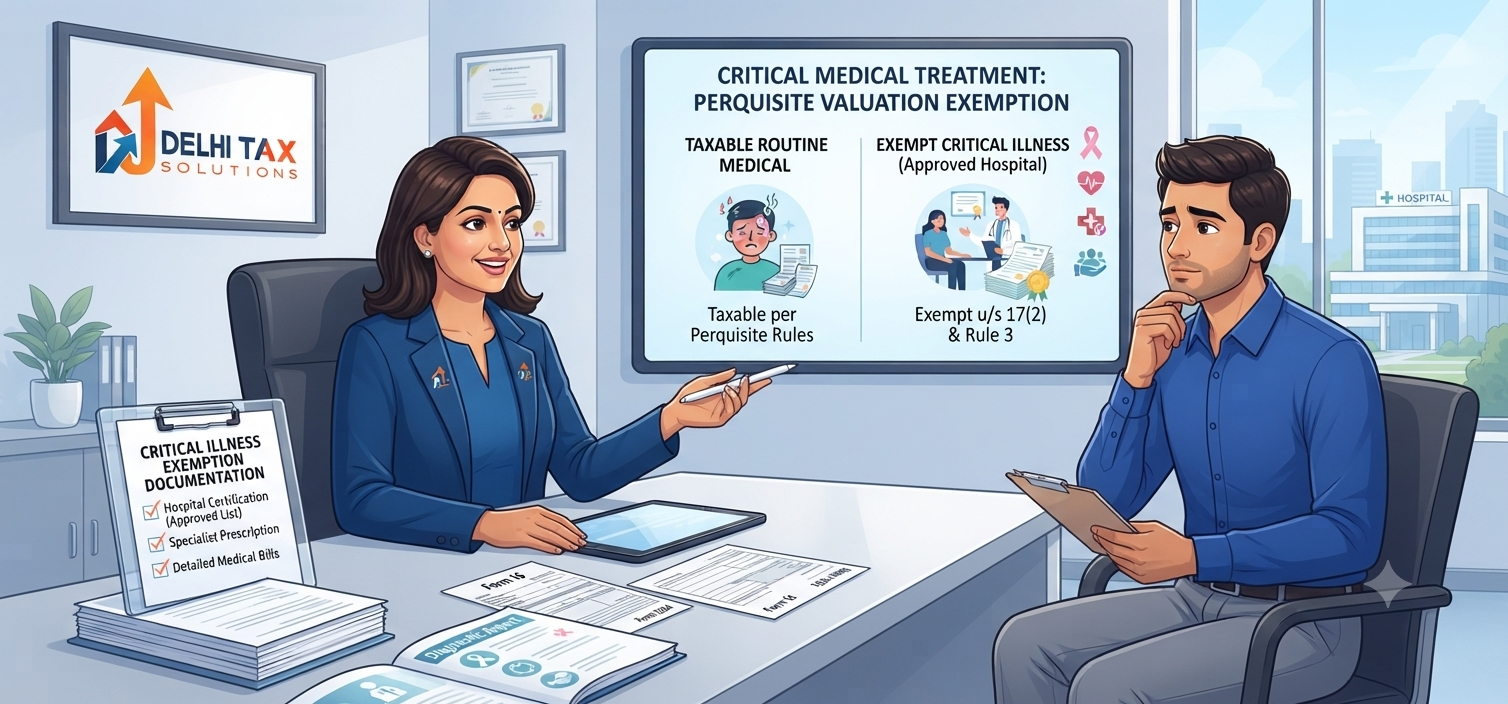
Not every medical procedure qualifies for tax-free perquisite status. The law explicitly limits exemptions to specified critical conditions, including malignant diseases (cancer), tuberculosis, AIDS, and advanced heart diseases requiring surgical intervention. Treatments must be certified by attending specialists.
Approved Hospital Networks
The exemption applies strictly if treatments are performed in hospitals, clinics, or nursing homes maintained by the government, a local authority, or any hospital approved by the Chief Commissioner of Income Tax. Official policy publications by the Press Information Bureau frequently highlight updates regarding empanelled healthcare institutions.
Treatment Abroad Guidelines
When an employee or family member undergoes critical treatment abroad, the expenditure on medical treatment and stay abroad—along with one attendant’s expenses—qualifies for exemption, provided the Reserve Bank of India permits the foreign exchange release and guidelines under Section 17(2) are strictly met.
| Medical Benefit Type | Taxability Status | Governing Statutory Condition |
|---|---|---|
| Routine Medical Allowance | Fully Taxable | Added to gross salary under regular slab rates |
| Hospital Maintained by Employer | Exempt from Tax | Available to all employees without discrimination |
| Critical Illness Reimbursement | Fully Exempt | Specified diseases treated in approved hospitals under Rule 3 |
Managing employee benefits correctly ensures seamless payroll processing. Business entities must also reconcile their overall financial compliance via GST – Delhi Tax Solution when handling complex corporate service contracts.
What Documentation and Hospital Certifications Are Mandatory?
Medical Prescriptions and Bills
To successfully claim medical perquisite exemptions, employees must retain itemized hospital bills, diagnostic reports, and formal prescriptions issued by registered medical practitioners. Audits conducted by our CA team show that missing invoices frequently trigger automated tax scrutiny notices.
Hospital Accreditation Certificates
The hospital where the critical treatment is performed must hold valid statutory recognition or approval. Employees should obtain a certificate from the medical director or chief administrator of the hospital confirming that the facility is officially recognized for treating the specific critical illness.
Employer Reporting and Form 12BA
Employers must detail tax-free medical perquisites in Form 12BA and Statement of Particulars when issuing Form 16. Ensuring consistency across all tax documents aligns with compliance protocols detailed in Assessee & Assessment Year Explained.
How Do Employer Health Insurance and Direct Reimbursements Differ?
Group Medical Insurance Premiums
Premiums paid by an employer for group health insurance policies (like Mediclaim) covering employees and their dependents do not constitute a taxable perquisite. This provides a tax-efficient way for businesses to safeguard their workforce.
Direct Cash Reimbursements
Unlike insurance premiums, direct cash reimbursements for non-critical outpatient treatments are fully taxable as salary perquisites. Only reimbursements specifically tied to notified critical illnesses in approved medical facilities enjoy complete tax exemption under Rule 3.
Strategic Compensation Planning
Corporate tax advisors recommend structuring employee wellness policies to leverage group insurance alongside designated critical care provisions, maximizing tax savings for both the organization and its personnel.
Conclusion and Professional CA Guidance
Navigating medical perquisite valuation exemptions requires strict adherence to Rule 3 guidelines, accurate hospital documentation, and precise knowledge of Section 17(2) provisions. By understanding which critical treatments qualify for tax relief, employees can protect vital financial resources during health emergencies. Talk to a Delhi Tax Solutions expert to evaluate your medical reimbursement claims and secure your tax filings within 3 days. Looking ahead, tax compliance frameworks will continue to evolve, making professional advisory indispensable for salaried taxpayers and employers alike.
Frequently Asked Questions (FAQs)
Q: What medical treatments qualify for perquisite valuation exemption under the Income Tax Act?
A: Under Section 17(2) of the Income-Tax Act, treatments for specified critical illnesses—such as cancer, tuberculosis, AIDS, and severe heart diseases requiring hospitalization—qualify for complete perquisite valuation exemption when financed or reimbursed by an employer in approved medical facilities, sparing employees from additional tax burdens during medical crises.
Q: How does Rule 3 regulate medical perquisite exemptions for salaried employees in India?
A: Rule 3 of the Income-Tax Rules establishes the regulatory framework for valuing employee perquisites. It dictates that medical treatments provided in employer-maintained hospitals or specialized empanelled institutions for notified diseases are excluded from taxable income, provided all mandatory hospital accreditation and doctor certification norms are fulfilled.
Q: Are medical reimbursements for family members covered under tax-free perquisite rules?
A: Yes, medical reimbursements for critical treatments cover not just the employee but also their spouse, children, parents, and dependent brothers or sisters. Employer-funded or reimbursed expenses for eligible family members undergoing treatment in approved hospitals enjoy the same perquisite tax exemption under current tax statutes.
Q: What documents and hospital certificates are required to claim medical perquisite exemptions?
A: Claimants must provide itemized hospital bills, diagnostic test reports, formal prescriptions from registered medical specialists, and an official certificate from the treating hospital confirming its approved status and the specific critical illness treated. Employers retain these documents to verify tax-free perquisites in Form 12BA.
Q: How does employer-provided health insurance differ from direct medical treatment reimbursement perquisites?
A: Employer-paid premiums for group health insurance policies covering employees and dependents are entirely tax-free and do not count as taxable perquisites. Conversely, direct cash reimbursements for medical care are taxable unless they strictly meet the statutory criteria for critical illnesses treated in approved government or empanelled hospitals.
Disclaimer: This article is for general informational purposes and is not a substitute for personalised professional tax advice. About this article: Researched using official government sources and Delhi Tax Solutions’ in-house tax advisory team. Last updated September 2026.
