? Key Takeaways
- Section 80C offers a maximum deduction of ?1.5 Lakhs annually for approved tax saving investments.
- Health insurance premiums under Section 80D reduce your taxable income significantly.
- Traditional deductions are restricted strictly under the old tax regime framework.
- Disability and medical treatment claims have dedicated provisions up to Section 80U.
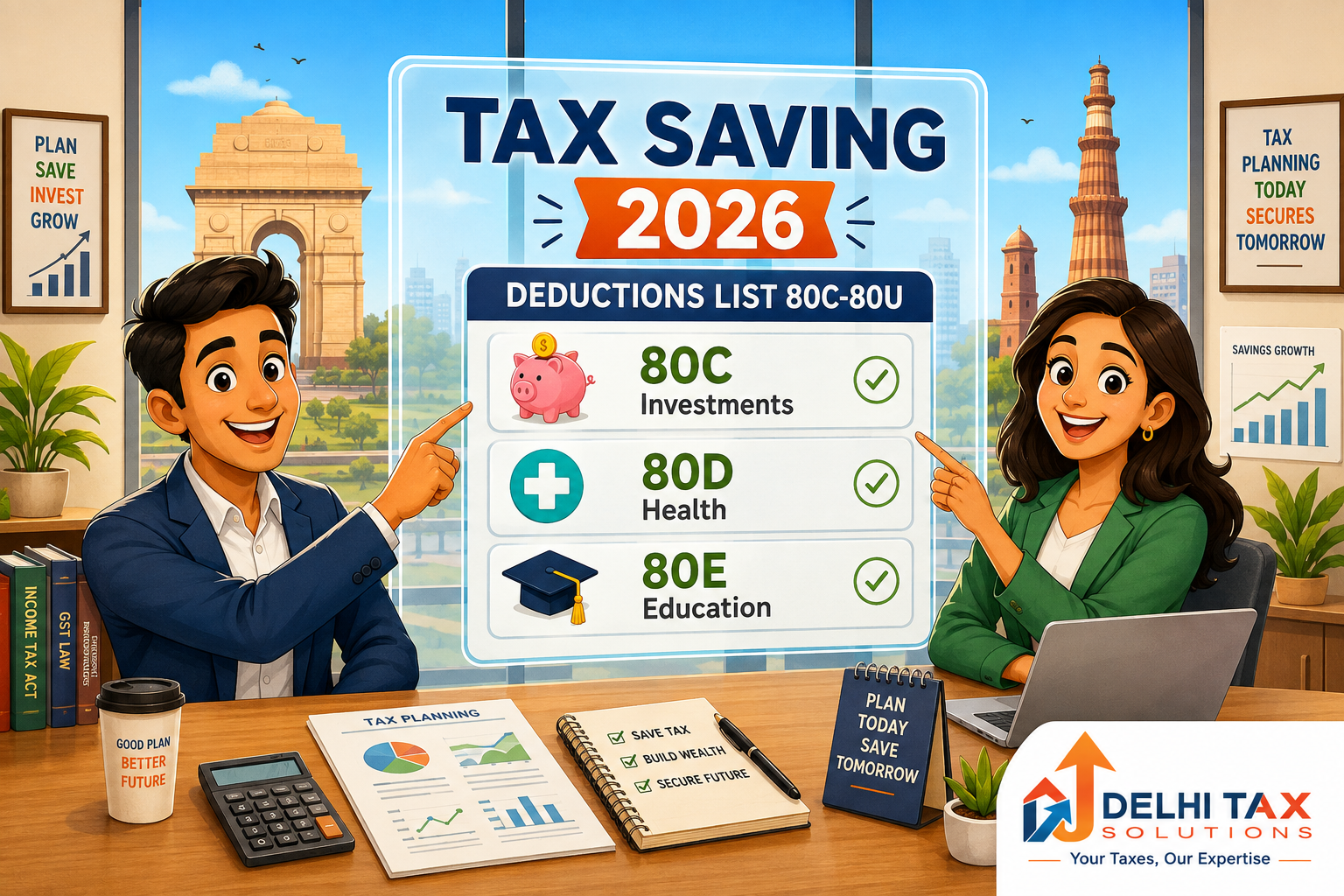
Section 80C to 80U: Complete List of Income Tax Deductions (2026)
Navigating personal finance in India requires a firm grip on legal tax-saving mechanisms. Every financial year, millions of taxpayers look for legitimate ways to lower their tax liability without risking capital. Knowing the right provisions transforms a complicated calculation into an organized strategy.
The income tax deductions list 80C 80U covers everything from basic provident fund contributions to specialized medical allowances. Based on cases handled by our CA team at Delhi Tax Solutions, taxpayers who systematically map out these provisions retain substantially more of their hard-earned income. When you align your financial choices with the Income Tax Act, tax season becomes an orderly administrative task rather than an annual panic.
Understanding Chapter VI-A Deductions: Core Overview
Chapter VI-A of the Income Tax Act contains the statutory provisions that allow resident individuals and Hindu Undivided Families (HUFs) to reduce their gross total income. These deductions are categorized across various sections, starting from Section 80C and extending through Section 80U. Each section targets a specific social or economic objective, such as promoting long-term savings, encouraging health insurance coverage, supporting higher education, or providing relief for individuals with disabilities. According to guidelines published by the Income Tax Department, taxpayers must explicitly claim these amounts while filing their annual returns to receive the corresponding tax relief.
Section 80C, 80CCC, and 80CCD: The Foundation of Tax Saving Investments 2026
Section 80C remains the most popular tool for tax saving investments 2026. It allows an aggregate maximum deduction of ?1.5 Lakhs per financial year across a wide variety of approved financial instruments.
Qualifying Instruments Under Section 80C
Employees and self-employed professionals can channel funds into Public Provident Fund (PPF), Equity Linked Savings Schemes (ELSS) mutual funds, Life Insurance premiums, and Employees’ Provident Fund (EPF) contributions. Additionally, principal repayments on home loans and children’s tuition fees qualify under this umbrella limit. Keeping precise records of these receipts is vital if you intend to secure tax exemptions under the old tax regime.
Pensions and National Pension System (NPS)
Beyond standard 80C instruments, Section 80CCC covers payments made toward approved annuity plans of life insurance companies. Furthermore, Section 80CCD(1B) provides an exclusive additional deduction of up to ?50,000 for self-contributions made to the National Pension System (NPS), bringing the total potential relief for retirement savings even higher.
Section 80D: Medical Insurance and Healthcare Deductions
Healthcare costs continue to rise, making health insurance a critical component of personal financial planning. Section 80D offers specific reliefs that encourage families to maintain adequate medical coverage.
Limits for Individuals and Senior Citizens
Under 80D health insurance deduction rules, an individual can claim up to ?25,000 for health insurance premiums paid for self, spouse, and dependent children. If the taxpayer or their spouse is a senior citizen aged 60 years or above, this limit increases to ?50,000. An additional deduction of up to ?50,000 is available for medical insurance premiums paid for senior citizen parents, offering substantial total relief for multi-generational households.
Preventive Health Check-Up Cap
Taxpayers often overlook the embedded provision for preventive health check-ups. Within the overall limits specified under Section 80D, up to ?5,000 can be claimed for cash or digital payments made toward preventive health check-ups for family members. This encourages proactive wellness tracking while maintaining compliance with standard tax provisions.
Education, Loans, and Donations: Sections 80E, 80G, and More
The broader scope of Chapter VI-A extends well beyond standard savings and medical policies, addressing higher education and philanthropic contributions.
Higher Education Loans (Section 80E)
Section 80E allows individuals to claim a deduction on the interest paid on education loans taken for higher studies for themselves, their spouse, or their children. Notably, there is no upper monetary limit on the interest amount that can be claimed, and the deduction is available for a maximum of eight consecutive financial years starting from the year repayment begins.
Philanthropic Contributions (Section 80G)
Donations made to specified charitable funds and relief organizations qualify for deductions under Section 80G. Depending on the specific institution, the deduction is either 50% or 100% of the donated amount, subject to qualifying limits. For accurate processing on the portal, taxpayers must verify that donation receipts contain the correct registration numbers and PAN details of the trust.
Disability and Special Medical Provisions: Sections 80DD, 80DDB, and 80U
Specialized provisions exist to support taxpayers dealing with severe medical conditions and disabilities within their immediate families.
Medical Treatment for Dependents (Section 80DD)
Section 80DD provides deductions for expenses incurred on the medical treatment, training, and rehabilitation of a dependent relative with a disability, or amounts paid toward specified schemes for their maintenance. A flat deduction of ?75,000 is allowed for normal disability, while severe disability qualifies for a higher deduction of ?1.25 Lakhs.
Disability of the Assessee (Section 80U)
While Section 80DD applies to dependents, Section 80U provides direct relief to resident individuals who suffer from certified physical or mental disabilities. This provision ensures financial cushion and recognition for taxpayers navigating personal health challenges while managing their professional and personal responsibilities.
Comparing Old vs New Tax Regime Deduction Rules
Choosing the correct tax framework dictates whether your investment documents play an active role in your annual filing. The evolution of tax administration has brought distinct paths for individual compliance.
| Provision / Section | Old Tax Regime Applicability | New Tax Regime Applicability |
|---|---|---|
| Section 80C (PPF, ELSS, Insurance) | Allowed up to ?1.5 Lakhs | Not Available |
| Section 80D (Health Insurance) | Allowed as per tier limits | Not Available |
| Section 80CCD(2) (Employer NPS) | Allowed | Allowed (Subject to limits) |
| Standard Deduction | Allowed | Allowed |
As noted in recent updates shared by the Press Information Bureau, taxpayers must evaluate their unique financial commitments before locking in their regime choice during annual return submission.
When organizing your filings or reviewing your corporate compensation structure, ensuring compliance across all documentation streams is essential. For corporate setups, professional guidance can streamline your obligations, much like organizing your PAN card application. For complex individual tax schedules, reviewing procedural frameworks via resources like how to file ITR online ensures your deductions are accurately recorded without clerical errors.
? Quick Summary
Maximizing deductions under Sections 80C through 80U requires strict adherence to old tax regime rules, precise record-keeping of investment receipts, and timely filing on the official portal.
Conclusion
Mastering the complete income tax deductions list from Section 80C to 80U empowers taxpayers to build robust financial strategies and retain more capital. Whether through provident funds, health insurance, or educational loans, each provision offers a legal avenue to optimize annual tax liabilities.
Do not wait until the final deadline to organize your financial proofs and investment receipts. Partner with a Delhi Tax Solutions expert to review your tax exemptions and handle your complete ITR filing flawlessly.
About this article: Researched using official government sources and Delhi Tax Solutions’ in-house tax advisory team. Last updated August 2026.
Disclaimer: This article is for general informational purposes and is not a substitute for personalised professional tax advice.
Frequently Asked Questions (FAQs)
+ Q: What is the maximum deduction limit under Section 80C, and what instruments qualify?
A: Section 80C permits a maximum aggregate deduction of ?1.5 Lakhs per financial year from your gross total income. Qualifying instruments include Public Provident Fund (PPF), Employees’ Provident Fund (EPF), Equity Linked Savings Schemes (ELSS), life insurance premium payments, principal repayment on home loans, and children’s tuition fees. Taxpayers opting for the old tax regime must maintain authentic investment proofs and premium receipts to substantiate these claims during assessment or portal verification.
+ Q: How does Section 80D health insurance deduction apply to senior citizen parents?
A: Under Section 80D, taxpayers can claim deductions for medical insurance premiums paid for themselves and their family up to ?25,000, which increases to ?50,000 if the taxpayer or spouse is a senior citizen. Furthermore, if you pay health insurance premiums for your parents who are senior citizens aged 60 years or above, you are eligible for an additional deduction of up to ?50,000. This brings the total potential health insurance deduction limit to ?1 Lakh when covering senior citizen parents alongside yourself.
+ Q: Can salaried individuals claim deductions under Sections 80C to 80U if they opt for the new tax regime?
A: Salaried individuals choosing the new default tax regime cannot claim traditional Chapter VI-A deductions such as Section 80C, 80D, 80DD, or 80E. The new tax regime offers concessional tax slab rates and a standard deduction but foregoes most exemptions and deductions. However, specific provisions like employer contributions to the National Pension System under Section 80CCD(2) remain claimable under both regimes, ensuring targeted retirement support irrespective of the chosen tax framework.
+ Q: What documents and proofs are required to claim Section 80G donations on the income tax portal?
A: To successfully claim deductions under Section 80G for philanthropic donations, taxpayers must possess official stamped receipts issued by the eligible charitable trust or fund. The receipt must clearly display the donor’s name, the registration number of the trust under Section 80G, its permanent account number (PAN), and the exact donation amount. During the ITR filing process, you must enter the donee’s PAN, address, and registration details accurately into the donation schedule to avoid processing errors or mismatch notices from the tax department.
+ Q: What is the difference between Section 80DD and Section 80U for disability-related tax deductions?
A: The primary distinction lies in who receives the medical care or lives with the condition. Section 80DD allows a resident individual or HUF to claim deductions for expenses incurred on the medical treatment, training, or rehabilitation of a dependent relative with a disability. In contrast, Section 80U provides a direct tax deduction to the taxpayer themselves if they are certified as a person with a disability by a medical authority. Both sections offer a flat deduction of ?75,000 for standard disability and ?1.25 Lakhs for severe disability.
