
💡 Key Takeaways
- The Income Tax Act, 2025 introduces the “Tax Year” concept starting April 1, 2026.
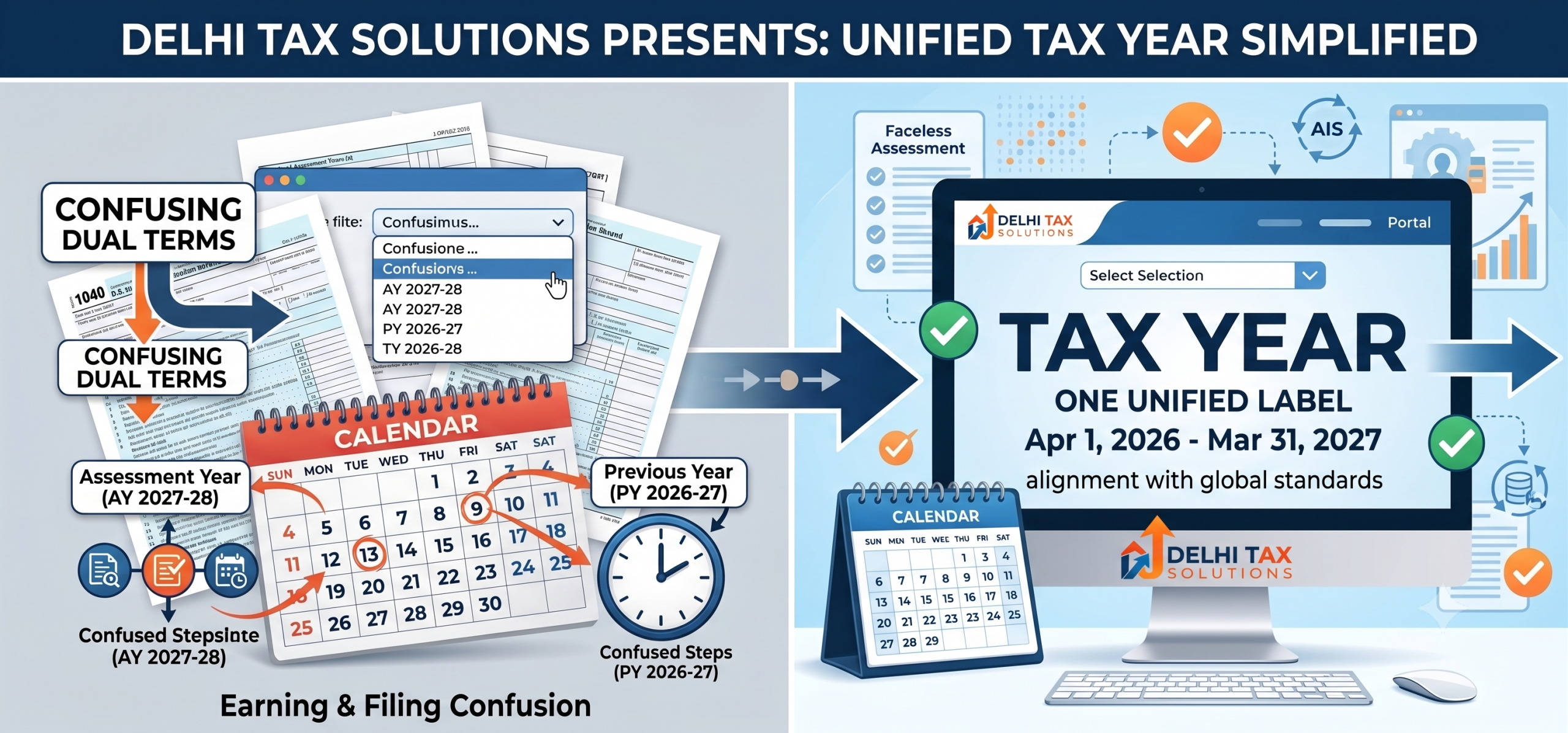
- “Tax Year” entirely replaces the confusing terms “Assessment Year” and “Previous Year”.
- Income earned and taxes filed for a financial period now share the exact same year label.
- Tax Year 2026-27 simply refers to the 12-month financial period from April 1, 2026, to March 31, 2027.
- This modernisation perfectly aligns Indian tax compliance with global digital reporting standards.
Introduction
The Indian taxation landscape undergoes a historic transformation on April 1, 2026. The new legislative framework scraps the outdated terms “Assessment Year” (AY) and “Previous Year” (PY) that confused individual taxpayers and business owners for decades. Many taxpayers are actively asking what is tax year in income tax act 2026. The answer fundamentally reshapes how Indian residents report their annual income and pay their statutory taxes.
Under the newly enacted direct tax laws, the government aims to drastically simplify compliance. The exact definition of what is tax year in income tax act 2026 directly impacts your next Income Tax Filing Services cycle. You will no longer need to calculate taxes for a previous year and file returns in an assessment year.
This unified approach eliminates paperwork errors and reduces litigation across the board. Every Indian taxpayer and MSME owner must understand how these rules apply. By grasping exactly what is tax year in income tax act 2026, you protect your business from costly filing mistakes. Keep reading to learn the exact legal definitions, key transitional provisions, and how this shift affects your upcoming financial deadlines.
What is the ‘Tax Year’ in Income Tax Act 2026?
Based on the tax year definition section 11 of the new legislation, when determining what is tax year in income tax act 2026, the law defines it as a unified twelve-month period commencing on the 1st of April of a given financial year. It completely replaces the dual concepts of “Previous Year” and “Assessment Year.” For example, income earned between April 1, 2026, and March 31, 2027, simply falls under “Tax Year 2026-27.” This singular terminology eliminates filing ambiguity, ensures accurate tax reporting, and directly aligns Indian compliance with simplified global taxation frameworks.
Tax Year vs Assessment Year: What Has Changed?
For decades, the Income Tax Act, 1961 mandated two separate labels for a single financial timeline. A taxpayer earned income in the “Previous Year” and filed their tax returns for that income in the subsequent “Assessment Year.” This dual-label system frequently caused Indian taxpayers to select the wrong year in their ITR forms, leading to defective return notices from the Central Processing Centre (CPC).
To clarify this historical confusion, the Income Tax Act 2025 tax year rules legally merge these timelines into one cohesive label. Now, the year you earn the money and the year you designate on your tax return carry the exact same name.
The Direct Comparison
| Feature | Old Regime (Act, 1961) | New Regime (Act, 2025) |
|---|---|---|
| Earning Period Label | Previous Year (PY) | Tax Year |
| Filing Period Label | Assessment Year (AY) | Tax Year |
| Example (FY 26-27) | PY 2026-27 / AY 2027-28 | Tax Year 2026-27 |
| Complexity Level | High (Dual Terms) | Low (Unified Term) |
| Global Alignment | Poor (Outdated UK system) | Excellent (Modern standards) |
Understanding what is tax year in income tax act 2026 eliminates the risk of selecting the wrong drop-down menu on the e-filing portal. Taxpayers simply match their financial statements to the exact same tax year label.
Understanding the “Tax Year” Meaning India: Why the Shift?
The transition to a unified tax timeline forms the core of India’s broader economic reforms. According to official Press Information Bureau (PIB) updates [1], the government designed the new legislation for textual simplification, tax rate continuity, and reduced litigation. The outdated 1961 terminology created unnecessary friction for ordinary citizens trying to comply with the law.
By establishing a clear tax year meaning India, the Central Board of Direct Taxes (CBDT) supports the rollout of fully faceless assessments. The unified label allows the government’s IT infrastructure to automatically sync a taxpayer’s Annual Information Statement (AIS) with their exact financial year transactions without date-matching errors.
⚡ Quick Summary
The single tax year label removes archaic terminology. It allows automated tax portals to process returns faster, drastically reduces human error, and completely aligns India’s tax system with transparent digital compliance standards.
If you search online to discover what is tax year in income tax act 2026, you will find the government prioritised a “Taxpayer-Centric Approach.” This specific strategy improves the overall ease of filing.
How Does the Income Tax Act 2025 Tax Year Impact ITR Filing?
When your business begins the ITR filing 2026 preparations, the entire e-filing infrastructure will update to reflect the new terminology. The Income Tax Department clarifies [2] that for payments pertaining to Tax Year 2026-27 onwards, taxpayers must select the Income Tax Act, 2025 on the portal. The old 1961 Act remains active solely for processing past dues.
Updating Accounting and Challans
Indian businesses must update their accounting software before the April deadline. Advance Tax payments will now clearly state “Tax Year 2026-27” on the challan. There is no longer any need to calculate an advanced assessment year mentally before making a tax deposit.
Integration with Other Compliance Modules
This simplified terminology extends beyond direct taxes. When applying for Company Registration India, your first audited financials will align perfectly with the unified tax year. This synchronization makes it easier for Chartered Accountants to manage simultaneous filings for the Ministry of Corporate Affairs (MCA).
If your internal accounting team is asking what is tax year in income tax act 2026, assure them the actual calculation of profit remains structurally identical.
Key Transitional Provisions for Tax Year 2026-27
Moving an entire nation to a modern framework requires careful transitional rules. Section 536(3) of the new Act specifically addresses how to interpret older documents. It legally mandates that any reference to a tax year starting on April 1, 2025, or earlier must be read as a reference to the corresponding “previous year” under the old 1961 Act.
Treatment of Brought Forward MAT Credit
Corporate taxpayers must pay attention to the Minimum Alternate Tax (MAT). Based on Press Information Bureau (PIB) notifications [3], MAT becomes a final tax at a reduced rate of 14 percent. Accumulated MAT credit up to March 31, 2026, remains available for set-off in the new regime, limited to one-fourth of the tax liability.
Navigating Reassessment Notices
The new system also modifies how the department handles escaped income. According to the Income Tax Department [4], reassessment proceedings require a reasoned order under Section 281(3) before a formal reopening notice is issued.
When corporate directors ask their CA what is tax year in income tax act 2026, they often worry about losing past credits. The law explicitly protects historical credits.
Preparing Your Business for the New Era
Preparing for the new tax year India 2026 demands proactive preparation. While tax rates remain predictable, administrative changes require updates to enterprise software, invoicing systems, and payroll management tools. Companies must ensure their HR departments communicate the new terminology clearly to employees.
By fully comprehending what is tax year in income tax act 2026, business owners can train their staff early. The new legal framework explicitly removes outdated levies, such as the Equalization Levy, and eliminates the requirement for separate accounting based on Income Computation and Disclosure Standards (ICDS) from Tax Year 2027-28 onwards.
To ensure comprehensive compliance management, business owners should also review the GST vs Income Tax differences.
If your business maintains a GST Registration Online, you will find the direct tax timeline now feels just as straightforward as the monthly GST reporting cycle. Delhi Tax Solutions strongly advises auditing ongoing tax disputes before March 2026 to ensure a clean transition.
Conclusion
The elimination of the “Assessment Year” terminology marks a massive victory for simplified compliance in India. By establishing a single, unified 12-month period, the government permanently solved the most common source of tax filing errors. You now know exactly what is tax year in income tax act 2026—it is simply the financial year in which you earn your income and for which you file returns.
Adapting to this new terminology early prevents future administrative headaches. We anticipate the new e-filing portals will launch with this updated nomenclature shortly before the April 2026 effective date. Talk to a Delhi Tax Solutions expert today to get your compliance updated.
About this article: Researched using official government sources and Delhi Tax Solutions’ in-house tax advisory team. Last updated August 2026.
Disclaimer: This article is for general informational purposes and is not a substitute for personalised professional tax advice.
Frequently Asked Questions (FAQ)
+ What is the difference between tax year and assessment year in India?
Under the old Income Tax Act of 1961, the ‘Previous Year’ was the 12-month period you earned income, and the ‘Assessment Year’ was the subsequent year you filed returns. Starting April 1, 2026, the new direct tax law merges these into a single term called the “Tax Year.” This means income earned and taxes filed for a specific financial period will share the exact same year label, eliminating filing confusion entirely.
+ When does the new Income Tax Act 2025 come into effect?
The new Income Tax Act, 2025 is legally slated to come into effect on April 1, 2026. It applies to all income earned during the Financial Year 2026-27 and onwards. For any tax payments, advance tax deposits, or return filings related to this period, taxpayers must strictly select the new Act on the official e-filing portal to ensure their payments process correctly without triggering penalty notices.
+ How does the new tax year impact my advance tax payments?
The shift to the new tax year terminology simplifies how you deposit your advance tax instalments on June 15, September 15, December 15, and March 15. Instead of calculating a future Assessment Year to write on your challan, you will simply select the current Tax Year (e.g., Tax Year 2026-27). This direct matching system significantly reduces data-entry errors when generating tax payment challans on the government portal.
+ Will I lose my brought forward MAT credit in the new tax year?
No, corporate taxpayers will not lose their historical tax credits. The new tax laws state that brought forward Minimum Alternate Tax (MAT) credit accumulated up to March 31, 2026, will remain available for set-off. However, this set-off is restricted to a maximum of one-fourth of your tax liability under the new regime. Furthermore, MAT becomes a final tax at a reduced rate of 14 percent starting from the new tax year.
+ Is there any change to tax rates or slabs in the new tax year?
The primary goal of the new legislative framework is textual and structural simplification, not sweeping financial changes. According to the Central Board of Direct Taxes (CBDT), the core tax rates remain consistent to ensure continuity and predictability for taxpayers. While the terminology shifts to “Tax Year,” your fundamental profit calculations, allowed business deductions, and standard tax slab application remain structurally identical to the previous financial year’s logic.
