💡 Key Takeaways
- The Vivad Se Vishwas (VSV) scheme provides a golden opportunity to settle pending direct tax disputes by paying only the disputed tax amount, waiving massive penalties and interest.
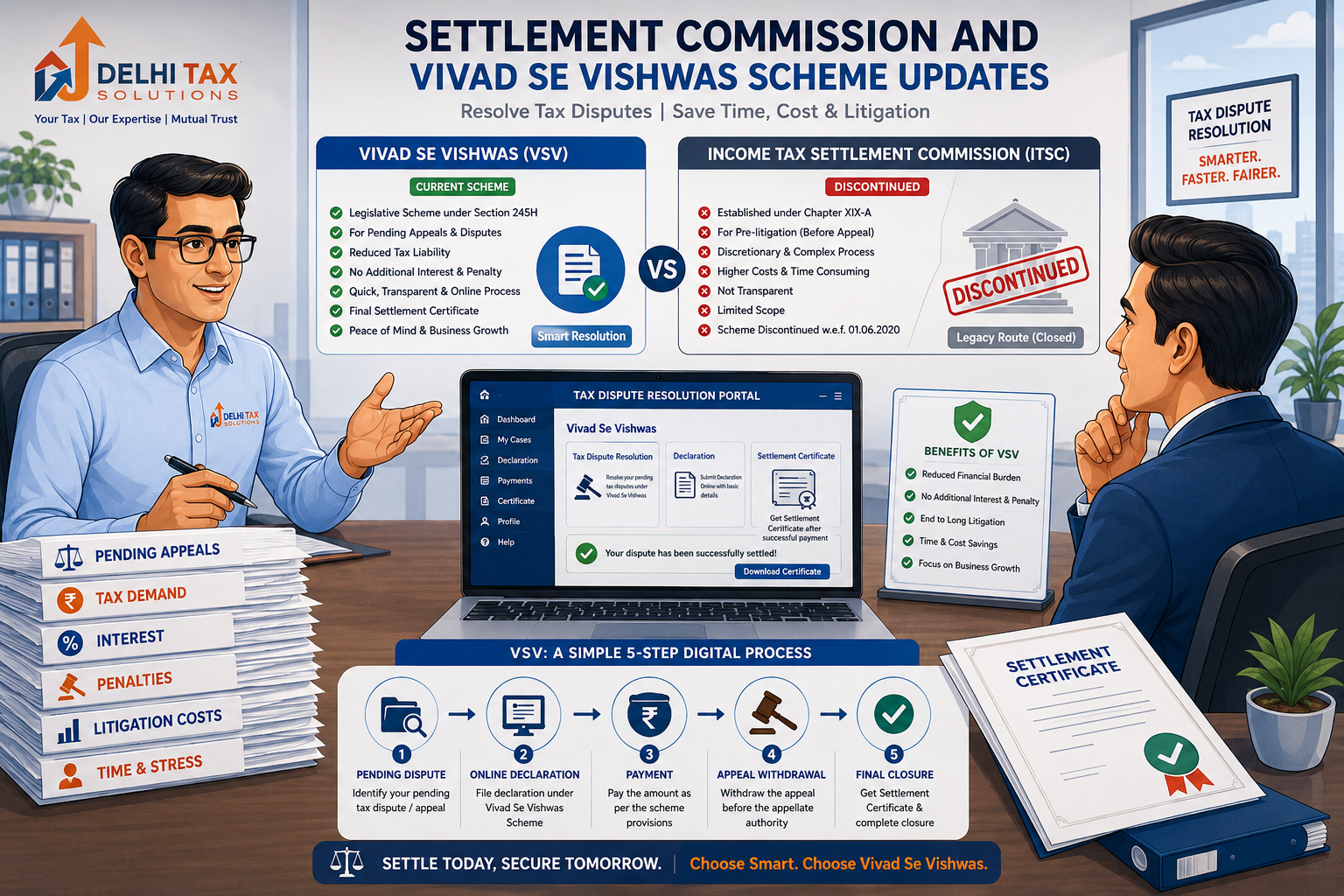
- The traditional Income Tax Settlement Commission (ITSC) has been formally abolished, replaced by the Interim Board for Settlement to handle legacy pending cases.
- Checking Vivad Se Vishwas eligibility is essential for taxpayers looking to resolve long-standing appellate litigation.
- Properly utilizing a dispute resolution scheme tax window saves businesses from protracted legal battles and heavy financial attrition.
- Maintaining transparent Income Tax Filing records ensures faster processing of settlement declarations.
For decades, India’s direct tax ecosystem has been burdened with an immense backlog of litigation. Taxpayers and the Revenue Department frequently found themselves locked in appeals taking years to resolve. To declutter the appellate forums, the government has repeatedly introduced amnesty and settlement mechanisms. Navigating the latest Vivad Se Vishwas scheme updates and understanding the current Income Tax Settlement Commission status is critical for anyone facing pending tax demands. Whether it involves legacy corporate disputes stemming from Company Registration structuring or individual capital gains scrutiny, leveraging these schemes can offer a clean slate.
The Demise of the Income Tax Settlement Commission
What Was the ITSC?
The Income Tax Settlement Commission was historically a quasi-judicial body set up to allow errant taxpayers to come clean, declare undisclosed income, and pay their tax dues in exchange for immunity from prosecution and penalty waivers. It was a preferred route for complex cases involving search and seizure operations.
Current Status and the Interim Board
To streamline dispute resolution and reduce redundant statutory bodies, the government formally abolished the ITSC. Taxpayers can no longer file fresh applications before the Commission. Instead, the government established an Interim Board for Settlement to exclusively process and dispose of applications that were already pending when the ITSC was dissolved. If you have legacy disputes involving heavy TDS Compliance penalties, you must now look toward the Vivad Se Vishwas framework or the newly formed Dispute Resolution Committees (DRCs) for small taxpayers.
Vivad Se Vishwas: The Ultimate Dispute Resolution Scheme
Scheme Mechanics and Benefits
The “Vivad Se Vishwas” (No Dispute, Only Trust) scheme was designed to end pending direct tax litigation. The core premise is incredibly attractive: if a taxpayer agrees to pay the disputed tax amount, the government completely waives the associated interest and penalties. In cases where the dispute only pertains to penalties, interest, or fees, the taxpayer typically only needs to pay 25% of the disputed amount to settle the case entirely.
Who is Eligible?
Determining your Vivad Se Vishwas eligibility involves checking the status of your appeal. Generally, the scheme covers cases where appeals were pending before the Commissioner of Income Tax (Appeals), the Income Tax Appellate Tribunal (ITAT), High Courts, or the Supreme Court as of the specified cut-off date. It is heavily utilized to settle complex Property Tax related capital gains disputes and corporate assessments.
⚡ Strategic Advantage
Participating in the VSV scheme not only waives potentially crippling interest that accumulates over years of litigation but also guarantees absolute immunity from prosecution related to that specific dispute.
Comparing Settlement Options
As the legal landscape shifts, understanding your remaining avenues is crucial. Here is how standard litigation compares to the VSV scheme:
| Feature | Standard Appellate Litigation | Vivad Se Vishwas Scheme |
|---|---|---|
| Timeframe | Can take 5 to 15+ years across ITAT, HC, and SC. | Resolved rapidly within a few months of declaration. |
| Cost (Tax + Interest) | Tax demand + accumulating interest (1% per month). | Pay only the disputed tax; 100% interest waiver. |
| Penalty Risk | High risk of 100% to 300% penalties if appeal is lost. | 100% penalty waiver upon payment of disputed tax. |
| Outcome Certainty | Uncertain; dependent on judicial interpretation. | Guaranteed closure and issuance of a final certificate. |
Applying for the Scheme and Advisory Support
The Digital Application Process
To participate in this dispute resolution scheme tax window, eligible taxpayers must file a declaration online through the official Income Tax Department e-filing portal. After processing, the designated authority issues a certificate calculating the final amount payable. Once the taxpayer pays this amount and withdraws their pending appeals, the matter is permanently closed. Official updates regarding scheme extensions and window openings are frequently communicated via the Press Information Bureau.
Consulting Chartered Accountants
Evaluating whether to fight an appeal or opt for settlement requires a rigorous cost-benefit analysis. A weak case with high accumulating interest is a prime candidate for VSV, while a strong legal case might warrant continued litigation. Regulatory bodies like the Reserve Bank of India and the Ministry of Corporate Affairs also prefer companies with clean, litigation-free balance sheets. If you have pending litigation or GST Registration cross-linkage issues complicating your direct taxes, professional guidance is crucial. Talk to a Delhi Tax Solutions expert today. Our certified Chartered Accountants will calculate your potential savings under VSV, handle the declaration filings, and ensure a seamless resolution to your tax disputes.
Staying informed about Vivad Se Vishwas scheme updates allows you to strategically eliminate legal burdens and achieve absolute financial peace of mind. Connect with Delhi Tax Solutions to secure expert advisory and permanently settle your pending tax litigation.
About this article: Researched using official government sources and Delhi Tax Solutions’ in-house tax advisory team. Last updated August 2026.
Frequently Asked Questions (FAQs)
Q: What are the latest Vivad Se Vishwas scheme updates?
A: The Vivad Se Vishwas scheme periodically opens windows for taxpayers to settle pending direct tax litigation by paying the disputed tax amount in exchange for a complete waiver of interest and penalties. Always check the current active status on the e-filing portal.
Q: Who is eligible to apply for this tax dispute resolution scheme?
A: Taxpayers who have appeals pending before appellate forums (CIT(A), ITAT, High Courts, or the Supreme Court) as of the government-specified cut-off date are eligible to file a declaration under the VSV scheme.
Q: What happened to the Income Tax Settlement Commission?
A: The Income Tax Settlement Commission (ITSC) has been formally abolished. No new applications are accepted. An Interim Board for Settlement was constituted solely to dispose of the legacy applications that were pending at the time of its abolition.
Q: Does the scheme waive both interest and penalties?
A: Yes, for disputes involving tax arrears, paying the principal disputed tax amount guarantees a 100% waiver of all associated interest and penalties, along with immunity from prosecution.
Q: How can taxpayers file a declaration under Vivad Se Vishwas?
A: Declarations are filed entirely online via the Income Tax e-filing portal. After submission, the designated authority verifies the claim and issues a certificate specifying the exact settlement amount to be paid to close the case.
