
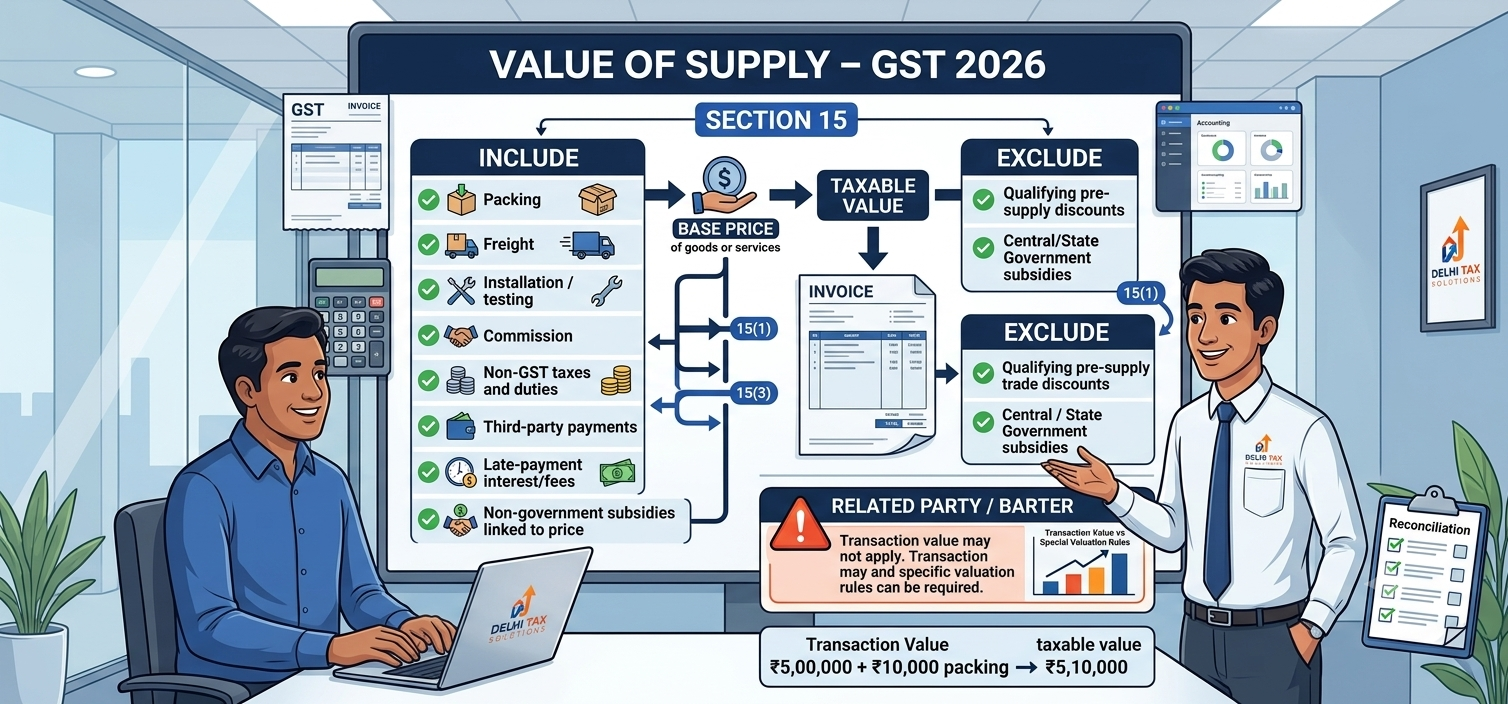
💡 Key Takeaways:
- The value of supply under GST is generally the transaction value (the price actually paid or payable).
- Incidental expenses like packing, freight, and installation must be added to the taxable value.
- Pre-supply trade discounts shown on the invoice are excluded from the taxable value.
- Subsidies provided by the Central or State Government are not added to the transaction value.
- Related-party transactions trigger special valuation rules regardless of the invoice price.
Calculating the exact amount on which GST applies sounds simple until you add freight, trade discounts, late fees, and packing charges to the invoice. An incorrect calculation means you either overcharge your customers or shortchange the government. Both scenarios lead to severe compliance headaches.
Understanding the exact value of supply ensures your business stays audit-ready. Under Indian tax law, the taxable amount is not just the base price of the product; it encompasses various specific inclusions and exclusions dictated by statutory guidelines. Whether you are a newly minted startup founder or an established MSME owner, mastering this calculation protects your working capital. Companies setting up their accounting workflows right from the start can explore our company registration in India services to build a solid foundation.
What is the Value of Supply Under GST?
The value of supply under Section 15 of the CGST Act is the transaction value, which is the price actually paid or payable for the goods or services. This value is accepted for GST calculation provided the buyer and seller are not related parties, and price is the sole consideration for the supply. If these conditions are met, GST is applied directly to this transaction value.
The concept of transaction value GST simplifies taxation by relying on the actual commercial agreement between two independent parties. Instead of assigning artificial market values to goods, the law trusts the invoice price—provided the transaction happens at arm’s length.
However, the government carefully defines what this transaction value must include. Businesses cannot artificially lower the base price by charging separately for essential services like packing or testing without paying tax on those amounts.
Understanding the Core Conditions of Section 15
To use the transaction value as the absolute value of taxable supply, two fundamental conditions under Section 15(1) must be satisfied.
The Parties Are Not Related
The supplier and the recipient cannot be related persons. If a parent company sells goods to a subsidiary at a heavily discounted rate, the invoice price is not trusted. In such cases, the business must refer to specific valuation rules to determine the open market value.
Price is the Sole Consideration
The payment must be entirely in money. If a buyer pays ₹50,000 in cash but also gives the seller a used machine worth ₹20,000, the true taxable value is ₹70,000. When barter or exchange happens, the transaction value fails, triggering the valuation rules.
Businesses dealing with complex pricing structures often consult our Complete GST Compliance Hub to ensure their invoicing software aligns with these statutory requirements.
Specific Inclusions Under Section 15(2) of CGST Act
The Section 15 CGST Act explicitly lists items that must be added to the base price before applying the GST rate. Failing to include these leads to short-payment of tax.
Other Taxes and Duties
Any taxes, duties, cesses, or fees levied under any law—other than the GST law itself—must be included. For example, if a municipal tax is charged on a supply, GST is calculated on the total amount including that municipal tax.
Third-Party Payments Made by Recipient
If the supplier is liable to pay a third party, but the recipient pays it directly, that amount must be added to the taxable value. If you hire a contractor for ₹1,00,000 and directly pay their cement vendor ₹20,000, the GST applies on the full ₹1,20,000.
Incidental Expenses Before Delivery
This is where most businesses make errors. Incidental expenses like commission, packing, testing, and GST on freight charges must be included. If a machine costs ₹5,00,000 and special wooden packing costs ₹10,000, the 18% standard GST rate implication applies to ₹5,10,000.
Interest, Late Fees, and Penalties
If a customer pays late and you charge an interest or late fee of ₹2,000, this fee is deemed part of the taxable value. You must issue a debit note and pay GST on this ₹2,000. It is heavily scrutinized during audits.
Subsidies Directly Linked to Price
Subsidies linked directly to the price of the product must be added to the value. However, there is a major exception: subsidies provided by the Central or State Government are expressly excluded.
Exclusions from the Taxable Value (Section 15(3))
The law provides specific relief by allowing certain amounts to be excluded from the taxable value, directly reducing the tax burden.
Pre-Supply Trade Discounts
Any discount given before or at the time of supply is excluded, provided it is duly recorded on the invoice. If a ₹10,000 product has a 10% trade discount shown on the bill, GST applies only on ₹9,000.
Post-Supply Volume Discounts
Discounts given after the supply happens (like year-end volume targets) can be excluded if they are established in an agreement entered into before the supply. Additionally, the buyer must reverse the Input Tax Credit (ITC) attributable to that discount.
Quick Summary Table: Inclusions vs Exclusions
This comparison table breaks down exactly how to treat various invoice components to calculate the final taxable value accurately.
| Component / Expense Type | Treatment under Section 15 | Statutory Reasoning |
|---|---|---|
| Basic Price of Goods/Services | Include | Forms the core transaction value. |
| Municipal Taxes or Custom Duties | Include | Taxes other than GST form part of the base. |
| Packing and Freight Charges | Include | Incidental expenses incurred before delivery. |
| Late Payment Interest/Penalty | Include | Considered an addition to the original supply. |
| Non-Government Subsidies | Include | Directly affects the pricing structure. |
| Trade Discount clearly shown on invoice | Exclude | Statutory relief under Section 15(3)(a). |
| Central/State Government Subsidies | Exclude | Exempted specifically under Section 15(2)(e). |
If you are setting up your invoicing structure for the first time, getting professional help ensures these calculations run automatically. Learn more about structural setup through our GST Registration Services.
In a Nutshell
To arrive at the final value of supply, start with the base price. Add any non-GST taxes, third-party payments, incidental costs (like freight and packing), late fees, and private subsidies. Finally, subtract any trade discounts clearly recorded on the invoice. This final figure is the amount you multiply by your applicable GST rate.
What Our CA Team Sees in Practice
Based on cases handled by our CA team, theoretical rules often clash with practical business operations. Tax authorities heavily scrutinize valuation during departmental audits. Here is what we actively monitor.
First, businesses often separate packing charges into a different ledger and forget to charge GST on them. Under the GST valuation rules, packing is an incidental expense. If you sell 12% GST goods but fail to charge GST on the packing amount, the auditor will demand the tax with an 18% per annum interest penalty.
Second, post-supply volume discounts create a massive compliance trap. Suppliers issue commercial credit notes to buyers for reaching yearly targets but fail to ensure the buyer reverses their Input Tax Credit. If the buyer does not reverse the ITC, the supplier cannot reduce their output tax liability.
Finally, related-party transactions (like a director providing rent-free premises to their own private limited company) are flagged immediately. Even if the invoice says “Zero Price,” the GST rules demand tax on the open market value. We always advise clients to structure related-party pricing carefully.
You can stay updated on these specific departmental interpretations by regularly checking circulars on the CBIC GST Taxpayer Portal and the official Official GST Portal.
Final Thoughts
Determining the correct value of supply goes far beyond simply looking at the sticker price of a product. You must account for incidental expenses, non-GST taxes, late fees, and strict discount rules under Section 15 of the CGST Act. A minor miscalculation on freight or packing charges can compound into massive penalty demands over a financial year.
By mapping out your exact inclusions and exclusions before generating invoices, you safeguard your business from audit scrutiny and profit leakage. Always ensure your accounting software is configured to treat discounts and subsidies precisely as the law mandates. Talk to a Delhi Tax Solutions expert to get your GST registration filed within 3 days and ensure your invoice templates are 100% compliant. We are here to handle the complexities so you can focus on growth. Check out our Delhi Tax Solutions Blog Index for more practical tax guides.
Frequently Asked Questions
Q: What is the value of supply under Section 15 of the CGST Act?
A: The value of supply under Section 15 of the CGST Act is defined as the transaction value. This is the exact price actually paid or payable for the goods or services. It is accepted as the taxable value provided the buyer and seller are not related persons and the price is the sole consideration for the supply.
Q: Is transaction value always accepted for GST calculations?
A: No, the transaction value is not always accepted. If the supplier and recipient are related parties (such as a holding and subsidiary company), or if the payment involves barter or exchange rather than just money, the transaction value is rejected. In such cases, businesses must use specific GST valuation rules to determine the open market value.
Q: Are packing and freight charges included in the value of supply?
A: Yes, packing and freight charges are included in the value of supply. Section 15(2)(c) of the CGST Act specifically states that any incidental expenses charged by the supplier to the recipient before or at the time of delivery must be added to the basic price before applying the applicable GST rate.
Q: How are trade discounts treated for GST valuation?
A: Trade discounts are excluded from the value of taxable supply under Section 15(3), provided they are given before or at the time of the supply and are clearly recorded on the face of the tax invoice. Post-supply volume discounts can also be excluded if they are tied to a pre-existing agreement and the buyer reverses the corresponding Input Tax Credit.
Q: Does a government subsidy affect the value of taxable supply?
A: A government subsidy does not increase the taxable value. Under Section 15(2)(e), while subsidies directly linked to the price of a product are generally added to the transaction value, subsidies provided specifically by the Central Government or State Governments are explicitly excluded from the calculation of GST.
This article is for general informational purposes and is not a substitute for personalised professional tax advice. About this article: Researched using official government sources, real-time competitor and search-trend analysis, and Delhi Tax Solutions’ in-house tax advisory team. Last updated September 2026.
