
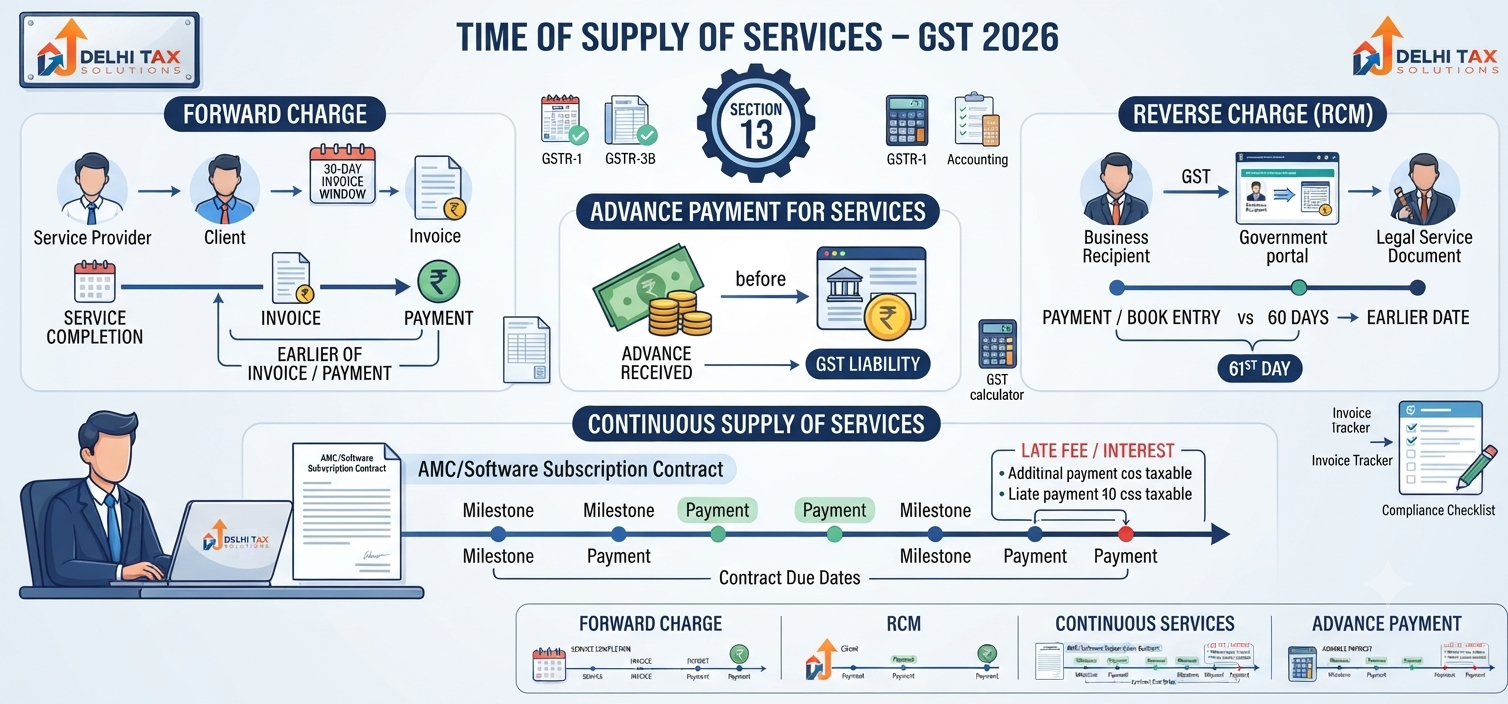
💡 Key Takeaways:
- Time of supply determines the exact month when tax liability must be reported and paid.
- For services under forward charge, liability is the earlier of invoice issuance or payment receipt.
- Advances received for services attract immediate GST liability upon book entry or bank credit.
- Reverse charge transactions for services lock liability on the 61st day or payment date.
Determining your exact tax liability under Indian indirect tax laws depends heavily on identifying when a commercial transaction legally takes place. This critical milestone is known as the time of supply. For service providers, consultants, and IT agencies, getting this timing wrong triggers statutory interest penalties.
While the rules for goods focus primarily on physical removal dates, intangible deliverables operate under a different statutory framework. Section 13 of the CGST Act governs when a service provider must account for tax. Understanding these provisions prevents cash flow crunches and mismatched GSTR filings.
This comprehensive guide details the statutory provisions for determining the time of supply of services. We will explore forward charge rules, advance payment taxability, reverse charge timelines, and real-world compliance advice straight from our practice.
What is Time of Supply of Services Under GST?
The time of supply of services defines the exact statutory point when tax liability arises under Section 13 of the CGST Act. It establishes the tax period in which a transaction must be reported in GSTR-1 and discharged via GSTR-3B. For standard forward charge services, liability occurs at the earliest of invoice issuance or payment receipt, provided the invoice is issued within statutory time limits.
Time of Supply Under Forward Charge (Section 13(2))
Under Section 13(2) of the CGST Act, standard professional and commercial services follow the forward charge mechanism, where the service provider collects tax from the client and remits it to the government.
Date of Invoice vs Payment Receipt Rules
Unlike goods, which enjoy an exemption on advance payments, services are strictly bound by advance tax rules. Under Section 13(2)(a), the time of supply is the earlier of the date of invoice issuance or the date of payment receipt, assuming the invoice is issued within 30 days of service completion.
If an advance payment is credited to your bank account before the invoice is raised, tax liability arises immediately on that receipt date. Accountants must track bank credits closely to maintain accurate service tax timing across financial reporting cycles.
Mandatory 30-Day Invoice Issuance Window
Section 31 of the CGST Act mandates that service providers must issue a tax invoice within 30 days from the date of supply of service. For banking, insurance, and financial institutions, this extended window is 45 days.
If you fail to issue the invoice within this 30-day window, Section 13(2)(b) shifts the time of supply trigger. The liability then becomes the earlier of the actual date of service provision or the date of payment receipt.
Establishing proper billing structures during your initial company registration in India ensures your billing software automatically flags approaching 30-day invoice deadlines.
Time of Supply Under Reverse Charge Mechanism (Section 13(3))
Under the Reverse Charge Mechanism (RCM), the recipient of the service is legally responsible for paying the GST directly to the government instead of the service provider. This applies to legal consultancy, sponsorship services, and director fees.
The 61-Day Rule for B2B Service Receivers
Determining when to pay GST under RCM requires evaluating two specific dates. Under Section 13(3), the time of supply for reverse charge services is the earlier of the following:
- The date on which payment is entered in the books of account of the recipient or debited from their bank account, whichever is earlier.
- The date immediately following 60 days from the date of issue of the invoice by the supplier.
If neither date can be ascertained, the time of supply defaults to the date the transaction is entered in the recipient’s books of account. For cross-border transactions involving associated enterprises where the supplier is located outside India, the time of supply is strictly the date of debit or book entry by the recipient, whichever is earlier.
Practical Example of RCM Service Compliance
Suppose an advertising agency in Delhi receives legal advisory services from an advocate. The advocate issues an invoice on March 1. The agency records the payment in its accounting books on April 10.
The 60-day window from the invoice date expires on April 30. Comparing the payment date (April 10) against the 61st day (May 1), the earlier date is April 10. Consequently, April 10 determines the tax period for discharging the RCM liability.
Ensuring your operational workflows align with proper tax filings is vital. Securing timely GST registration online allows your business to seamlessly claim Input Tax Credit (ITC) on RCM payments.
Continuous Supply, Vouchers, and Delayed Payments (Section 13(4)-(6))
Many professional service arrangements operate on ongoing contracts rather than one-off project billing. Section 13 provides specialized guidelines for these recurring structures.
Continuous Services and Milestone Billing
Under Section 2(33) and Section 31(5) of the CGST Act, a continuous supply of services involves contracts lasting longer than 30 days with periodic payment obligations. Examples include annual maintenance contracts (AMCs), software subscription licenses, and security services.
The time of supply for continuous services aligns with the due date specified in the contract. If the contract does not specify a due date, tax timing is tied to the date the milestone event is completed or when the invoice is issued.
Delayed Payment Penalties and Interest
Clients often delay settling professional invoices beyond agreed credit terms, prompting suppliers to levy late fees or interest. Under Section 13(6), the time of supply for any additional value generated through interest, late fees, or penalties is strictly the date on which the supplier actually receives that extra amount. You do not accrue liability on penal interest until cash changes hands.
Summary Comparison Table: Service Supply Provisions
To help corporate finance teams audit transactions efficiently, the table below consolidates the statutory rules under Section 13 of the CGST Act across all service delivery models.
| Service Category | Primary Provision | Determining Timestamp (Earliest of) |
|---|---|---|
| Forward Charge | Section 13(2)(a) | Actual invoice date (within 30 days) OR actual payment receipt date. |
| Delayed Invoice | Section 13(2)(b) | Service provision date OR actual payment receipt date. |
| Reverse Charge (RCM) | Section 13(3) | Payment debit date OR 61st day from the date of supplier invoice. |
| Continuous Services | Section 13(2) / 31(5) | Contract due date, milestone completion date, or payment receipt date. |
| Interest / Late Fee | Section 13(6) | Date the supplier receives the additional penalty amount. |
What Our CA Team Sees in Practice: Common Audit Pitfalls
In our tax advisory practice, we frequently observe businesses running afoul of service timing rules during annual GST audits. The most persistent compliance trap involves failing to account for tax on advance client retainers.
Unlike goods, where advances are exempt from tax, service providers must pay GST on advance retainers the moment the money hits their bank account or is entered into accounting software. Forgetting to discharge tax on unbilled advances results in departmental interest notices under Section 50.
Another major audit trigger involves write-offs and bad debts. Service providers often assume that if a client defaults on payment, they can omit reporting the invoice. Under GST law, once an invoice is issued under forward charge, tax liability crystallizes regardless of whether the client pays. Adjustments require formal credit notes issued within statutory deadlines.
In a Nutshell
For services, advance payments attract immediate tax liability. Always monitor the 30-day invoice window and reconcile your books against the official GST Portal.
Conclusion
Mastering the time of supply of services under Section 13 is vital for maintaining robust compliance and protecting your business working capital. Remember that forward charge transactions depend on invoice or payment dates, advance retainers require immediate tax payment, and reverse charge rules track the 61-day mark.
Proactive invoice tracking ensures smooth input tax credit matching for your corporate clients. Do not let complex tax timelines slow down your firm. Speak with a Delhi Tax Solutions expert today to review your billing schedules and compliance health.
You can discover additional financial insights across our tax and finance blogs. Staying informed protects your enterprise against unexpected liabilities.
About this article: Researched using official government sources, real-time competitor and search-trend analysis, and Delhi Tax Solutions’ in-house tax advisory team. Last updated September 2026.
Disclaimer: This article is for general informational purposes and is not a substitute for personalised professional tax advice.
Frequently Asked Questions (FAQs)
Q: What is the time of supply of services under GST?
A: The time of supply of services under Section 13 of the CGST Act represents the exact legal timestamp when tax liability arises. For standard forward charge supplies, it is determined as the earlier of the date when the tax invoice is issued (within the 30-day statutory limit) or the date when the payment is received by the service provider.
Q: Do I have to pay GST on advance payments received for services?
A: Yes, registered service providers must pay GST on advance retainers or advance payments received from clients. Unlike goods, which enjoy an advance tax exemption, service tax liability is triggered immediately on the date the advance payment is entered in your accounting books or credited to your bank account, whichever is earlier.
Q: How is the time of supply calculated for reverse charge on services?
A: Under the Reverse Charge Mechanism (RCM) for services, the time of supply is established as the earlier of two dates: the date payment is recorded in the recipient’s accounting books or debited from their bank account, or the date immediately following 60 days from the date of invoice issuance by the supplier.
Q: What is the statutory deadline for issuing a GST invoice for professional services?
A: Under Section 31 of the CGST Act, service providers must issue a valid tax invoice within a maximum period of 30 days from the date of completion of the service. For specialized institutions such as banks, insurance companies, and financial institutions, this permitted window is extended up to 45 days.
Q: What are the rules for continuous supply of services under Section 13?
A: For continuous supplies of services—such as annual maintenance contracts or recurring software licenses—where periodic payments are required, the time of supply is tied to the due date specified in the contract. If the contract does not define a due date, tax timing aligns with the actual milestone completion date or invoice issuance.
