💡 Key Takeaways:
- Time of supply determines the exact point when tax liability arises under GST.
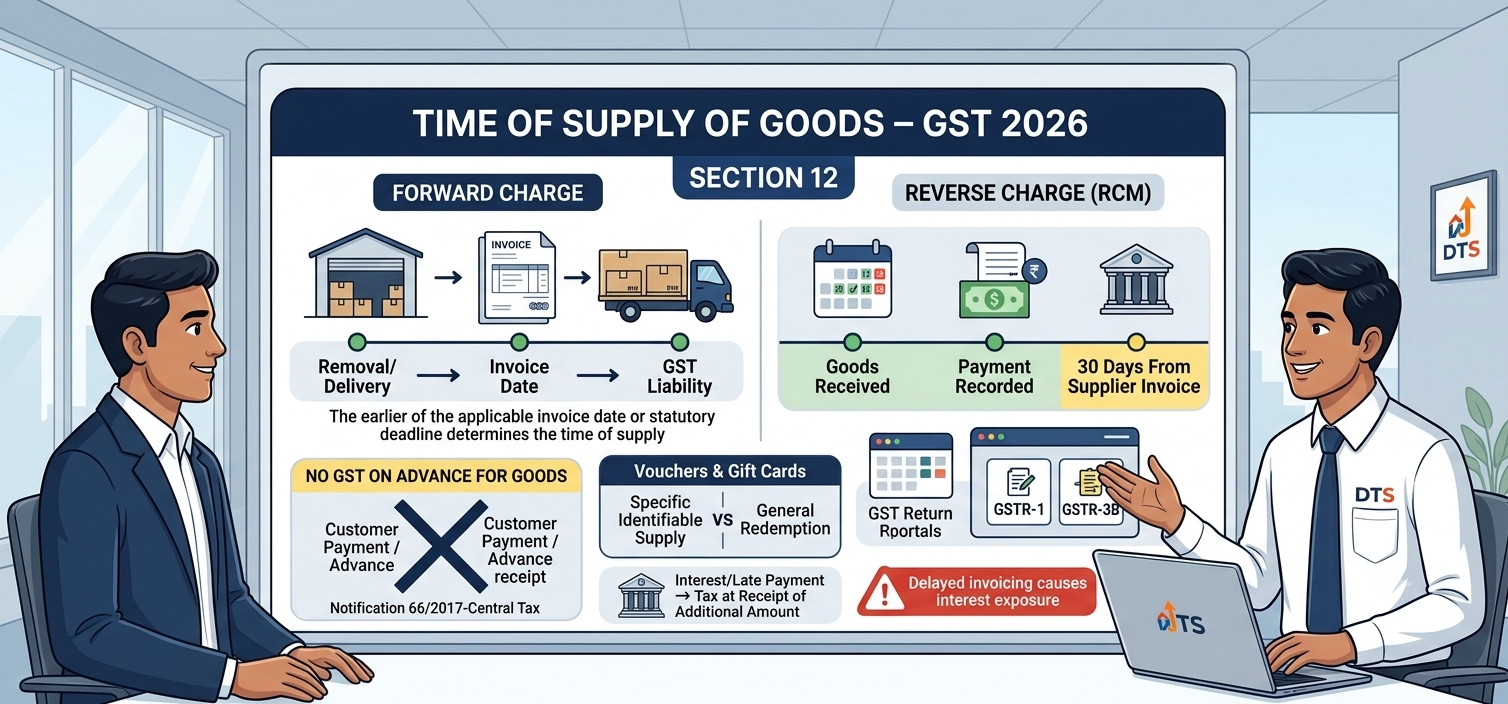
- For goods under forward charge, tax liability is tied strictly to the invoice date.
- Advance payments for goods are exempt from GST under Notification No. 66/2017-Central Tax.
- Reverse charge time of supply depends on goods receipt, payment entry, or 30 days from invoice.
Knowing when to pay tax is just as critical as knowing how much to pay. Under the Indian Goods and Services Tax framework, calculating your liability depends on identifying the exact point when a commercial transaction legally occurs. This critical timestamp is called the time of supply.
If you record the timestamp too late, you face mandatory interest penalties under GST law. Record it too early, and you unnecessarily drain your working capital. While services follow distinct payment-tracking rules, goods operate under an entirely separate statutory mechanism governed by Section 12 of the CGST Act.
This guide explains the exact statutory provisions for determining the time of supply of goods. We will cover forward charge rules, advance payment exemptions, reverse charge deadlines, and real-world compliance advice straight from our practice.
What is Time of Supply of Goods Under GST?
The time of supply of goods defines the exact statutory point when tax liability arises under Section 12 of the CGST Act. It dictates the tax period in which a transaction must be reported in GSTR-1 and paid via GSTR-3B. For goods under forward charge, liability occurs on the actual date of invoice issuance or the legal deadline for issuing the invoice under Section 31, whichever is earlier.
Time of Supply Under Forward Charge (Section 12(2))
Under Section 12(2) of the CGST Act, standard commercial sales follow the forward charge mechanism, where the seller charges tax directly on the tax invoice and remits it to the government.
Date of Invoice vs Payment Receipt: The Advance Exemption
In the original GST framework of 2017, taxpayers had to pay tax on whichever occurred first: the invoice date or the date payment was received. This created accounting challenges for businesses taking advances for custom manufacturing.
To resolve this friction, the Ministry of Finance issued Notification No. 66/2017-Central Tax. This notification exempted all registered suppliers of goods (excluding composition dealers) from paying tax on advance payments. Today, when evaluating the date of invoice vs payment receipt for goods, the payment date is completely disregarded. Tax becomes payable solely based on the invoice date.
Mandatory Invoice Timeframe Under Section 31
You cannot delay tax liability simply by delaying your invoice. Section 12(2) specifically ties the time of supply to the mandatory invoice deadline prescribed under Section 31.
For goods requiring movement, the invoice must be issued on or before the removal of goods. For goods that do not require movement, it must be issued on or before delivery to the recipient. If a seller removes goods on October 10 but issues the invoice on October 20, the legal time of supply remains October 10.
If your enterprise handles multi-state operations or requires new branch setups, securing timely GST registration online ensures you maintain full compliance with invoice generation rules across all locations.
Time of Supply Under Reverse Charge Mechanism (Section 12(3))
Under the Reverse Charge Mechanism (RCM), the recipient of goods becomes directly liable to pay GST to the government instead of the seller. This commonly applies to specified agricultural purchases or transactions with unregistered suppliers.
30-Day Rule for Goods Received Under RCM
Determining when to pay GST under RCM requires evaluating three specific dates. Under Section 12(3), the time of supply reverse charge goods is the earliest of the following three dates:
- The date on which the goods are physically received by the recipient.
- The date on which the payment is recorded in the buyer’s books of account or debited from their bank account, whichever is earlier.
- The date immediately following 30 days from the date of issue of invoice by the supplier.
If it is impossible to determine liability using these three rules, the time of supply defaults to the date the transaction is entered in the recipient’s books of account.
Practical Example of RCM Time of Supply
Suppose a private limited firm purchases cashew nuts from an agriculturist under RCM. The supplier issues an invoice on May 1. The goods arrive at the factory on May 12. The firm records payment in its books on June 15.
The 30-day period from the invoice date expires on May 31. Comparing the receipt date (May 12), payment date (June 15), and the 31st day from invoice (June 1), the earliest date is May 12. Therefore, May 12 is the official time of supply, and tax must be paid in the May return cycle.
Proper legal structuring during your initial company registration in India helps ensure your finance team establishes compliant accounting systems right from day one.
Time of Supply for Vouchers, Residuary Cases, and Interest (Section 12(4)-(6))
Not every commercial transaction follows a straightforward purchase order structure. Section 12 provides specific rules for vouchers, unknown timing scenarios, and late payment charges.
How Vouchers and Gift Cards Are Taxed
Under Section 12(4), when a business issues pre-paid vouchers, physical coupons, or digital gift cards redeemable for goods, the tax timing depends on predictability:
- Identifiable Supply: If the specific goods are known at the time of issue (e.g., a voucher redeemable exclusively for a specific brand of shoes), the time of supply is the date the voucher is issued.
- General Supply: If the voucher can be redeemed for any item across a department store, the time of supply is the date the customer actually redeems the voucher.
Residuary Clause and Delayed Payment Interest
When a transaction cannot be placed under forward charge, reverse charge, or voucher provisions, Section 12(5) provides a residuary safety net. If a periodic return must be filed, the deadline date for that return becomes the time of supply. In all other scenarios, it is the actual date on which GST is paid.
Furthermore, suppliers often charge interest, late fees, or penalties for delayed invoice payment. Under Section 12(6), the time of supply for such additional value additions is strictly the date on which the supplier actually receives the extra payment.
Summary Comparison Table: Time of Supply Provisions
To help finance teams quickly audit their transactions, the table below consolidates the statutory rules under Section 12 of the CGST Act across all supply scenarios.
| Supply Type | Primary Provision | Determining Timestamp (Earliest of) |
|---|---|---|
| Forward Charge | Section 12(2) | Actual invoice date OR mandatory invoice deadline under Section 31. |
| Reverse Charge (RCM) | Section 12(3) | Goods receipt date, payment entry/debit date, OR 31st day from invoice date. |
| Vouchers (Specific) | Section 12(4)(a) | Date of voucher issuance. |
| Vouchers (General) | Section 12(4)(b) | Date of voucher redemption. |
| Interest / Late Fee | Section 12(6) | Date the supplier receives the additional amount. |
What Our CA Team Sees in Practice: Common Audit Pitfalls
In our tax advisory practice, we frequently observe businesses making compliance mistakes regarding the time of supply of goods. The most common error stems from confusing the rules for goods with those for services.
Accounts teams often pay GST on advance receipts for goods, misinterpreting the law. While services still attract tax on advance payments, goods do not. Paying tax prematurely creates reconciliation discrepancies between GSTR-1, GSTR-3B, and your financial ledgers.
Another frequent audit trigger involves continuous supply contracts or goods sent on approval. Under Section 31(7), when goods are sent on approval, the invoice must be issued at the time of supply or 6 months from the date of removal, whichever is earlier. Failing to issue an invoice at the 6-month mark leads to immediate interest notices from the tax department.
In a Nutshell
For goods, ignore advance payment dates and focus strictly on invoice removal dates under Section 31. For RCM goods, monitor the 30-day invoice window carefully on the official GST Portal.
Conclusion
Mastering the time of supply of goods under Section 12 is essential for maintaining smooth tax operations and avoiding non-compliance penalties. Remember that forward charge supplies depend on invoice timelines, advance receipts for goods remain tax-exempt, and reverse charge purchases require tracking goods receipt and 30-day windows.
Proper compliance protects your cash flow and ensures seamless input tax credit flows for your customers. Do not let tax uncertainties slow down your business growth. Speak with a Delhi Tax Solutions expert today to review your invoicing workflows and tax filing accuracy.
You can discover additional business tax strategies across our tax and finance blogs. Taking a proactive approach to tax compliance ensures long-term operational success.
About this article: Researched using official government sources, real-time competitor and search-trend analysis, and Delhi Tax Solutions’ in-house tax advisory team. Last updated September 2026.
Disclaimer: This article is for general informational purposes and is not a substitute for personalised professional tax advice.
Frequently Asked Questions (FAQs)
Q: What is the time of supply of goods under GST?
A: The time of supply of goods under Section 12 of the CGST Act is the exact point in time when tax liability arises. Under normal forward charge transactions, it is the date when the tax invoice is actually issued by the supplier or the last date by which the invoice is legally required to be issued under Section 31, whichever is earlier.
Q: Do I have to pay GST on advance payments received for goods?
A: No, registered businesses do not need to pay GST on advance payments received for the supply of goods. Notification No. 66/2017-Central Tax exempted suppliers of goods from paying tax on advances. Tax liability arises only when the tax invoice is issued or required to be issued upon removal or delivery of goods.
Q: How is the time of supply calculated for reverse charge on goods?
A: Under the Reverse Charge Mechanism (RCM) for goods, the time of supply is the earliest of three specific dates: the date of physical receipt of goods, the date payment is recorded in your books or debited from your bank, or the date immediately following 30 days from the invoice date issued by the supplier.
Q: What is the deadline for issuing a GST invoice for goods?
A: Under Section 31 of the CGST Act, if the supply involves movement of goods, the invoice must be issued on or before the time of removal of goods for supply to the recipient. If the supply does not involve movement, the invoice must be issued on or before the date of delivery or making goods available to the recipient.
Q: What is the time of supply when vouchers or gift cards are issued?
A: Under Section 12(4), if the supply of goods is identifiable at the time the voucher is issued (such as a coupon redeemable only for a specific product), the time of supply is the voucher issue date. If the supply is not identifiable at issuance, the time of supply is the actual redemption date.
