
? Key Takeaways
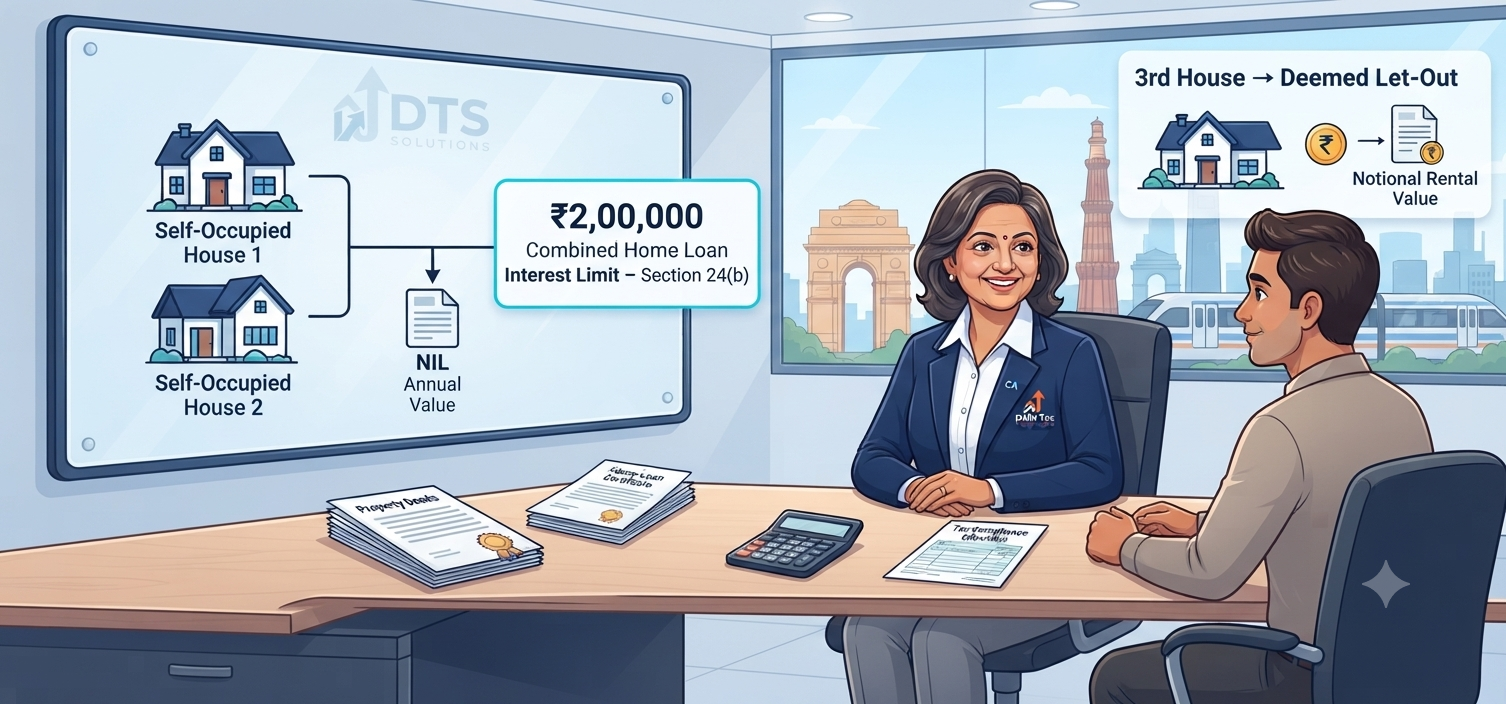
- Indian tax laws permit taxpayers to claim up to two residential properties as self-occupied with a NIL annual value.
- Owning three or more residential properties automatically triggers deemed let-out tax rules on additional houses.
- Combined home loan interest deductions across all self-occupied properties are capped at ?2,00,000 per financial year.
- Municipal taxes paid on self-occupied properties cannot be claimed as a deduction under current tax provisions.
- Accurate ITR reporting requires aligning property ownership deeds with housing loan certificates and bank statements.
Acquiring multiple residential properties represents a major milestone for growing families and real estate investors across India. However, managing direct tax compliance on multiple real estate assets requires navigating intricate statutory provisions under the Income-tax Act. Understanding the tax on owning two self occupied houses is essential for property owners seeking to optimize their tax liabilities legally. While historical tax statutes restricted self-occupation benefits to a single home, current regulations offer valuable exemptions for secondary residences, provided specific legal conditions are fulfilled.
Navigating these property holding structures requires reconciling personal housing usage with statutory tax guidelines. Official frameworks published by the Income Tax Department outline how residential properties must be classified for annual tax assessments. Taxpayers managing real estate portfolios across Delhi NCR must balance these property calculations alongside routine Income Tax filings, Company Registration formalities, and TDS obligations on property transactions.
This authoritative advisory guide breaks down statutory valuation rules, second house property tax rules, deemed let out property classifications, and home loan interest caps for multiple residential holdings.
What are the tax implications of owning multiple self-occupied properties?
Under Section 23(4) of the Income-tax Act, individual taxpayers and Hindu Undivided Families (HUFs) can claim up to two residential properties for personal occupation with a NIL annual value. According to policy advisories issued by the Press Information Bureau, this legislative provision protects homeowners from paying notional rental tax on secondary homes kept for family use. However, if an individual owns three or more residential properties, only two can be designated as self-occupied at the taxpayer’s option, while any remaining properties are automatically treated as deemed let-out assets.
How do second house property tax rules operate under Section 23?
Applying second house property tax rules involves understanding how the Income Tax Act evaluates annual rental potential. Regulatory frameworks monitored by the Ministry of Corporate Affairs establish that while the first and second homes benefit from a NIL annual value exemption, any additional property beyond two units is assessed on its notional fair market rent. This notional rent is computed based on municipal valuation or standard rent, even if the property remains completely vacant throughout the year.
Flexibility in property selection
Taxpayers have the legal right to choose which two specific properties they wish to designate as self-occupied to minimize their overall tax burden.
Exclusion of commercial assets
The NIL annual value exemption applies strictly to residential buildings and appurtenant land; commercial properties or land parcels do not qualify for self-occupation benefits.
What constitutes a deemed let out property under tax law?
Managing a deemed let out property portfolio requires recognizing when unrented real estate triggers tax liabilities. Regulatory circulars monitored by the Reserve Bank of India and tax authorities specify that if a taxpayer owns three residential houses and designates two as self-occupied, the third house is legally deemed to be let out. Consequently, a notional Gross Annual Value (GAV) is assigned to that third property, from which actual municipal taxes paid and a 30 percent standard deduction can be subtracted.
Notional rental income assessment
Tax authorities calculate income on deemed let-out assets using expected market rent, meaning property owners owe tax on projected earnings despite receiving zero cash flow.
Deduction eligibility
Unlike true self-occupied homes, deemed let-out properties qualify for the standard 30 percent repair deduction and full deductions on actual home loan interest without statutory ceilings.
| Property Classification | Annual Value Determination | Standard Deduction (30%) | Home Loan Interest Limit (Sec 24b) |
|---|---|---|---|
| First Self-Occupied House | NIL Annual Value (Sec 23(2)) | Not Applicable | Capped at ?2,00,000 combined |
| Second Self-Occupied House | NIL Annual Value (Sec 23(4)) | Not Applicable | Shared under ?2,00,000 ceiling |
| Third Property & Onwards | Deemed Let-Out (Notional Market Rent) | Fully Eligible on NAV | Fully Allowed (No upper cap) |
| Rented Out Property | Actual Rent or Expected Rent (Higher) | Fully Eligible on NAV | Fully Allowed (No upper cap) |
? Quick Summary
Up to two houses enjoy NIL valuation, but owning three or more properties subjects extra units to deemed let-out notional taxation.
How does the two self-occupied properties exemption function in practice?
Executing the two self-occupied properties exemption requires careful documentation of property ownership, utility bills, and residential status. Based on cases handled by our CA team at Delhi Tax Solutions, taxpayers frequently fail to claim exemptions correctly because they neglect to update property designations across their annual income tax returns. Co-owned properties further complicate calculations, requiring proportionate sharing of exemptions and loan deductions among co-borrowers in line with their ownership stakes.
Annual designation flexibility
Taxpayers can alter which properties they designate as self-occupied across different financial years based on mortgage status and rental yields.
Vacant rural or urban homes
Properties that remain vacant due to employment relocation or business commitments in other cities also qualify for self-occupation benefits under specific statutory conditions.
What are the rules regarding home loan interest on two houses?
Maximizing tax efficiency involves analyzing home loan interest on two houses under Section 24(b) of the Income-tax Act. While let-out and deemed let-out properties permit unlimited deductions on home loan interest, self-occupied properties face a strict aggregate ceiling of ?2,00,000 per financial year across all self-occupied units combined. Taxpayers holding mortgages on two self-occupied homes must distribute this ?2,00,000 limit between both properties without exceeding the statutory cap. Furthermore, construction must conclude within five years from the end of the financial year in which the loan was borrowed to qualify for the full ?2,00,000 threshold. Additional property investments also require proper GST Registration evaluations if commercial spaces or mixed-use developments are involved.
Aggregate mortgage cap
The ?2,00,000 interest deduction limit applies to the taxpayer as an individual, not per property, when dealing with self-occupied housing.
Strict timeline compliance
Failing to complete construction within the mandated five-year window reduces the self-occupied home loan interest deduction from ?2,00,000 down to ?30,000.
Talk to a Delhi Tax Solutions expert to get your multi-property tax computations and ITR filings managed seamlessly today.
About this article: Researched using official government sources and Delhi Tax Solutions’ in-house tax advisory team. Last updated August 2026.
This article is for general informational purposes and is not a substitute for personalised professional tax advice.
Frequently Asked Questions (FAQs)
Q: How is tax calculated when owning two self-occupied houses in India?
A: When an individual owns two residential houses used for personal occupation, both properties are granted a NIL annual value under Section 23 of the Income-tax Act, meaning zero notional rental income is charged to tax. However, the taxpayer can claim a maximum combined home loan interest deduction of up to ?2,00,000 across both self-occupied properties under Section 24(b), subject to strict construction completion timelines.
Q: What happens to additional properties if a taxpayer owns more than two houses?
A: If a taxpayer owns three or more residential properties, only two properties can be specified as self-occupied at the owner’s discretion. Any remaining residential properties are automatically classified as deemed let-out properties. Tax authorities assess notional market rent on these additional homes and charge tax on that expected rental value even if the properties remain vacant throughout the financial year.
Q: How does the home loan interest deduction under Section 24(b) apply to multiple properties?
A: For self-occupied properties, the total home loan interest deduction is strictly capped at an aggregate ceiling of ?2,00,000 per financial year, which must be shared across both self-occupied homes. Conversely, for third properties classified as deemed let-out or actual let-out properties, the actual interest paid on borrowed capital is fully deductible against rental income without any upper monetary limit.
Q: Can municipal taxes be claimed as a deduction on self-occupied properties?
A: Municipal taxes paid to civic bodies on self-occupied properties cannot be claimed as a tax deduction. Under Indian tax provisions, municipal tax deductions are permitted exclusively for let-out and deemed let-out properties where the Net Annual Value is greater than zero. Because self-occupied properties enjoy a statutory NIL annual value, municipal tax deductions do not apply.
Q: How do taxpayers report multiple house properties when filing annual ITR returns?
A: Taxpayers owning multiple residential properties must report each property separately under the “Income from House Property” schedule when filing ITR-2 or ITR-3 forms. Taxpayers must explicitly designate up to two properties as self-occupied and report details for any additional deemed let-out properties, including municipal valuations, ownership shares, co-borrower PAN numbers, and home loan interest certificates.
