
? Key Takeaways
- Rental income from jointly owned property is taxed in the hands of each co-owner based on their specific ownership share.
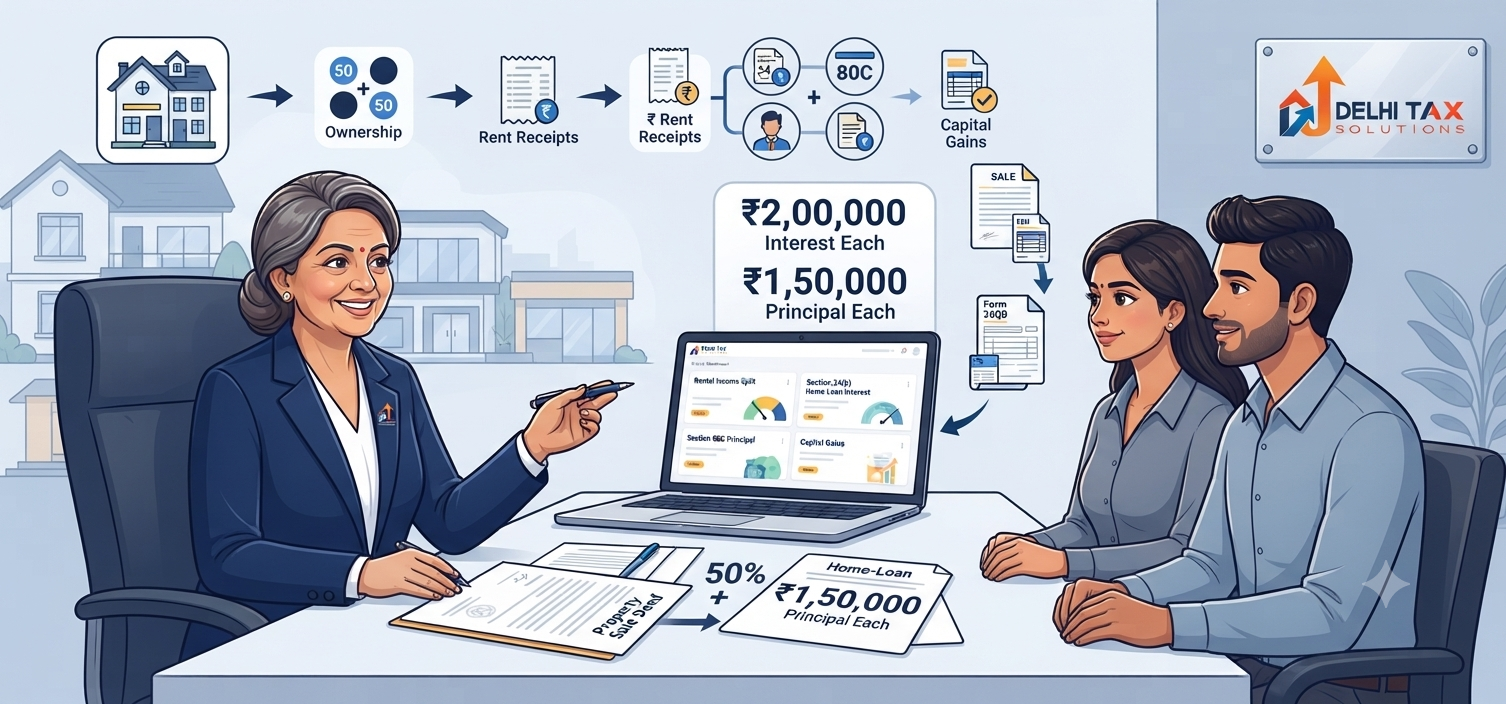
- Co-borrowers can individually claim up to ?2,00,000 for home loan interest under Section 24 and ?1,50,000 for principal under Section 80C.
- Capital gains tax upon selling a joint property is calculated separately for each co-owner according to their registered sale deed share.
- Definite capital gains exemptions under Section 54 can be claimed individually by co-owners if they reinvest proceeds into new residential houses.
- Proper documentation of capital contribution and bank transfers prevents tax scrutiny during income tax assessments.
Purchasing real estate with a spouse, family member, or business partner is a popular investment strategy across India. However, managing direct tax liabilities on jointly owned assets requires strict adherence to statutory rules. Understanding tax on jointly owned property India regulations prevents tax duplication, optimizes deductions, and ensures full transparency during annual tax filings. Under the Income-tax Act, tax authorities evaluate co-ownership through specific legal lenses regarding income splits, loan repayments, and capital appreciation.
Navigating these complex tax structures requires aligning real estate transactions with official government guidelines. Directives published by the Income Tax Department outline how co-owners must report earnings and claim statutory rebates. Taxpayers across Delhi NCR frequently combine property acquisitions with broader Income Tax planning, Corporate Registration structures, and GST Registration requirements for commercial assets.
This authoritative advisory guide breaks down statutory apportionment rules, rental income splits, co-owner capital gains calculations, and home loan deduction limits.
How does tax on jointly owned property India function?
Under Section 22 of the Income-tax Act, income from house property is not taxed under the head of co-ownership as an Association of Persons (AOP) if the individual shares of each co-owner are definite and ascertainable. According to policy updates released by the Press Information Bureau, tax authorities assess rental earnings, interest deductions, and capital gains individually in the hands of each co-owner proportional to their legal share mentioned in the registered sale deed. This prevents unfair tax burdens and allows families to maximize legitimate tax exemptions legally.
How is the joint property rental income split calculated?
Managing a joint property rental income split requires reporting rental receipts strictly in proportion to the ownership percentage held by each co-owner. Regulatory frameworks monitored by the Ministry of Corporate Affairs establish that if two co-owners hold a 50:50 share in a residential property yielding ?6,00,000 annual rent, each person must declare ?3,00,000 under income from house property in their respective ITR forms. Tax evasion through arbitrary income shifting between family brackets is strictly prohibited by tax audit provisions.
Standard deduction benefits
Each co-owner is entitled to claim a flat 30 percent standard deduction on their respective share of net annual value, lowering taxable rental income.
Municipal tax deductions
Property taxes paid during the financial year can be claimed as a deduction by co-owners in proportion to who actually funded the municipal payment.
What are the rules for joint home loan tax benefit claims?
Maximizing a joint home loan tax benefit requires both co-ownership of the property and co-borrowing status on the financial loan agreement. Regulatory circulars monitored by the Reserve Bank of India and income tax rules specify that if both co-owners are co-borrowers and contribute to loan repayments, each individual can claim up to ?2,00,000 for interest under section 24 co-borrower deduction provisions. Furthermore, each co-owner can claim up to ?1,50,000 for principal repayment under Section 80C.
Independent deduction limits
Unlike single-borrower properties capped at ?2,00,000, a co-borrower couple can jointly claim up to ?4,00,000 in home loan interest deductions annually.
Proportional contribution rule
Tax authorities expect interest and principal deductions to mirror actual financial contributions toward loan EMI payments made from individual bank accounts.
| Tax Component | Single Owner Limit (?) | Joint Owner Limit (Two Co-owners, ?) | Governing Provision |
|---|---|---|---|
| Home Loan Interest (Self-Occupied) | ?2,00,000 per annum | ?4,00,000 per annum (?2L each) | Section 24(b) |
| Principal Repayment Deduction | ?1,50,000 per annum | ?3,00,000 per annum (?1.5L each) | Section 80C |
| Standard Deduction on Rent | 30% of Net Annual Value | 30% of Net Annual Value for each co-owner | Section 24(a) |
| TDS on Property Purchase | 1% above ?50,00,000 | 1% above ?50,00,000 (apportioned shares) | Section 194-IA |
? Quick Summary
Co-owners who are co-borrowers can double their tax savings, claiming independent deductions up to ?4 Lakhs for home loan interest and ?3 Lakhs for principal.
How is co-owner capital gains tax determined upon sale?
Calculating co-owner capital gains tax upon selling real estate requires dividing the total sale consideration and acquisition cost according to registered deed ratios. Based on cases handled by our CA team at Delhi Tax Solutions, property sellers frequently miscalculate holding periods when co-owners acquire shares at different dates. Capital gains are classified as Short-Term Capital Gains (STCG) if held for 24 months or less, or Long-Term Capital Gains (LTCG) if held beyond 24 months, with indexation benefits applied where statutory rules permit.
Separate computation sheets
Each co-owner must compute capital gains independently in their tax returns, factoring in their specific cost of acquisition and improvement expenses.
TDS withholding compliance
When buyers deduct 1 percent TDS under TDS regulations upon purchasing joint property, separate Form 26QB filings must be generated for each individual seller corresponding to their exact share.
What are the documentation and compliance steps for co-owners?
Executing proper capital gains exemption co-owners strategies under Section 54 or Section 54EC requires strict documentary evidence and timely reinvestment. To claim exemptions on capital gains, each co-owner must reinvest their respective capital gains share into a new residential property or specified bonds within statutory timeframes. Failing to maintain clear bank transfer trails for down payments and EMIs can trigger tax notices from scrutiny assessment units.
Reinvestment tracking
If capital gains are pooled to buy a new property, the new sale deed should reflect co-ownership proportions matching the capital contribution of each individual.
Audit readiness
Maintaining joint account statements, loan amortization schedules, and stamp duty receipts protects co-owners against retrospective tax adjustments.
Talk to a Delhi Tax Solutions expert to get your joint property tax computations and ITR filings managed accurately today.
About this article: Researched using official government sources and Delhi Tax Solutions’ in-house tax advisory team. Last updated August 2026.
This article is for general informational purposes and is not a substitute for personalised professional tax advice.
Frequently Asked Questions (FAQs)
Q: How is rental income split between co-owners of a property in India?
A: Rental income from a jointly owned property is split and taxed in the hands of each co-owner strictly in proportion to their legal ownership share defined in the registered sale deed. For example, if two co-owners hold equal 50 percent shares, rental earnings, municipal tax deductions, and standard deductions are divided equally and reported in their respective income tax returns under income from house property.
Q: Can co-owners claim separate deductions for home loan interest under Section 24?
A: Yes, co-owners who are also co-borrowers on the home loan can claim separate interest deductions under Section 24 of the Income-tax Act. Each co-borrower is eligible to claim up to ?2,00,000 per financial year for self-occupied properties, allowing a combined deduction of up to ?4,00,000 for a couple, provided loan EMIs are funded from their individual bank accounts.
Q: How is capital gains tax calculated when selling a jointly owned property?
A: Capital gains tax upon selling a joint property is calculated independently for each co-owner. The total sale consideration and cost of acquisition are split according to their ownership ratios. Each individual computes their respective capital gain, applies indexation benefits for long-term holdings exceeding 24 months, and pays tax based on their individual income tax slabs.
Q: Are co-owners individually eligible for Section 80C principal repayment deductions?
A: Yes, co-owners who contribute to the principal repayment of a joint home loan can individually claim deductions under Section 80C up to the statutory limit of ?1,50,000 per financial year. To claim this tax benefit safely during scrutiny, the principal payments must be made from the respective co-borrower’s bank account matching their claimed deduction proportion.
Q: What happens if the financial contribution ratio of co-owners differs from their ownership share?
A: If financial contributions toward home loan EMIs or down payments differ from the registered sale deed ownership shares, income tax authorities generally allow tax deductions and rental income splits based on actual financial contributions rather than deed percentages alone. Maintaining transparent bank transaction records is essential to substantiate these claims during assessments.
