
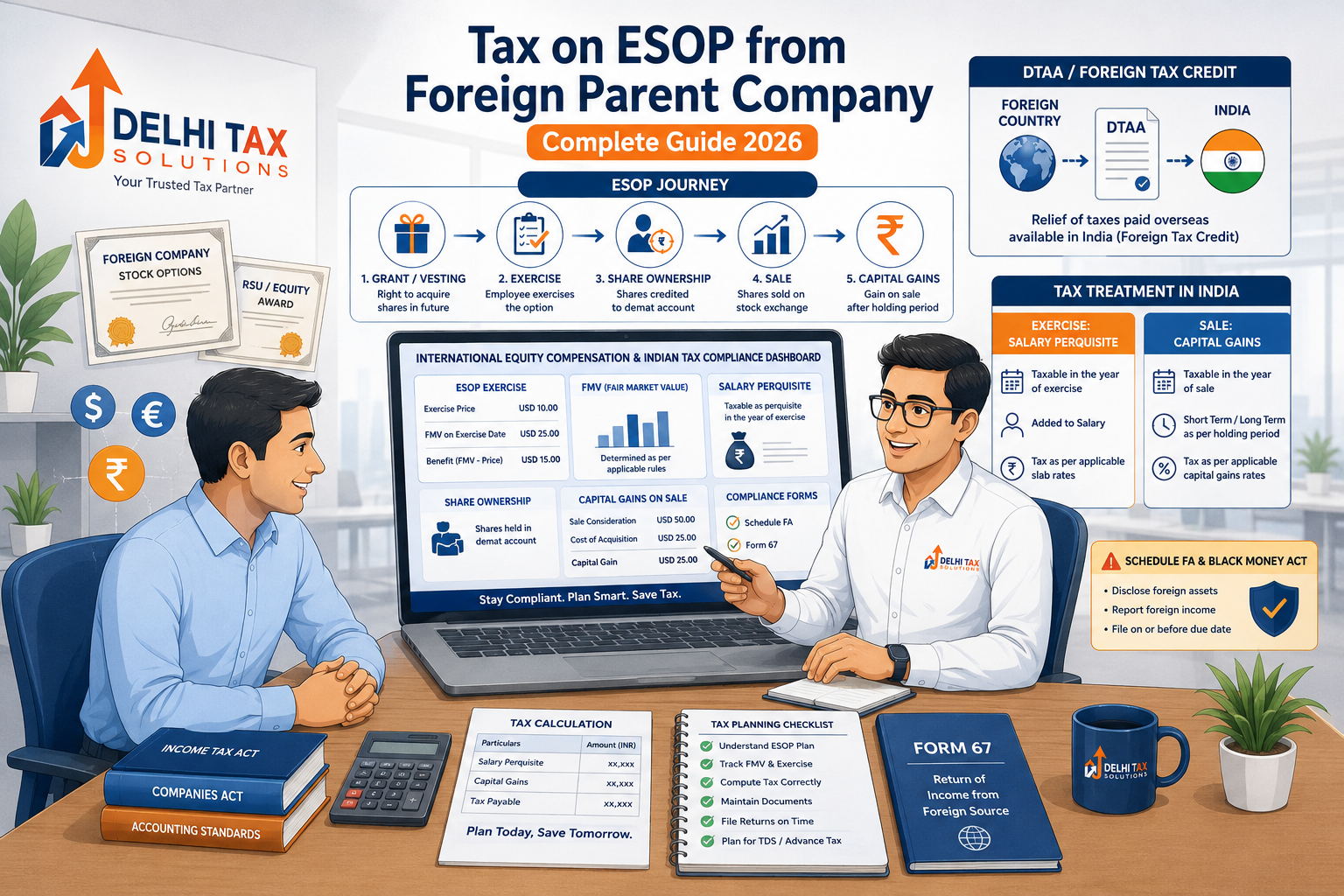
💡 Key Takeaways
- Foreign ESOP perquisite is taxable in India upon exercise at slab rates based on FMV.
- Unvested foreign stock options do not require reporting in Schedule FA until they vest.
- Capital gains arise when selling foreign shares, classified as short-term or long-term.
- DTAA relief helps prevent double taxation if tax was paid abroad.
- Strict non-disclosure penalties apply under the Black Money Act for hidden foreign assets.
Navigating equity compensation across international borders presents unique regulatory hurdles for Indian professionals working in multinational subsidiary companies. When your overseas employer awards equity incentives, understanding the exact tax treatment becomes essential for compliance. Based on cases handled by our CA team at Delhi Tax Solutions, employee stock ownership plans from overseas entities trigger tax obligations at multiple stages, from exercise to ultimate sale.
As per the latest CBDT notification, failing to account for foreign financial assets can result in severe statutory notices. This guide breaks down everything you need to know about compliance, valuation rules, and tax minimization strategies under Indian tax law.
What is the Tax Liability on Foreign ESOPs in India?
Tax on ESOP from foreign parent company occurs at two distinct events: exercise and sale. When an employee exercises stock options granted by an overseas parent entity, the difference between the fair market value (FMV) on the exercise date and the exercise price is treated as a perquisite. This perquisite value is added to your salary income and taxed according to your applicable income tax slab rates.
Subsequently, when you sell those shares, capital gains tax applies. If the foreign shares are held for specified holding periods, long-term capital gains (LTCG) or short-term capital gains (STCG) rules take effect. Proper documentation ensures you remain fully compliant with Indian exchange control regulations governed by the Reserve Bank of India.
How is Foreign ESOP Perquisite Tax Calculated?
Calculating the taxable perquisite value requires determining the exact Fair Market Value (FMV) of the foreign stock on the date of exercise. Registered merchant bankers or official stock exchange quotations on the exercise date provide the benchmark FMV. For accurate reporting, this rupee equivalent is calculated using the telegraphic transfer buying rate specified by the Income Tax Department on the date of exercise.
Foreign ESOP perquisite tax India demands careful tracking because employers based overseas may not deduct Indian TDS at the time of exercise. Consequently, employees must compute this value independently and factor it into their advance tax calculations to avoid penal interest under Sections 234B and 234C. Professional guidance from Delhi Tax Solutions ensures your salary computations accurately reflect these international perquisites.
⚡ Compliance Alert
Overseas employers rarely deduct Indian TDS upon option exercise. Employees must proactively calculate and deposit advance tax to avoid penal interest under Sections 234B and 234C.
Mandatory Reporting Requirements in Schedule FA
Resident Indians holding foreign stock options or shares must disclose them meticulously in Schedule FA of their income tax return. Foreign shares reporting Schedule FA is compulsory for all residents, even if the shares are held in overseas brokerage accounts. However, unvested options are generally exempt from Schedule FA disclosure since beneficial interest has not yet transferred to the employee.
Non-compliance carries steep penalties under anti-black money legislation. To streamline your corporate filings, explore our corporate compliance offerings via Delhi Tax Solutions. Accurate disclosure prevents scrutiny notices and aligns your global wealth footprint with domestic disclosures.
Capital Gains and DTAA Relief on Foreign Stock Sales
When selling shares acquired via foreign stock plans, capital gains arise. If sold within 24 months for unlisted foreign shares, STCG applies at applicable slab rates. For listed foreign securities, holding thresholds determine asset classification. ESOP double taxation NRI employee scenarios often occur when foreign countries levy tax at sale. Double Taxation Avoidance Agreement (DTAA) provisions allow taxpayers to claim foreign tax credit (FTC) by filing Form 67.
Official policy updates published by the Press Information Bureau frequently clarify cross-border tax treaties. Ensuring proper documentation through our licensing and advisory channels safeguards your international investments against double taxation.
Tax Stage Comparison: Exercise vs. Sale of Foreign ESOPs
| Tax Stage | Tax Head | Valuation / Basis | Applicable Rate |
|---|---|---|---|
| Exercise Event | Income from Salary (Perquisite) | FMV minus Exercise Price | Individual Slab Rates (up to 30%+) |
| Sale Event | Capital Gains | Sale Price minus FMV at Exercise | STCG or LTCG based on holding period |
Avoiding Penalties and Managing Compliance Smoothly
Managing cross-border equity requires vigilance regarding regulatory thresholds and statutory timelines. The Ministry of Corporate Affairs and tax authorities coordinate closely to track foreign remittances and share allotments. Maintaining clean records of all Form 12BB declarations, brokerage statements, and foreign bank transfers protects taxpayers during audits.
For individuals establishing international ventures or structuring stock incentive plans, our expert consultancy at Delhi Tax Solutions provides robust compliance frameworks. Review our extensive resources on our main blog index for regular updates on Indian tax reforms.
About this article: Researched using official government sources and Delhi Tax Solutions’ in-house tax advisory team. Last updated August 2026.
Frequently Asked Questions (FAQs)
Q: How is the perquisite value calculated when exercising stock options from a foreign parent company?
A: The perquisite value is calculated as the difference between the fair market value (FMV) of the shares on the exact date of exercise and the price paid by the employee. This valuation must be converted into Indian Rupees using the Reserve Bank of India reference rate on the date of exercise. As per Income Tax Department guidelines, this amount is treated as taxable salary income and must be reported under salary perquisites in your ITR.
Q: Is it mandatory to report foreign ESOPs and RSUs in Schedule FA of ITR-2 if they are unvested?
A: Under current Indian tax compliance rules, unvested stock options or RSUs generally do not need to be reported in Schedule FA because the taxpayer does not hold legal or beneficial interest in the underlying foreign asset yet. Reporting becomes strictly mandatory only after the options vest and are exercised, establishing formal ownership of foreign financial accounts or shares during the relevant financial year.
Q: How can I avoid double taxation when selling shares of a foreign parent company in India?
A: Double taxation can be mitigated by claiming Foreign Tax Credit (FTC) under the relevant Double Taxation Avoidance Agreement (DTAA) signed between India and the foreign jurisdiction where tax was withheld or paid. Taxpayers must file Form 67 electronically on the income tax portal prior to filing their ITR, detailing the foreign income and taxes paid abroad to claim appropriate relief.
Q: What are the tax implications under Indian law when a foreign parent company takes over or merges?
A: Corporate mergers involving a foreign parent company often result in the rollover or substitution of stock options. Under specific provisions, if the conversion happens as part of an approved global corporate restructuring without direct cash payout, immediate capital gains taxation may be deferred until the eventual sale of the newly allotted shares. Expert CA consultation is recommended to verify specific notification exemptions.
Q: What are the heavy penalties for failing to disclose foreign assets like ESOPs in an Indian income tax return?
A: Failing to disclose foreign financial assets and shares in Schedule FA attracts severe statutory penalties under the Black Money (Undisclosed Foreign Income and Assets) and Imposition of Tax Act. A flat penalty of ₹10 lakh can be levied independently of regular income tax assessments for non-disclosure, making accurate reporting imperative for all resident taxpayers holding overseas equity.
