
? Key Takeaways
- Forfeited advance money in real estate deals is taxed under Income from Other Sources.
- Section 56(2)(ix) governs the statutory tax treatment of retained earnest money and token deposits.
- Prior to the 2014 statutory amendment, such forfeited amounts reduced the property cost of acquisition.
- Sellers must declare retained sums in their annual ITR filings to avoid scrutiny notices.
- Failed property transactions require careful bookkeeping to distinguish capital receipts from taxable revenue sums.
Real estate negotiations across India frequently collapse before final registration due to financing hurdles or title disputes. When a prospective buyer defaults and the seller retains the initial token deposit, complex tax liabilities arise. Understanding tax on advance money forfeited property sale regulations is essential for property owners. Taxpayers across Delhi NCR frequently integrate real estate dispute reviews with professional Income Tax filing, comprehensive Property Tax audits, corporate Company Registration structures, and statutory TDS compliance.
Official compliance rules published by the Income Tax Department outline exact classification standards. Policy circulars issued by the Press Information Bureau clarify how legislative amendments altered historical tax treatment. This technical guide examines statutory sections, head-of-income shifts, and compliance workflows for sellers.
What is the statutory tax treatment of forfeited advance money?
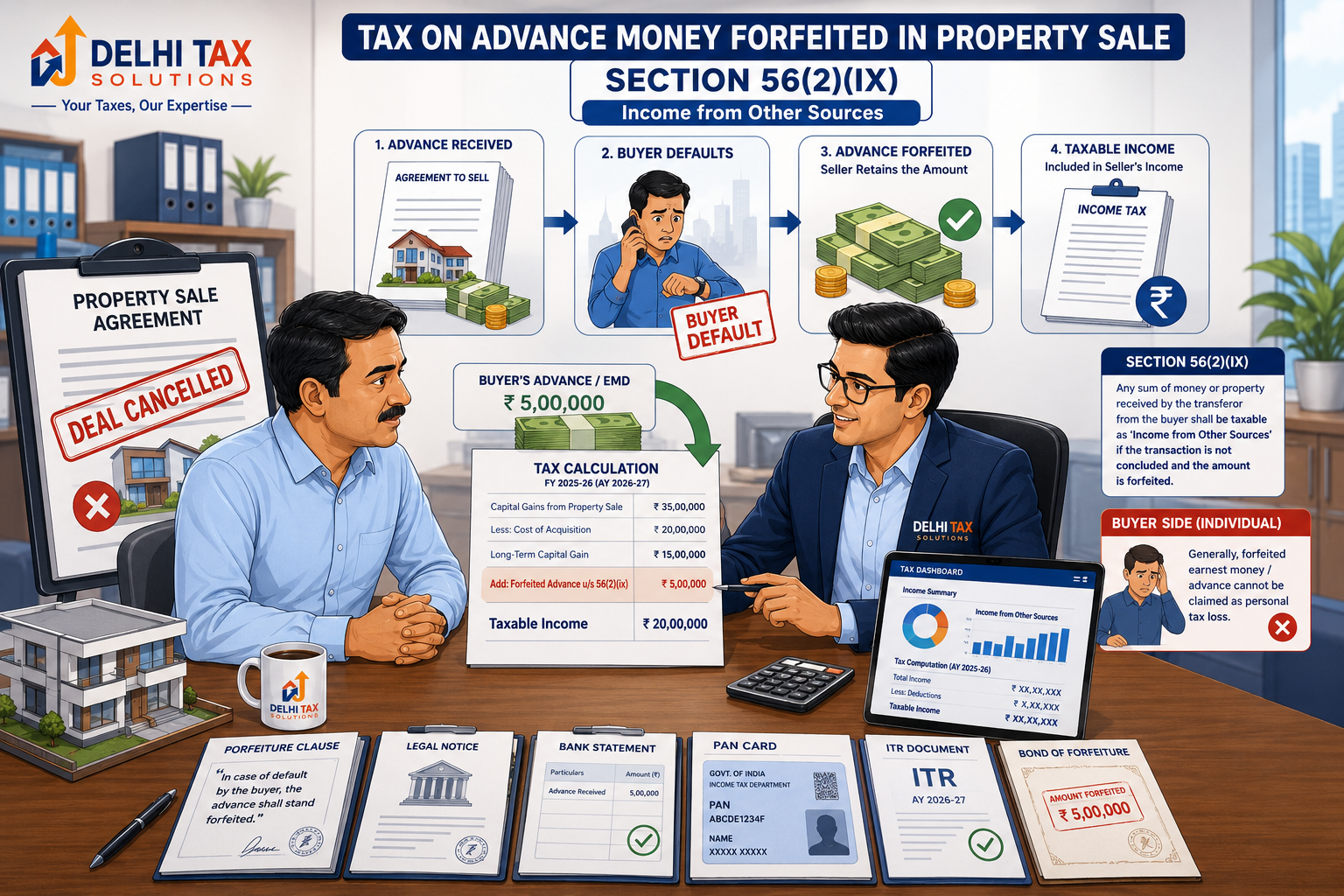
The tax on advance money forfeited property sale is categorized as taxable revenue under Section 56(2)(ix) of the Income-tax Act. When a real estate transaction falls through because the buyer defaults on agreement terms and the seller legally retains any advance sum or earnest money, that retained amount is treated as income under the head “Income from Other Sources.” According to regulatory frameworks overseen by the Ministry of Corporate Affairs, this legislative provision ensures that windfall gains from broken contracts are subject to regular slab-rate taxation rather than escaping tax net entirely.
How does Section 56(2)(ix) apply to forfeited advance income tax?
Analyzing forfeited advance income tax requires examining how historical tax laws evolved prior to 2014. Before the Finance Act of 2014 introduced specific provisions, sellers adjusted retained earnest money against the cost of acquisition when calculating eventual capital gains. Based on cases handled by our CA team at Delhi Tax Solutions, this old practice allowed sellers to defer or reduce capital gains tax only when the property sold years later. The legislature closed this loophole, making retained advances immediately taxable in the financial year forfeiture occurs.
Legislative amendment background
The introduction of Section 56(2)(ix) shifted forfeited capital advances from capital gains adjustments to immediate revenue taxation.
Immediate financial year taxability
Sellers must include retained token money in their taxable income computation for the exact financial year the deal officially collapses.
Slab-rate income taxation
The forfeited amount is added to the seller’s total annual income and taxed according to their applicable income tax slab rates.
What is the advance money property tax section mechanism?
The core legislative mechanism governing the advance money property tax section targets any sum of money received under an agreement for the transfer of a capital asset that is subsequently retained. Financial guidelines monitored by the Reserve Bank of India confirm that advance sums received and forfeited on or after April 1, 2014, fall squarely under Section 56(2)(ix). Sellers cannot claim that these sums represent non-taxable capital receipts once breach of contract conditions are legally established.
Capital asset transfer scope
The provision applies to agreements involving land, buildings, shares, and other specified capital assets under Indian tax statutes.
Contractual breach conditions
The tax liability triggers strictly when the agreement fails due to buyer default and the seller exercises legal forfeiture rights.
Exclusion of refunded advances
If advance money is voluntarily refunded to the prospective buyer upon deal cancellation, no tax liability arises for the seller.
How is failed property deal tax treatment evaluated during audits?
Executing proper failed property deal tax treatment requires maintaining robust documentation, including signed agreement-to-sell deeds, legal forfeiture notices, and bank statements. Tax audit teams frequently scrutinize large cash or bank inflows that remain unexplained after a property sale fails. If a seller fails to disclose retained earnest money, tax authorities can levy penalties for underreporting income during automated e-assessments.
Agreement documentation trail
Preserving original agreement-to-sell clauses outlining forfeiture terms proves legal entitlement to retain earnest deposits.
Bank statement reconciliation
Matching incoming advance deposits with corresponding ledger accounts prevents automated mismatch flags during annual ITR processing.
| Transaction Stage | Pre-2014 Tax Treatment | Current Tax Treatment (Post-2014) | Applicable Head of Income |
|---|---|---|---|
| Advance Money Received | Capital receipt (Not taxable) | Capital receipt (Not taxable) | Not Applicable |
| Advance Money Refunded | No tax impact | No tax impact | Not Applicable |
| Advance Money Forfeited | Reduced cost of acquisition | Fully taxable upon forfeiture | Income from Other Sources |
| Subsequent Property Sale | Higher capital gains tax | Normal capital gains tax | Capital Gains |
? Quick Summary
Advance money forfeited during a failed property transaction is strictly taxed as “Income from Other Sources” under Section 56(2)(ix) in the year of forfeiture.
What are the compliance rules under Section 56 2 ix advance forfeited income tax?
Compliance with Section 56 2 ix advance forfeited income tax mandates transparent reporting in ITR forms. Taxpayers must report retained earnest money under the specific schedule for income from other sources rather than mixing it with business receipts or capital gains. Failing to classify these sums correctly can trigger scrutiny notices from central tax processing units. Engaging qualified Chartered Accountants ensures full statutory compliance.
ITR schedule reporting
Forfeited sums must be declared accurately in the designated schedule of the income tax return to prevent discrepancy alerts.
Professional verification checks
Expert CA review ensures that forfeited deposits are neither double-taxed nor incorrectly deducted from future capital gains calculations.
How do advance earnest money forfeiture tax implications affect buyers?
While sellers face revenue taxation on forfeited sums, navigating advance earnest money forfeiture tax implications from the buyer’s perspective involves different rules. Under Indian tax laws, a prospective buyer who loses an advance due to default cannot claim it as a capital loss or business loss, as personal capital advances do not qualify for loss set-offs unless the buyer is a professional real estate trader whose business involves dealing in property options.
Non-deductibility for individuals
Salaried or individual buyers losing earnest money cannot claim tax deductions or carry forward such losses against other income heads.
Business trader exception
Real estate developers or commercial traders may claim forfeited advances as business expenses if transactions relate directly to commercial stock-in-trade.
Talk to a Delhi Tax Solutions expert to get your property transaction tax filings and advance forfeiture computations managed accurately today.
About this article: Researched using official government sources and Delhi Tax Solutions’ in-house tax advisory team. Last updated August 2026.
This article is for general informational purposes and is not a substitute for personalised professional tax advice.
Frequently Asked Questions (FAQs)
Q: Is advance money forfeited during a property sale taxable in India?
A: Yes, advance money or earnest deposit forfeited during a failed property sale is fully taxable in India. When a prospective buyer defaults on the agreement and the seller legally retains the advance, that retained sum is treated as taxable revenue under Indian tax laws.
Q: Under which section of the Income Tax Act is forfeited advance money taxed?
A: Forfeited advance money received in the context of a capital asset transfer agreement is taxed under Section 56(2)(ix) of the Income-tax Act. Under this provision, the retained amount is classified explicitly under the head “Income from Other Sources” and taxed at applicable slab rates.
Q: How does a failed property deal impact the seller’s tax liability?
A: When a property deal fails and the seller retains the advance, the seller must include that forfeited amount as taxable income in their annual income tax return for that specific financial year. This increases their total taxable income and attracts tax according to their slab rate.
Q: Can the buyer claim a deduction or loss for forfeited advance money?
A: Generally, individual or salaried buyers cannot claim any tax deduction, capital loss, or business loss for forfeited earnest money. Personal capital losses arising from defaulted property purchases are not eligible for set-off or carry-forward under current income tax regulations.
Q: What is the difference between capital gains reduction and income from other sources for earnest money?
A: Prior to April 2014, forfeited earnest money reduced the seller’s cost of acquisition, deferring tax impact until the property was eventually sold. Under current laws introduced by Section 56(2)(ix), forfeited amounts are taxed immediately as current income from other sources in the year the deal fails.
