
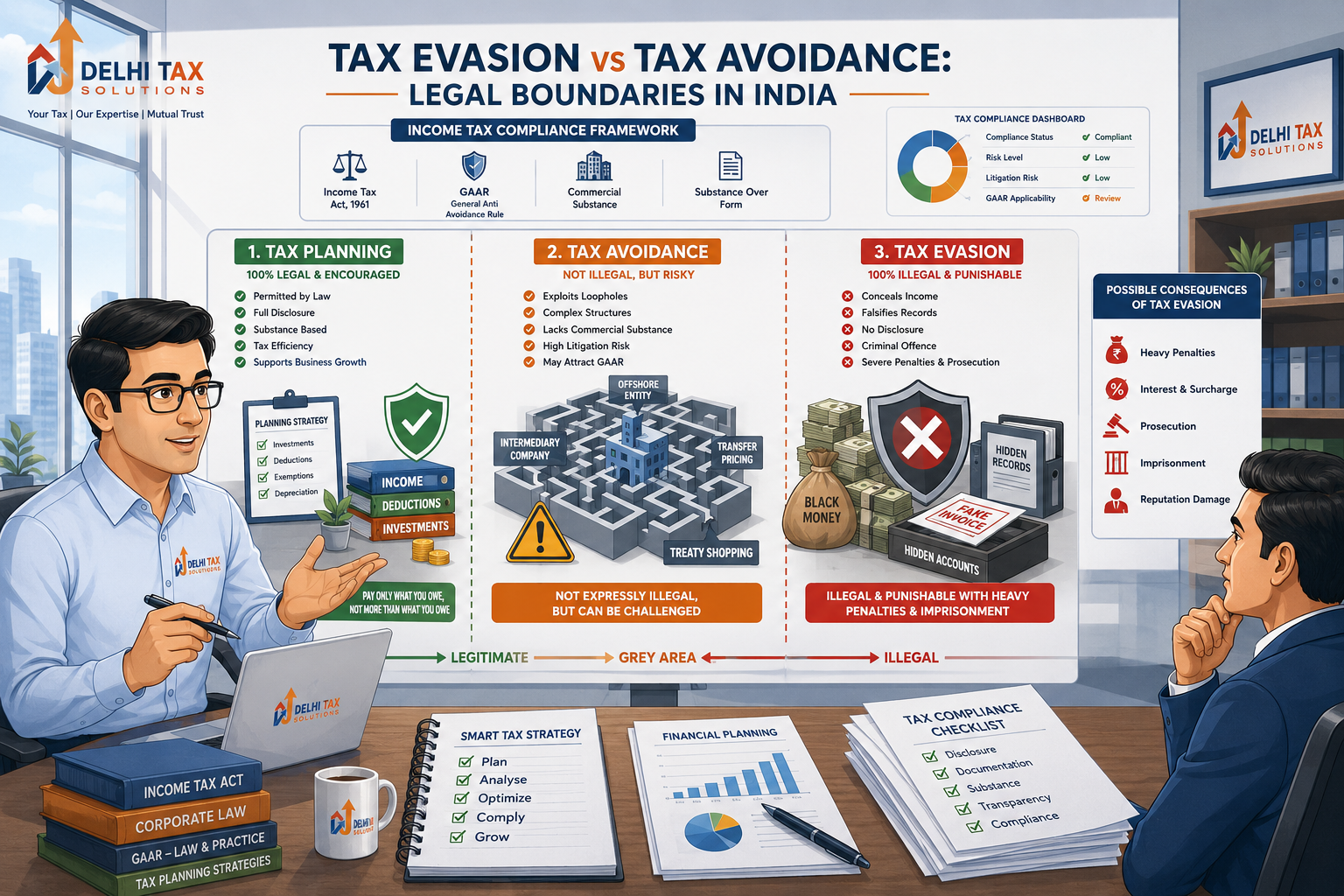
💡 Key Takeaways
- Tax evasion involves illegal practices like concealing income or inflating deductions, punishable by severe penalties and imprisonment.
- Tax avoidance involves exploiting legal loopholes to reduce tax liability; while traditionally acceptable, it is now strictly regulated by GAAR.
- Tax planning is the entirely legal and encouraged practice of utilizing statutory exemptions and deductions to optimize tax burdens.
- The General Anti-Avoidance Rule (GAAR) grants authorities the power to deny tax benefits if an arrangement lacks commercial substance.
- Maintaining absolute transparency in Income Tax Filing prevents lawful tax planning from being misconstrued as evasion.
For taxpayers and corporate entities, minimizing tax liability is a primary financial objective. However, the methods employed to achieve this goal dictate whether one is acting as a prudent citizen or committing a statutory offense. Navigating the legal landscape requires a clear understanding of tax evasion vs tax avoidance India frameworks. The lines between legitimate structuring and illegal concealment can sometimes seem blurred, especially with the introduction of modern anti-abuse regulations. Whether you are finalizing personal tax returns or structuring a new business through Company Registration, understanding these legal boundaries is critical to maintaining a clean compliance record.
Defining the Spectrum: Planning, Avoidance, and Evasion
1. Tax Planning (The Legal Route)
Tax planning is the completely legal and government-encouraged method of minimizing tax liabilities by utilizing the deductions, exemptions, and rebates provided within the Income Tax Act. Examples include investing in Section 80C instruments (PPF, ELSS), claiming health insurance premiums under Section 80D, or properly structuring Property Tax payments to claim capital gains exemptions. It embodies the spirit of the law.
2. Tax Avoidance (The Gray Area)
Tax avoidance historically referred to the practice of legally arranging one’s financial affairs in a way that minimizes tax, often by exploiting loopholes or ambiguities in the law. It does not involve fraud, but it often contradicts the *intent* of the legislators. For instance, creating complex corporate structures purely to route funds without actual commercial activity was considered tax avoidance. Today, this gray area is heavily policed.
3. Tax Evasion (The Illegal Route)
Tax evasion is unequivocally illegal. It involves willful and deliberate acts to hide income, falsify documents, or inflate expenses to reduce tax liability. Failing to report international assets, claiming fake GST Registration input tax credits, or maintaining off-the-books cash transactions constitute tax evasion. It invites severe consequences, including massive penalties and rigorous imprisonment.
⚡ Key Insight
The Supreme Court of India famously noted that while a citizen is free to arrange their affairs to reduce taxes (planning), colorable devices and sham transactions (evasion/aggressive avoidance) cannot be legally sustained.
The Impact of GAAR on Tax Avoidance
What is GAAR?
To curb aggressive tax avoidance, India implemented the General Anti-Avoidance Rule (GAAR). The primary objective of GAAR tax avoidance provisions is to target “Impermissible Avoidance Arrangements” (IAAs). If the Income Tax Department determines that a transaction was entered into primarily to obtain a tax benefit and it lacks commercial substance, GAAR can be invoked.
Commercial Substance Over Form
Under GAAR, the revenue authorities have the power to recharacterize a transaction, disregard corporate structures, or deny tax treaty benefits. For example, if a holding company is set up in a low-tax jurisdiction strictly to avoid taxes in India, without carrying out real business operations, GAAR empowers tax officers to declare the arrangement void for tax purposes. This enforces the principle of “substance over form.”
Consequences of Crossing the Line
Penalties for Tax Evasion
The penalties for deliberate tax evasion are crippling. Under the Income Tax Act, the penalty for under-reporting or misreporting income can range from 50% to 200% of the tax sought to be evaded. Furthermore, willful attempt to evade tax under Section 276C can result in rigorous imprisonment extending from 6 months up to 7 years, along with fines. Flawed TDS Compliance intentionally designed to defer government revenue also attracts severe prosecution.
| Attribute | Tax Planning | Tax Avoidance | Tax Evasion |
|---|---|---|---|
| Legality | 100% Legal & Ethical | Legal but highly restricted by GAAR | 100% Illegal & Criminal |
| Method | Using statutory exemptions and deductions. | Exploiting legal loopholes and ambiguous phrasing. | Concealing income, fraud, and falsifying books. |
| Objective | Aligning with legislative intent to save tax. | Defeating the spirit of the law technically. | Committing deliberate fraud to hide tax liability. |
| Consequences | Tax savings and peace of mind. | Denial of tax benefits if GAAR is invoked. | Heavy penalties, asset seizure, and imprisonment. |
Best Practices and Professional Advisory
Ensuring Robust Compliance
To safely navigate these boundaries, transparency is non-negotiable. Ensure that all business transactions possess genuine commercial substance beyond mere tax considerations. Official communications from the Press Information Bureau continuously emphasize the administration’s reliance on data analytics to detect sham transactions. Regulatory bodies like the Reserve Bank of India and the Ministry of Corporate Affairs also monitor capital flows and beneficial ownership strictly to prevent evasion schemes.
Consulting Chartered Accountants
The complexity of modern tax laws, combined with the stringent application of GAAR, means that DIY tax structuring is highly risky for businesses and high-net-worth individuals. If you are unsure about the difference between tax evasion and avoidance in your specific financial arrangement, professional guidance is crucial. Talk to a Delhi Tax Solutions expert today. Our certified Chartered Accountants will review your financial architecture, ensure your tax planning aligns perfectly with statutory intent, and protect you from aggressive scrutiny.
Understanding the exact legal boundaries in India empowers you to minimize your tax burden confidently and lawfully. Connect with Delhi Tax Solutions to secure expert advisory and build a compliant, tax-efficient financial strategy.
About this article: Researched using official government sources and Delhi Tax Solutions’ in-house tax advisory team. Last updated August 2026.
Frequently Asked Questions (FAQs)
Q: What is the difference between tax evasion and tax avoidance?
A: Tax evasion is the illegal act of hiding income or falsifying documents to reduce tax liability. Tax avoidance is the practice of exploiting legal loopholes to minimize taxes, which, while technically legal, is now heavily restricted by anti-abuse laws like GAAR.
Q: Is tax planning considered legal in India?
A: Yes. Tax planning is entirely legal and encouraged. It involves arranging your financial affairs to utilize statutory deductions, exemptions, and rebates provided by the Income Tax Act in accordance with the legislative intent.
Q: How does the Income Tax Department view tax avoidance under GAAR?
A: Under the General Anti-Avoidance Rule (GAAR), the Income Tax Department can declare any arrangement an “Impermissible Avoidance Arrangement” if its primary purpose is to obtain a tax benefit and it lacks genuine commercial substance, thereby denying the tax benefit.
Q: What are the penalties for tax evasion in India?
A: Tax evasion penalties can include fines ranging from 50% to 200% of the evaded tax amount. Additionally, willful evasion can lead to rigorous imprisonment ranging from 6 months up to 7 years.
Q: Where is the legal line drawn between legitimate tax management and illegal evasion?
A: The line is drawn at transparency and legislative intent. Legitimate tax management uses established legal provisions openly (e.g., claiming 80C deductions). Illegal evasion involves deceit, fraud, concealment, and falsification of financial reality.
