
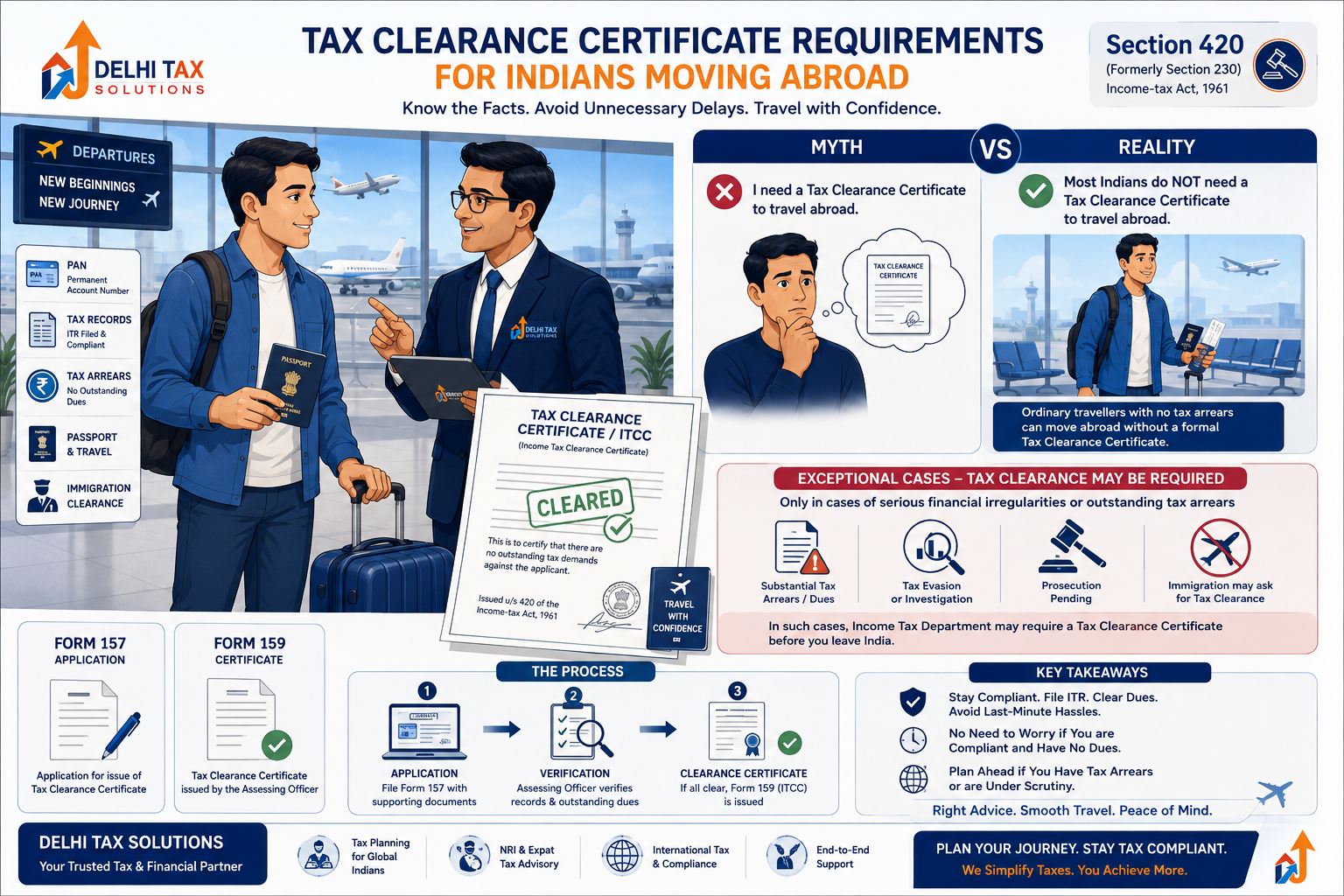
💡 Key Takeaways
- It is a widespread myth that every Indian citizen traveling or relocating overseas requires an Income Tax Clearance Certificate (ITCC).
- Under Section 420 of the new Income-Tax Act, 2025 (which replaced the legacy Section 230 tax clearance certificate rules), clearance is only mandatory in rare, exceptional cases.
- Who needs tax clearance certificate? Only individuals involved in serious financial irregularities, or those with outstanding direct tax arrears exceeding ₹10 Lakhs (including Black Money Act liabilities) that are not stayed by any authority.
- Routine travelers and returning expats generally just need to provide their Permanent Account Number (PAN) and basic travel details, which is a passive disclosure rather than a formal approval process.
- For the minority who do require an NOC income tax before leaving India, applications are now filed via Form No. 157, and the certificate is issued in Form No. 159.
Relocating to a new country involves a mountain of paperwork, from securing long-term visas to managing cross-border financial transfers. However, one of the most common sources of anxiety is the persistent rumor that every departing citizen must obtain tax department approval. If you are researching the requirements for a tax clearance certificate India moving abroad, it is crucial to separate internet myths from statutory reality.
Following the transition to the new Income-Tax Act, 2025, and the introduction of updated procedural rules in 2026, the regulatory framework has shifted. However, the core principle remains unchanged: ordinary taxpayers do not face exit hurdles. Understanding these rules ensures your departure is seamless and compliant without unnecessary bureaucratic delays.
The Myth vs. Reality: Who Needs Tax Clearance Certificate?
The Legacy of Section 230 vs. The New Section 420
For decades, legal and financial professionals referred to this statutory requirement as the Section 230 tax clearance certificate under the old Income-Tax Act, 1961. With the implementation of the Income-Tax Act, 2025, the legislative framework governing departing individuals was migrated to Section 420.
Recently, the notification of new operational forms (Form 157 and Form 159) under the Income-Tax Rules, 2026, sparked widespread confusion. Social media narratives erroneously suggested that every Indian resident moving abroad was now subject to mandatory tax clearance. This is factually incorrect. The shift to the 2025 Act did not expand the scope of the clearance requirement; it merely modernized the administrative forms.
The Exact Statutory Criteria
Clarifications issued by the Press Information Bureau and the Central Board of Direct Taxes (CBDT) explicitly outline who needs tax clearance certificate approvals. An ITCC is required for individuals domiciled in India only if they meet the following exceptional conditions:
- Serious Financial Irregularities: The individual is involved in severe financial misconduct under the Income Tax Act, the Wealth Tax Act, or the Black Money (Undisclosed Foreign Income and Assets) Act, and their presence is deemed necessary for ongoing investigations.
- Significant Tax Arrears: The individual has outstanding direct tax dues exceeding ₹10 Lakhs, and these arrears have not been legally stayed by a tribunal or court.
Furthermore, an Assessing Officer cannot demand an ITCC arbitrarily. They must record the reasons in writing and obtain prior approval from the Principal Chief Commissioner of Income Tax. If you do not fall into these two categories, you do not require a formal NOC income tax before leaving India.
General Disclosure Rules for Most Travelers
If the vast majority of citizens do not need a clearance certificate, what are their obligations? Under Section 420(3) of the new Act (formerly Section 230(1A)), individuals domiciled in India are subject to a basic, passive disclosure requirement. At the time of departure, you are only required to furnish:
- Your Permanent Account Number (PAN).
- The purpose of your visit outside India.
- The estimated period of your stay abroad.
This information is generally captured automatically through immigration checkpoints and standard airline passenger manifests. It is an informational disclosure, not a clearance mechanism. Ensure your basic Income Tax Filing is up to date, and you will face no friction during your departure.
⚡ Expatriate Rule
While Indian citizens rarely need an ITCC, foreign nationals who have come to India for business, profession, or employment and have earned Indian-sourced income must generally obtain a tax clearance certificate before departing the country permanently.
Process to Obtain an NOC Income Tax Before Leaving India
If you are an expatriate returning to your home country, or an Indian resident who falls into the restricted categories mentioned above, you must undergo the formal clearance process. Under the 2026 rules, the procedure is as follows:
| Step | Action Required | Relevant Form |
|---|---|---|
| 1. Application | The departing individual (or their employer) submits an application to the jurisdictional tax authority, declaring that all tax liabilities have been met or that arrangements have been made to pay them. | Form No. 157 (Replaced legacy Form 30A) |
| 2. Undertaking | Often, a corporate employer provides an undertaking guaranteeing the payment of any pending taxes on behalf of the departing employee. | Employer Guarantee |
| 3. Issuance | Upon verification of tax records and pending demands, the Income Tax Officer issues the official clearance certificate, permitting the individual to leave the territory of India. | Form No. 159 (Replaced legacy Form 30B) |
Failure to obtain this certificate when legally mandated can result in the carrier (airline or shipping company) being held liable for the individual’s unpaid tax arrears.
Broader Financial Considerations for NRIs
While the tax clearance certificate India moving abroad requirement is minimal for most, becoming a Non-Resident Indian (NRI) triggers other substantial regulatory shifts.
If you are leaving behind domestic assets, rental properties, or investments, you must ensure strict TDS Compliance as an NRI, because withholding tax rates on property sales and interest income are significantly higher. If you operate an Indian business or consultancy remotely, you must assess whether your physical absence impacts your Company Registration status, domestic GST Registration, or directorships governed by the Ministry of Corporate Affairs. Finally, converting your domestic savings accounts to NRO/NRE accounts and remitting funds abroad must be executed under the Foreign Exchange Management Act (FEMA) guidelines established by the Reserve Bank of India.
Consulting Chartered Accountants
Navigating the transition from Resident to Non-Resident status is complex. Whether you need clarification on official notices from the Income Tax Department, require an employer undertaking drafted for an expatriate worker, or need assistance liquidating Indian assets prior to your move, expert guidance is vital. Talk to a Delhi Tax Solutions expert today. Our certified Chartered Accountants can assess your tax history, verify your exit compliance, and seamlessly manage your international transition.
About this article: Researched using official government sources and Delhi Tax Solutions’ in-house tax advisory team. Last updated August 2026.
Frequently Asked Questions (FAQs)
Q: Is a tax clearance certificate mandatory for all Indians moving abroad?
A: No. An Income Tax Clearance Certificate (ITCC) is not mandatory for all Indian citizens. It is only required in exceptional cases involving serious financial irregularities or outstanding tax demands exceeding ₹10 Lakhs.
Q: What happened to the Section 230 tax clearance certificate?
A: With the introduction of the new Income-Tax Act, 2025, the rules formerly housed under Section 230 of the 1961 Act have been migrated to Section 420. The statutory intent and criteria for requiring clearance remain identical.
Q: Do I need an NOC from income tax before leaving India for a holiday or business trip?
A: No. Unless you have received a specific order from a tax authority due to pending arrears or investigations, ordinary travel for tourism, business, or employment does not require a No Objection Certificate (NOC) from the tax department.
Q: What forms are used to apply for a tax clearance certificate?
A: Under the new Income-Tax Rules, 2026, the application for tax clearance is submitted in Form No. 157 (replacing the old Form 30A), and the certificate itself is issued by the authorities in Form No. 159.
Q: Are foreign nationals working in India required to get tax clearance?
A: Yes. Unlike Indian citizens, foreign nationals who have earned income in India through business, profession, or employment are generally required to obtain an ITCC before departing the country permanently.
