
💡 Key Takeaways
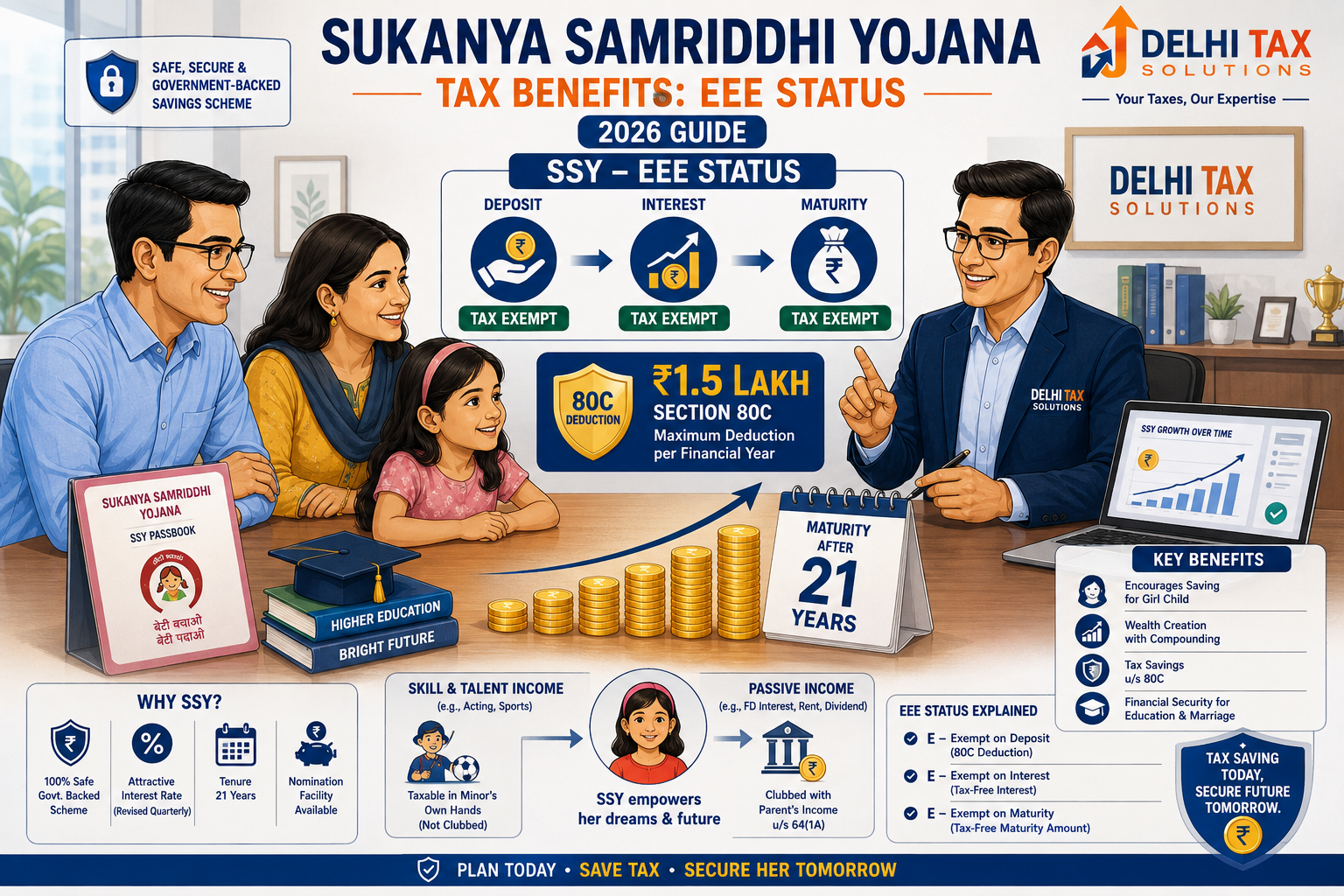
- SSY holds a highly coveted Exempt-Exempt-Exempt (EEE) status, making it entirely tax-free across all stages.
- Parents can claim a deduction of up to ₹1.5 Lakh annually under Section 80C for deposits made into the account.
- The interest accrued annually is not subject to income tax and does not need to be added to your taxable income.
- The entire maturity corpus, including both the principal and the accumulated interest, is completely tax-free upon withdrawal.
- You must declare the maturity payout in Schedule EI (Exempt Income) when filing your final tax return.
Planning for your child’s higher education and marriage requires far more than just saving money; it demands deploying capital into vehicles that protect your wealth from aggressive taxation and crippling inflation. The Government of India introduced the Sukanya Samriddhi Yojana (SSY) under the ‘Beti Bachao Beti Padhao’ campaign to empower the financial future of the girl child. Today, it stands as one of the most lucrative fixed-income investment tools available in the country. The unparalleled Sukanya Samriddhi Yojana tax benefits provide a massive strategic advantage for parents looking to build long-term, risk-free wealth. Mastering these specific statutory provisions allows you to slash your current tax liabilities while guaranteeing a massive, tax-free payout for your daughter decades down the line. Let us decode the exact mechanics of this government-backed scheme, ensuring your next Income Tax Filing capitalizes on every available deduction.
Decoding the SSY Exempt Exempt Exempt Status
Exemption on Initial Deposits (Stage 1)
The first tier of the SSY exempt exempt exempt status applies the moment you deposit money into the account. Every single rupee you contribute toward the scheme directly reduces your taxable income for that financial year, subject to the statutory limits of Section 80C. This means the capital you invest is effectively shielded from your highest applicable tax slab rate before it even begins generating returns.
Exemption on Accrued Interest (Stage 2)
Unlike standard bank fixed deposits, where the interest earned each year is added to your total income and taxed according to your slab, SSY interest behaves entirely differently. The government mandates that the interest credited to the SSY account at the end of every financial year is 100% tax-free. You do not owe a single rupee on this compounding growth. The Income Tax Department explicitly classifies this accrued interest as exempt from annual taxation.
Exemption on Final Maturity (Stage 3)
The final, most powerful tier of the EEE framework activates upon the account’s maturity (21 years from the date of opening). When the account matures, or when a partial withdrawal is executed for the girl’s higher education after she turns 18, the entire corpus is entirely tax-free. If your daughter receives a ₹65 Lakh payout at maturity, not a single rupee of that massive sum will be claimed by the government as capital gains or income tax.
⚡ In a Nutshell
The EEE status means your invested money is not taxed (Exempt), the interest it earns every year is not taxed (Exempt), and the final lump sum you receive after 21 years is completely not taxed (Exempt).
Maximizing the SSY 80C Deduction Limit
Qualifying Investment Caps
The law permits parents or legal guardians to open up to two SSY accounts (for two different girl children). To claim the Sukanya Samriddhi Yojana tax benefits upfront, you must utilize Section 80C of the Income Tax Act. The maximum SSY 80C deduction limit is strictly capped at ₹1,50,000 per financial year. If you deposit ₹2,00,000 into the account, only the first ₹1,50,000 will qualify for a tax deduction; the remaining ₹50,000 simply earns tax-free interest without providing an immediate tax break.
Clubbing with Other 80C Instruments
Taxpayers must remember that this ₹1.5 Lakh ceiling is an aggregate limit for the entire Section 80C basket. Your SSY contributions share this limit with your Life Insurance Premiums, Public Provident Fund (PPF), ELSS mutual funds, and even the principal repayment on your home loan. If your business is already maximizing its provident fund contributions through its Company Registration payroll setup, you must calculate precisely how much room is left in your personal 80C limit before allocating capital to the SSY account.
Impact on the Old vs. New Tax Regime
The introduction of the dual tax regime system has severely impacted traditional tax planning. To claim the SSY 80C deduction limit, you must specifically opt for the Old Tax Regime. The New Tax Regime expressly disallows Section 80C deductions. If you choose the New Tax Regime, you will not receive any upfront tax breaks on your SSY deposits. However, the interest earned and the final maturity payout will still remain entirely tax-free regardless of which regime you choose.
| Feature of SSY | Tax Implication (Old Regime) | Tax Implication (New Regime) |
|---|---|---|
| Annual Deposits (Up to ₹1.5L) | Deductible under Section 80C | No deduction allowed |
| Annual Interest Earned | 100% Tax-Free | 100% Tax-Free |
| Maturity Payout / Withdrawals | 100% Tax-Free | 100% Tax-Free |
| Wealth Tax Implications | None (Abolished) | None (Abolished) |
Why the SSY Interest Rate Tax Free Status Matters
Beating Inflation with Sovereign Guarantees
The government periodically reviews and notifies the interest rates for small savings schemes. Because the SSY interest rate tax free status is backed by a sovereign guarantee, it represents a virtually zero-risk investment. When you compare an 8.2% tax-free SSY return against a 7.5% taxable bank fixed deposit, the SSY severely outperforms the bank FD. A taxpayer in the 30% slab would need a bank FD offering roughly 11.7% just to match the post-tax return of the SSY account.
Avoiding Tedious TDS Deductions
Standard corporate bonds and bank deposits suffer from immediate 10% Tax Deducted at Source (TDS) if interest exceeds a certain threshold. SSY accounts are completely immune to these upfront deductions. Because the SSY interest rate tax free provision is statutory, post offices and authorized banks will never deduct TDS on your child’s account. This prevents the administrative nightmare of constantly tracking deductions and initiating complex TDS Compliance refunds every assessment year.
Compounding Without Tax Friction
When interest is taxed annually, your compounding engine leaks capital back to the government every single year. The SSY exempt exempt exempt status ensures 100% of your earned interest remains within the account to generate even more interest the following year. Over a 21-year horizon, this frictionless compounding generates a final corpus that is vastly superior to any taxable equivalent, accelerating your child’s financial independence exponentially.
ITR Filing and Compliance for SSY Investors
Documenting Your Annual Contributions
When filing your annual tax return, you must explicitly declare your SSY deposits under Chapter VI-A (Section 80C) to claim the upfront deduction. You do not need to attach your bank passbook to the ITR, but you must preserve the digital receipts or stamped deposit slips in your personal records. The Reserve Bank of India mandates that all authorized banks transmit deposit information to the central tax grid, ensuring your Form 26AS aligns with your declared deductions.
Reporting the Tax-Free Maturity Payout
Receiving tax-free money does not excuse you from reporting it to the government. In the financial year when the account matures and pays out the massive corpus, the recipient (the daughter) must declare this sum in her personal income tax return under ‘Schedule EI’ (Exempt Income). Failing to report a sudden influx of ₹60 Lakh into a savings account will immediately trigger an automated scrutiny notice from the authorities, who may mistake it for unreported corporate or GST Registration related commercial income.
Seeking Professional Wealth Advisory
Building a diversified portfolio requires balancing locked-in schemes like the SSY with liquid assets. Many high-net-worth individuals rely on corporate structures regulated by the Ministry of Corporate Affairs to manage their commercial wealth while using SSY purely as a protected family trust fund. The Press Information Bureau consistently highlights the scheme’s expanding adoption among informed investors across the nation. Consulting a certified Chartered Accountant ensures you do not inadvertently lock up too much capital in illiquid schemes while neglecting immediate business cash flow requirements.
Securing your child’s future is paramount, and the Sukanya Samriddhi Yojana tax benefits offer the most secure, legally protected route to multi-generational wealth creation. By fully understanding the unparalleled EEE status, you can systematically reduce your annual tax burdens while locking in a guaranteed, tax-free fortune for your daughter’s most critical life milestones. Remember that maximizing your 80C ceiling requires holistic planning across all your investment verticals. Talk to a Delhi Tax Solutions expert to perfectly integrate your SSY contributions into your broader tax-saving strategy. Securing professional CA guidance today guarantees your family maximizes every statutory advantage the government provides.
About this article: Researched using official government sources and Delhi Tax Solutions’ in-house tax advisory team. Last updated August 2026.
Frequently Asked Questions (FAQs)
Q: What are the Sukanya Samriddhi Yojana tax benefits?
A: The Sukanya Samriddhi Yojana tax benefits are among the highest in India, offering complete tax immunity. The scheme allows parents to claim an annual tax deduction on deposits up to ₹1.5 Lakh under Section 80C. Furthermore, the interest earned annually and the entire final maturity amount are completely exempt from income tax.
Q: How does the SSY exempt exempt exempt status work?
A: The SSY exempt exempt exempt (EEE) status signifies that the investment is tax-free across three critical stages: First, the initial deposit is exempt from your taxable income (under 80C). Second, the interest accrued each year is exempt from annual taxation. Third, the final withdrawal amount upon maturity is completely exempt from tax.
Q: What is the maximum SSY 80C deduction limit allowed?
A: The maximum SSY 80C deduction limit is ₹1,50,000 per financial year. This ₹1.5 Lakh ceiling is not exclusive to the SSY account; it is an aggregate limit that you must share with your other 80C investments, such as PPF, life insurance premiums, ELSS mutual funds, and the principal repayment on a home loan.
Q: Is the SSY interest rate tax free in India?
A: Yes, the SSY interest rate is 100% tax-free in India. Unlike a regular bank fixed deposit, where the earned interest is added to your total income and taxed according to your tax slab, the interest credited to an SSY account every year is entirely exempt from income tax and suffers no TDS deductions.
Q: Can NRIs invest in the Sukanya Samriddhi Yojana?
A: No, Non-Resident Indians (NRIs) are currently strictly prohibited from opening a new Sukanya Samriddhi Yojana account. The girl child must be a resident Indian citizen at the time of opening the account. If the child’s residential status changes to NRI after the account is opened, the rules dictate that the account must be closed prematurely.
