
? Key Takeaways
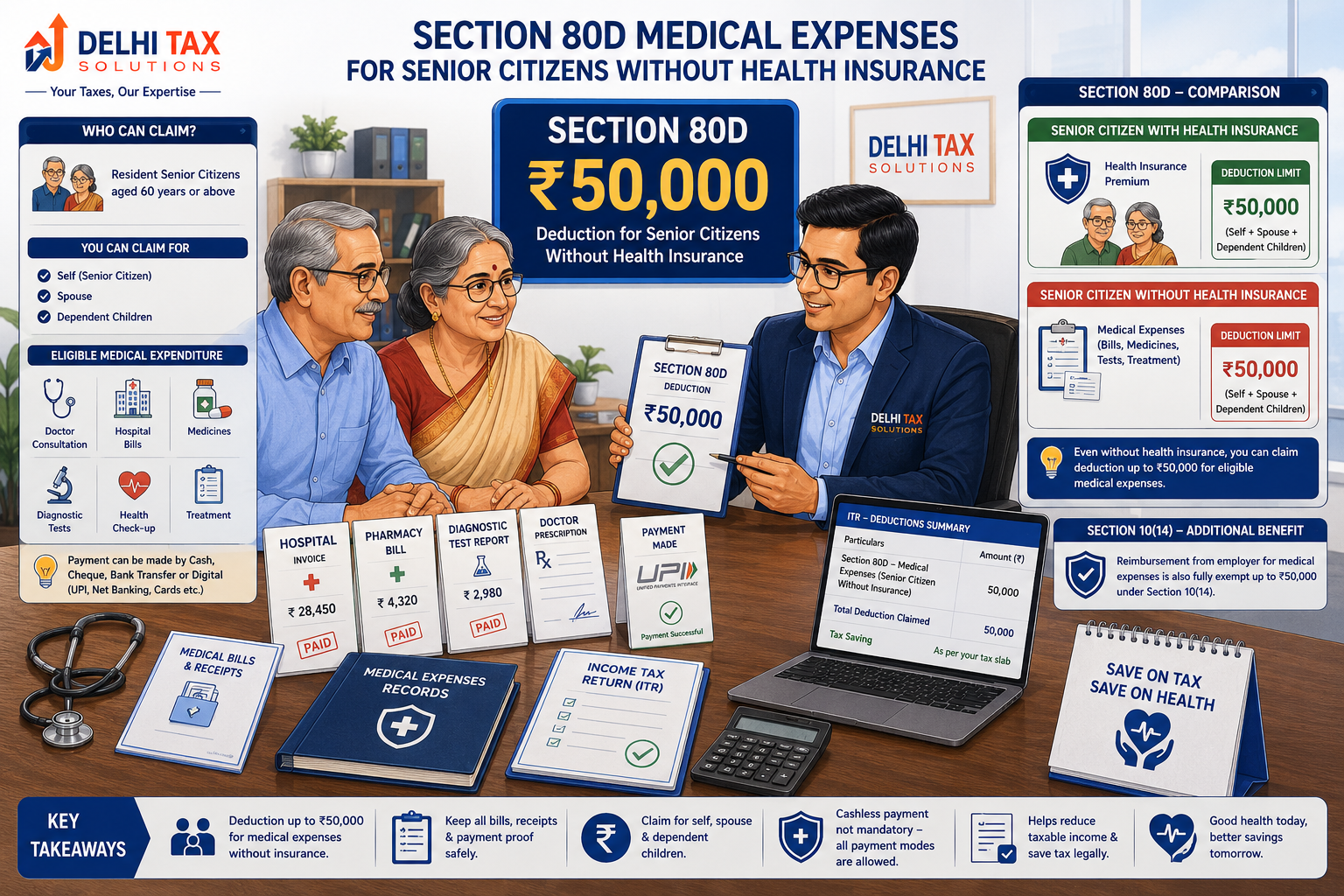
- Senior citizens without health insurance can claim medical bills up to ?50,000 under Section 80D.
- The overall deduction cap for senior citizen health expenses and insurance combined is ?50,000.
- Payments for medical expenditures must be made through digital banking channels, not cash.
- Proper invoice record-keeping ensures a seamless verification process during tax assessment.
Healthcare costs rise sharply with age, creating significant financial pressure for elderly households across India. Fortunately, tax laws offer substantial relief through specific statutory provisions. Many taxpayers remain unaware that they can claim deductions for healthcare expenses even when their elderly relatives lack active health insurance coverage. Utilizing Section 80D medical expenditure senior citizens provisions effectively can reduce your taxable income significantly. Our chartered accountant team at Delhi Tax Solutions frequently assists families in structuring their healthcare claims to ensure absolute compliance during Income Tax Filing. Let us examine how the Income Tax Act allows you to claim these vital expenses without policy hurdles.
What Is Section 80D Medical Expenditure Deduction?
Under Section 80D of the Income Tax Act, resident individuals and HUFs can claim deductions for health insurance premiums, preventive health check-ups, and direct medical expenditures incurred for senior citizens. A senior citizen is defined as an individual resident in India who is aged 60 years or older during the relevant financial year. According to guidelines published by the Income Tax Department, if a senior citizen does not possess a health insurance policy, the actual medical expenditure incurred on their behalf is fully eligible for tax deduction up to the statutory limit, provided payments are executed through traceable banking channels rather than physical cash.
Understanding 80D Deduction Limit Senior Citizens
Navigating the 80D deduction limit senior citizens framework requires understanding how caps operate across family members. For senior citizens aged 60 and above, the maximum allowable deduction under Section 80D is ?50,000 per financial year. This ?50,000 limit is a combined ceiling that covers health insurance premiums, preventive health check-ups up to ?5,000, and actual medical bills incurred for uninsured senior citizens. If you incur ?40,000 in hospital bills for your elderly father who has no medical insurance, you can claim that entire amount, provided you have not exhausted the ?50,000 cap with other health premiums for that specific category.
Claiming Medical Expenditure Deduction No Insurance
Securing a medical expenditure deduction no insurance claim requires careful adherence to procedural rules. When an elderly parent or family member is uninsurable due to pre-existing medical conditions or advanced age, out-of-pocket expenses for doctor consultations, medicines, diagnostic tests, and hospitalization become eligible. To qualify for this deduction, the payment must be settled digitally via net banking, UPI, credit card, or account payee cheque. Cash payments for medical bills do not qualify for deductions under Section 80D. Maintaining clean records helps business owners and corporate professionals manage compliance alongside other corporate requirements like TDS deductions or Company Registration audits.
| Beneficiary Category | Insurance Status | Max Deduction Limit (80D) |
|---|---|---|
| Self, Spouse, and Dependent Children | Insured or Uninsured | ?25,000 (?50,000 if senior citizen) |
| Senior Citizen Parents (Aged 60+) | With Health Insurance | Up to ?50,000 combined limit |
| Senior Citizen Parents (Aged 60+) | No Health Insurance | Up to ?50,000 for medical bills |
| Preventive Health Check-up | Applicable across all | Sub-limit of ?5,000 (within overall cap) |
? In a Nutshell
If senior citizen parents lack health insurance, you can claim actual medical bills up to ?50,000 under Section 80D. Always use digital payment methods to ensure your claims are accepted by tax authorities.
Maximizing Benefits with 80D Parents Senior Citizen Rules
Strategic deployment of 80D parents senior citizen provisions allows families to optimize their overall tax liability. You can claim deductions for health insurance or medical bills paid for your parents, whether they are fully dependent on you or financially independent. If you pay ?25,000 for your own family health insurance and another ?50,000 for your senior citizen parents’ medical expenses or insurance, your cumulative deduction under Section 80D reaches ?75,000. For individuals managing residential real estate or rental income, ensuring that Property Tax and personal deductions are synchronized avoids reporting discrepancies. According to periodic updates issued by the Press Information Bureau, transparency in personal finance reporting remains a core focus for tax administrators.
Documentation and Proof Required for ITR Filing
Submitting accurate claims during tax season requires assembling a robust documentation portfolio. You must retain original hospital bills, pharmacy receipts, chemist prescriptions, and bank statements showing digital transfers. While these documents are not uploaded directly when submitting your return, keeping them ready for verification protects you against automated scrutiny notices from tax authorities. If you operate a small business or freelance practice, keeping your personal healthcare deductions separate from commercial accounts registered under GST Registration is critical. Professional oversight from a qualified CA ensures that all statutory limits are respected without risking computational errors.
Avoiding Common Mistakes During Tax Assessment
Taxpayers frequently make avoidable errors when claiming healthcare expenses for elderly family members. A common mistake is paying medical bills in physical cash and attempting to claim them under Section 80D, which leads to immediate disallowance by automated processing systems. Another error is exceeding the combined ?50,000 ceiling by claiming both insurance premiums and medical bills independently when the cap applies jointly. Ensuring that your tax filing aligns with guidelines from the Ministry of Corporate Affairs or CBDT circulars guarantees peace of mind and prevents unnecessary tax litigation.
About this article: Researched using official government sources and Delhi Tax Solutions’ in-house tax advisory team. Last updated August 2026.
Frequently Asked Questions (FAQs)
Q: Can I claim medical expenses under Section 80D if my parents have no health insurance?
A: Yes, you can claim actual medical expenses incurred for senior citizen parents who do not have any health insurance coverage. Under Section 80D of the Income Tax Act, the government allows taxpayers to claim medical bills for uninsured senior citizens up to a maximum limit of ?50,000 per financial year, provided the payments are settled through banking channels rather than cash.
Q: What is the maximum deduction limit under Section 80D for senior citizens?
A: The maximum deduction limit under Section 80D for senior citizens aged 60 and above is ?50,000 per financial year. This limit is comprehensive, covering health insurance premiums, preventive health check-ups up to ?5,000, and out-of-pocket medical expenditures for uninsured senior citizens combined. You cannot claim beyond this ceiling for that specific category of family members.
Q: Are cash payments allowed for medical expenditure claims under 80D?
A: No, cash payments for medical expenditures or health insurance premiums do not qualify for deductions under Section 80D. All payments for medical bills claimed under this section must be made through digital modes such as net banking, UPI, debit/credit cards, or account payee cheques to ensure an unassailable financial audit trail acceptable to tax authorities.
Q: Can I claim both health insurance premium and medical bills for senior citizens?
A: You can only claim medical expenditure for senior citizens if they do not have an active health insurance policy. If your senior citizen parents have a health insurance policy, you can claim the premium paid up to ?50,000, but you cannot claim separate out-of-pocket medical bills on top of that insurance for the same individual if the combined ?50,000 limit is reached.
Q: How do I report senior citizen medical expenditures during ITR filing?
A: During ITR filing (such as ITR-1 or ITR-2), you must report the eligible deduction amount under the Section 80D schedule in your income tax return form. Ensure you enter the correct breakup for senior citizen parents versus self and family. Retain all original invoices, prescriptions, and digital payment receipts to verify the claim if requested during tax scrutiny.
