
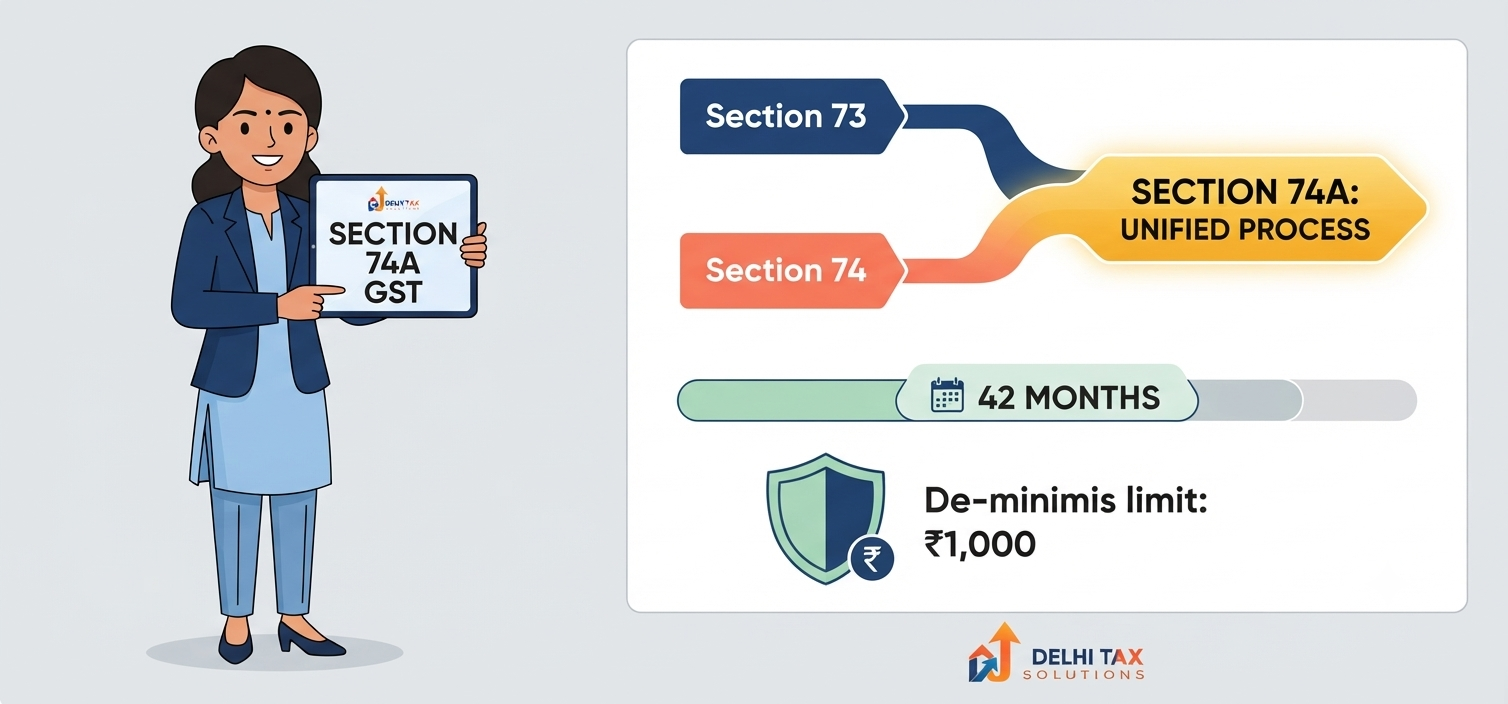
💡 Key Takeaways: Section 74A of CGST Act
- Unified Approach: The Finance Act 2024 introduced Section 74A, merging the erstwhile Section 73 (non-fraud) and Section 74 (fraud) into a single, unified demand procedure.
- Applicability: This new section is exclusively applicable to tax discrepancies arising from Financial Year 2024-25 onwards.
- Common Time Limit: Instead of separate 3-year and 5-year deadlines, Section 74A mandates a uniform 42-month (3.5 years) time limit for issuing a Show Cause Notice (SCN), irrespective of the presence of fraud.
- Extended Relief Window: Taxpayers now have 60 days (increased from 30 days) to settle demands with reduced or zero penalties after receiving an SCN.
- De-Minimis Limit: No notice will be issued if the tax shortfall is less than ₹1,000 in a financial year.
Since the inception of the Goods and Services Tax in 2017, the adjudication of tax demands was bifurcated based on the intent of the taxpayer. Innocent mistakes were handled under Section 73 (Non-Fraud), while cases of deliberate tax evasion were aggressively pursued under Section 74 (Fraud). However, this dual system often led to prolonged litigation regarding whether a notice was correctly issued under the appropriate section.
To streamline tax administration, the government introduced a major overhaul via the Finance Act 2024. The newly inserted section 74a gst brings a “middle path,” creating a single consolidated framework for investigating, notifying, determining, and penalizing tax discrepancies. Let’s delve into the mechanics of this unified demand process and understand how it impacts your business compliance from FY 2024-25 onwards.
The Shift to a Unified Demand Process
Before the introduction of Section 74A, assessing officers frequently invoked Section 74—even in cases without explicit proof of suppression—merely to leverage the extended 5-year limitation period. This practice burdened taxpayers with unwarranted allegations of fraud and the threat of 100% penalties.
Section 74A of the CGST Act resolves this by establishing a unified process. Whether the tax shortfall is due to an inadvertent error or a willful misstatement, the procedural initiation is now uniform. However, the law still maintains a distinction in the penalty quantum based on the nature of the default.
📌 Transitional Phase: What About Older Demands?
It is imperative to note that Section 74A does not apply retroactively. Any demand notices pertaining to FY 2023-24 or earlier will continue to be governed by the old provisions of Sections 73 and 74. Section 74A is strictly applicable for liabilities arising from FY 2024-25 onwards.
New Time Limits Under Section 74A
The most significant change brought by Section 74A is the standardization of timelines. The law has adopted a “middle path”—increasing the exposure period for non-fraud cases while reducing the look-back period for fraud cases.
- Issuance of Notice (SCN): The Show Cause Notice must be issued within 42 months (3.5 years) from the due date of furnishing the annual return for the relevant financial year, or from the date of the erroneous refund. This timeframe can be extended by up to 6 months by an officer not below the rank of Joint Commissioner.
- Issuance of Order: The final adjudication order must be passed within 12 months from the date of the issuance of the notice. This can also be extended by an additional 6 months if documented reasons are provided.
- Deemed Conclusion: If the final order is not issued within a maximum of 18 months (including extensions) from the date of the notice, the proceedings are automatically deemed concluded.
For more detailed insights on the legislative intent behind these timelines, you can refer to the official CBIC Tax Information Portal.
Graded Penalty Structure: Incentivizing Early Settlement
While the procedural timeline is unified, Section 74A retains graded penalties to penalize deliberate evasion more harshly than innocent errors. A notable taxpayer-friendly amendment is the extension of the “cure period”—taxpayers now have 60 days instead of the previous 30 days to pay the tax and claim reduced penalties.
1. Penalty for Non-Fraud Cases (Innocent Errors)
- Before SCN or Within 60 Days of SCN: If the taxpayer pays the demanded tax and applicable interest within this extended window, the penalty is Nil (0%), and proceedings are deemed concluded.
- Adjudication / Order Passed: If the case proceeds to an order, the penalty levied will be 10% of the tax due or ₹10,000, whichever is higher. (Note: This penalty also applies even if the tax is self-assessed but remains unpaid for over 30 days).
2. Penalty for Fraud / Willful Misstatement Cases
- Before SCN is Issued: Paying tax and interest before receiving the notice limits the penalty to 15% of the tax amount.
- Within 60 Days of SCN: Paying within 60 days of the notice reduces the penalty to 25%.
- Within 60 Days of Order: If paid within 60 days of the final adjudication order, the penalty is 50%.
- Defaulting on Order: Failure to settle the demand within the stipulated time results in a maximum penalty of 100% of the tax evaded.
If an appellate authority later determines that the charges of fraud were unsustainable, the penalties are automatically adjusted to the lower non-fraud rates.
De-Minimis Limit and Statement Issuance
To reduce administrative burden and prevent the harassment of taxpayers for trivial amounts, Section 74A introduces a strict threshold limit. No notice will be issued if the total tax discrepancy (unpaid tax, short payment, etc.) is less than ₹1,000 in a given financial year.
Furthermore, if an SCN has already been issued for a specific period, the proper officer is not required to issue a fresh, detailed SCN for subsequent periods if the grounds of the demand are identical. Instead, the officer can simply issue a “statement” detailing the tax amount for the new period, which carries the same legal weight as a formal notice. To understand the broader implications of the Finance Act 2024 on corporate compliance, you can review this comprehensive analysis on TaxGuru regarding Section 74A.
Need Help Navigating the New Section 74A Rules?
The transition from Sections 73 and 74 to the unified Section 74A requires a strategic shift in how businesses handle GST audits and demand notices. Determining the correct financial year and applying the new 60-day settlement window is critical to minimizing financial impact.
Stay ahead of compliance changes with Delhi Tax Solutions. Our expert advisory team can assist you in reviewing your FY 2024-25 records, responding to new statements, and defending against unwarranted penalty impositions.
Frequently Asked Questions (FAQs)
+ Q: From which financial year is Section 74A applicable?
A: Section 74A is applicable for tax demands and discrepancies arising from Financial Year 2024-25 onwards. For periods up to FY 2023-24, the old Sections 73 and 74 continue to apply.
+ Q: What is the time limit to issue a notice under Section 74A?
A: The time limit for issuing a Show Cause Notice under Section 74A is 42 months (3.5 years) from the due date of furnishing the annual return for the relevant financial year, uniform for both fraud and non-fraud cases.
+ Q: How has the penalty payment window changed in Section 74A?
A: The new section provides a longer “cure period”. Taxpayers now have 60 days (instead of 30 days) from the date of the notice to pay the tax and interest to avail of the 0% penalty (in non-fraud cases) or reduced penalties (in fraud cases).
+ Q: Can the department issue a notice for a ₹500 tax mismatch under Section 74A?
A: No. Section 74A introduces a statutory de-minimis limit. No demand notice will be issued if the tax amount in question is less than ₹1,000 in a particular financial year.
About this article: Based on Section 74A of the CGST Act, introduced via the Finance (No. 2) Act, 2024. Updated for 2026.
Disclaimer: This article is for educational and informational purposes only and does not constitute formal legal advice. Please consult a qualified GST advisor before responding to any demand notices.