
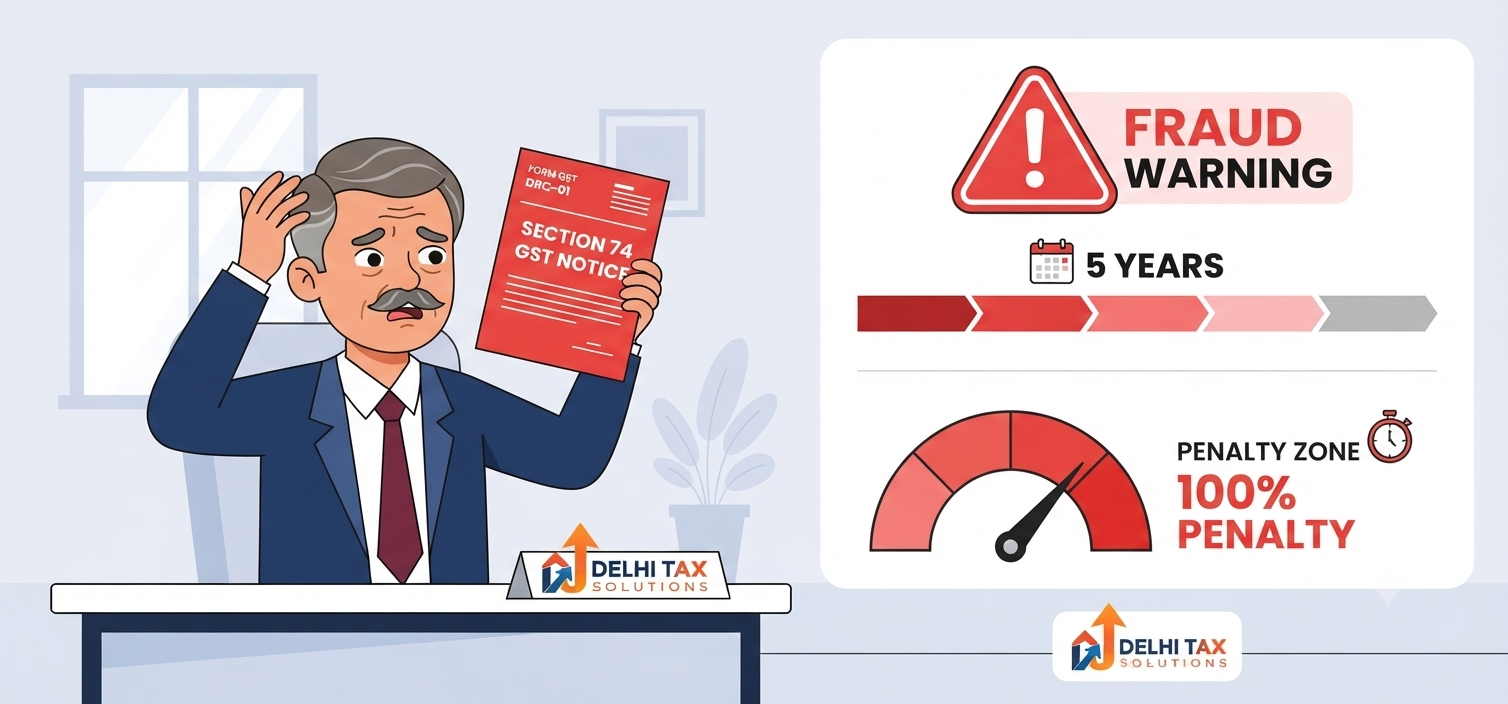
⚠️ Key Takeaways: Section 74 GST (Fraud & Misstatement)
- Severe Intent: Section 74 is invoked exclusively when there is an intent to evade tax through fraud, willful misstatement, or suppression of facts.
- Extended Timeline: Tax officers have an extended period of 5 years from the annual return due date to issue an adjudication order.
- High Penalty Slabs: Unlike non-fraud cases, penalties under Section 74 range from a minimum of 15% to a maximum of 100% of the tax evaded.
- Applicability: This specific section handles fraud demand notices for financial years up to FY 2023-24 (replaced by the unified Section 74A for FY 2024-25 onwards).
While Section 73 deals with innocent errors, receiving a show cause notice under section 74 is a severe legal matter. This section of the CGST Act, 2017 is the tax department’s primary weapon against deliberate tax evasion, fake invoicing, and intentional suppression of sales.
A notice under Section 74 GST means the tax authorities have gathered evidence suggesting you deliberately underpaid tax, claimed bogus Input Tax Credit (ITC), or obtained erroneous refunds using fraudulent means. Because the intent is malicious, the law grants the department more time to investigate and imposes crippling financial penalties.
What Triggers a Section 74 Notice? (The 3 Elements)
For a GST officer to legally invoke Section 74 instead of Section 73, the notice must clearly establish at least one of the following three elements:
- Fraud: Deliberate deception or criminal intent to evade tax (e.g., claiming ITC on fake invoices where no goods were ever supplied).
- Willful Misstatement: Knowingly providing false information or manipulating financial records, such as declaring a lower tax rate despite knowing the correct higher rate.
- Suppression of Facts: Intentionally hiding taxable turnover, failing to declare outward supplies, or ignoring the mandatory registration threshold to avoid paying taxes.
Time Limits: The 5-Year Extended Period
Because fraud is often hidden and takes longer to uncover, the law provides an extended timeline for officers to issue notices and pass final orders compared to normal cases.
| Event / Action | Statutory Deadline under Section 74 |
|---|---|
| Final Adjudication Order [Sec 74(9)] | Within 5 years from the due date for filing the Annual Return (GSTR-9) for the relevant financial year. |
| Show Cause Notice (SCN) [Sec 74(2)] | At least 6 months prior to the 5-year order deadline (i.e., within 4.5 years from the annual return due date). |
📌 FY 2024-25 Legislative Update
It is crucial to note that Section 74 governs cases up to FY 2023-24. For any tax discrepancies occurring from FY 2024-25 onwards, the government has introduced Section 74A, which standardizes the time limits (4.5 years for orders) for both fraud and non-fraud cases.
The Fraud Penalty GST Slabs: Up to 100%
Unlike Section 73, where you can escape penalties entirely by paying early, Section 74 guarantees a penalty. However, the law provides staggered concessions to encourage early settlement and reduce litigation. The fraud penalty gst is calculated based on when you choose to pay the tax and interest:
- Stage 1: Before SCN [Sec 74(5)] – If you pay the tax and interest before the notice is served, the penalty is reduced to 15% of the tax amount.
- Stage 2: Within 30 days of SCN [Sec 74(8)] – If you pay the tax and interest within 30 days of receiving the Show Cause Notice, the penalty is 25% of the tax amount.
- Stage 3: Within 30 days of Final Order [Sec 74(11)] – If you fight the case, lose, but pay within 30 days of the adjudication order, the penalty is 50%.
- Stage 4: Defaulting on Final Order – If you fail to pay within 30 days of the final order, the maximum penalty of 100% of the tax amount is enforced.
Can Section 74 be Challenged?
Yes. Often, tax officers aggressively invoke Section 74 to benefit from the extended 5-year limitation period, even when there is no actual fraud. If the department fails to prove “intent to evade,” appellate authorities or High Courts can strike down the Section 74 notice and convert it into a Section 73 notice, drastically reducing the penalty and potentially invalidating the notice on time-barring grounds.
Facing a Section 74 Fraud Notice? Act Fast!
A Section 74 notice carries severe financial implications, including 100% penalties and potential prosecution. Defending against allegations of fraud and willful misstatement requires aggressive legal strategy and evidence.
Do not face the department alone. Contact Delhi Tax Solutions for expert litigation support. We help you challenge wrongful Section 74 invocations, minimize penalties, and protect your business.
Frequently Asked Questions (FAQs)
+ Q: What is the difference between Section 73 and Section 74 GST?
A: Section 73 is invoked for innocent tax errors or short payments without malicious intent, carrying lower penalties. Section 74 is invoked exclusively for fraud, willful misstatement, or suppression of facts to intentionally evade taxes, carrying penalties up to 100%.
+ Q: Can I get a 0% penalty waiver under Section 74?
A: No. Unlike Section 73, you cannot get a 0% penalty waiver under Section 74. The minimum penalty you can pay is 15% of the tax evaded, provided you pay it voluntarily before the issuance of the Show Cause Notice.
+ Q: What is the time limit to issue an order under Section 74?
A: For financial years up to 2023-24, the final order under Section 74 must be issued within 5 years from the due date of filing the Annual Return (GSTR-9) for that specific financial year.
+ Q: What happens if I don’t reply to a Section 74 SCN?
A: If you ignore the notice, the tax officer will pass an ex-parte final order confirming the tax demand, levying interest, and imposing a 100% penalty. This can lead to the attachment of your bank accounts and cancellation of your GST registration.
About this article: Based on Section 74 of the CGST Act, 2017. Updated for 2026.
Disclaimer: This article is for educational and informational purposes only and does not constitute formal legal advice. Facing fraud charges requires immediate consultation with a qualified tax litigator.