
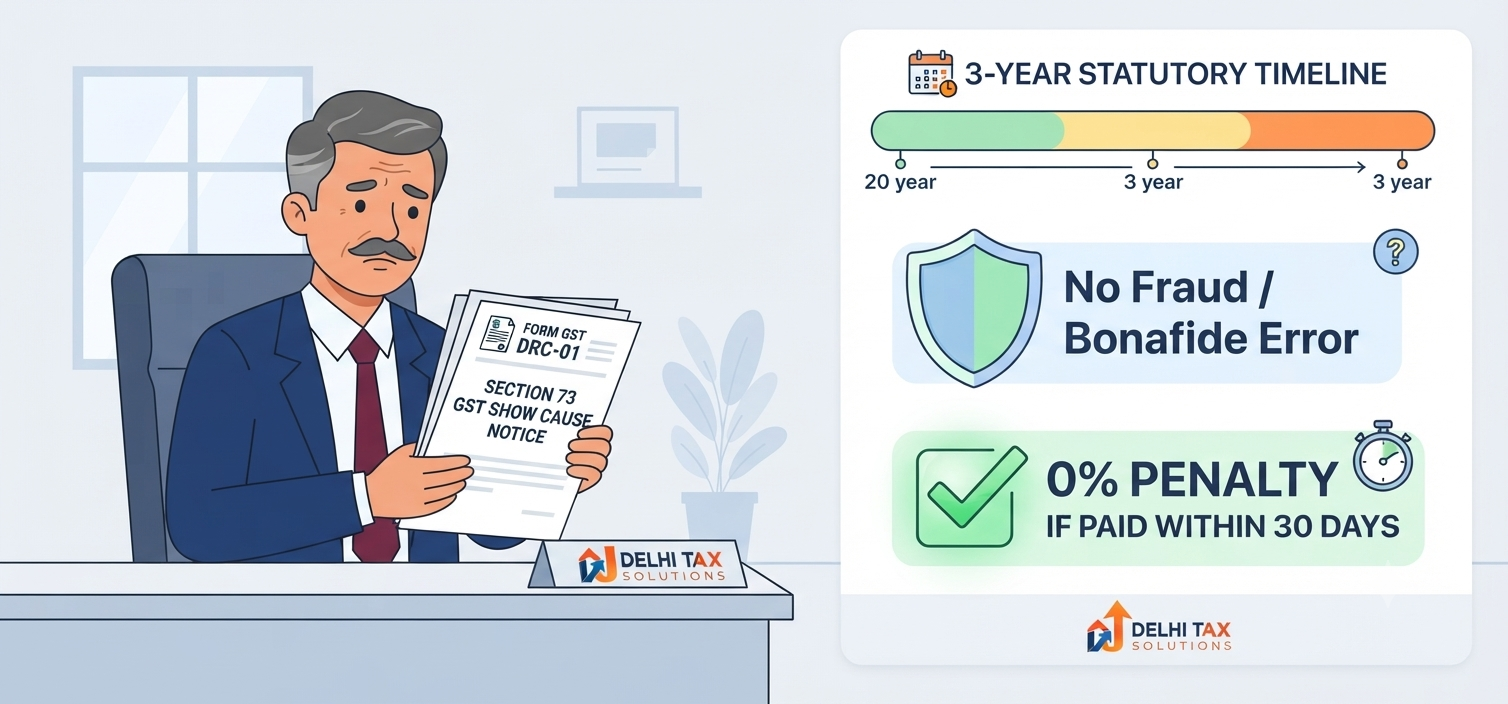
💡 Key Takeaways: Section 73 GST (Non-Fraud Tax Demands)
- Non-Fraud Provision: Section 73 applies to cases where tax is unpaid, short paid, erroneously refunded, or ITC is wrongly availed/utilized without any intent of fraud, suppression, or willful misstatement.
- Applicability Period: Section 73 governs demand notices for financial years up to FY 2023-24 (From FY 2024-25 onwards, unified demand provisions under Section 74A apply).
- 0% Penalty Waiver: If the taxpayer pays the tax shortfall along with interest before notice or within 30 days of receiving the Section 73 Show Cause Notice (SCN), no penalty is imposed.
- Time Limit for Notice: SCN under Section 73 must be issued at least 3 months prior to the 3-year deadline for issuing the final adjudication order.
Receiving a Show Cause Notice (SCN) from the tax department can be daunting. However, if the notice is issued under Section 73 of the CGST Act, it signifies that the tax authorities consider the discrepancy to be an innocent mistake, a clerical calculation error, or an interpretation difference rather than intentional tax fraud.
Understanding the statutory framework of a section 73 gst demand notice allows taxpayers to resolve tax disputes quickly, avoid heavy financial penalties, and maintain compliance. Let’s dive deep into the mechanics of Section 73, its strict time limits, and the exact steps to respond.
What Triggers a Demand Notice Under Section 73 GST?
A tax officer issues a notice under section 73 cgst act when they determine that tax has been unpaid, short paid, erroneously refunded, or Input Tax Credit (ITC) has been wrongly availed or utilized due to bonafide reasons. Key triggers include:
- Inadvertent Returns Mismatch: Discrepancies between outward supplies in GSTR-1 and tax paid in GSTR-3B without fraudulent intent.
- Excess ITC Claims: Claiming excess ITC in GSTR-3B compared to GSTR-2B due to timing differences or supplier delay.
- Wrong HSN or Rate Application: Applying an incorrect GST tax rate due to genuine classification doubts.
- Erroneous Refund Claims: Obtaining a refund through a calculation mistake rather than fake invoicing.
Time Limits for Section 73 SCN and Adjudication Order
The GST framework enforces strict statutory timeframes for tax officers to issue notices and pass final orders under Section 73:
| Event / Action | Statutory Deadline (Section 73) |
|---|---|
| Final Adjudication Order [Sec 73(9)] | Within 3 years from the due date for filing Annual Return (GSTR-9) for the relevant financial year. |
| Show Cause Notice (SCN) [Sec 73(2)] | At least 3 months prior to the order deadline (i.e., within 2 years and 9 months from the annual return due date). |
📌 Key Legislative Update: Section 73 vs Section 74A
Please note that Section 73 applies to demand notices up to Financial Year 2023-24. From Financial Year 2024-25 onwards, the Finance Act introduced a common statutory demand framework under Section 74A, replacing separate Section 73 and Section 74 proceedings for future tax years.
Penalty Structure Under Section 73: How to Benefit from 0% Penalty
One of the biggest advantages of Section 73 is the statutory incentive for early settlement. If you receive a Section 73 notice and agree with the tax liability, you can settle it without paying any penalty:
- Payment BEFORE Notice Issued [Sec 73(5)]: Pay the tax shortfall along with applicable interest via Form DRC-03 before SCN is issued. Result: 0% Penalty, and no SCN will be served.
- Payment Within 30 Days of SCN [Sec 73(8)]: Pay the tax and interest within 30 days of SCN service. Result: 0% Penalty, and all proceedings are deemed closed.
- Payment AFTER 30 Days or Upon Final Order [Sec 73(9)]: If payment is made after the 30-day window or pursuant to an adjudication order, a penalty of 10% of tax or ₹10,000 (whichever is higher) will be levied.
Difference Between Section 73 and Section 74 GST
It is vital for taxpayers to know whether their notice is under Section 73 or Section 74, as Section 74 carries severe financial penalties:
| Parameter | Section 73 (Non-Fraud) | Section 74 (Fraud / Suppression) |
|---|---|---|
| Trigger Basis | Innocent errors, bonafide mistakes, unintended omissions. | Fraud, willful misstatement, suppression of facts to evade tax. |
| Time Limit for Order | 3 Years from Annual Return due date. | 5 Years from Annual Return due date. |
| Penalty Rate | 0% (within 30 days) or 10% (₹10,000 min). | 15% to 100% of tax amount depending on payment stage. |
Need Expert Assistance with a Section 73 Notice?
Responding to a Section 73 Show Cause Notice requires precise legal analysis, proper DRC-03 submissions, and structured reconciliations to claim the 0% penalty waiver.
Get experienced legal support from Delhi Tax Solutions. Our tax experts help you draft robust replies, verify interest computations, and represent your case before GST authorities.
Frequently Asked Questions (FAQs)
+ Q: What is a Section 73 GST notice?
A: A Section 73 notice is a Show Cause Notice issued by the GST department for determination of unpaid or short paid tax, wrong ITC claims, or erroneous refunds where there is NO allegation of fraud, suppression, or deliberate tax evasion.
+ Q: Can I avoid penalties under Section 73 of the CGST Act?
A: Yes! If you pay the demanded tax along with applicable interest under Section 50 before notice or within 30 days of receiving the Section 73 notice, no penalty will be levied (0% penalty).
+ Q: What is the time limit for issuing a Section 73 order?
A: The final order under Section 73(9) must be issued within 3 years from the due date of filing the Annual Return for that financial year. The SCN itself must be issued at least 3 months prior to this deadline.
+ Q: Is Section 73 applicable for FY 2024-25 and onwards?
A: No. Section 73 governs demand notices up to FY 2023-24. From Financial Year 2024-25 onwards, a common demand framework under Section 74A applies for both fraud and non-fraud demand cases.
About this article: Based on Section 73 and Section 74A of the CGST Act, 2017. Updated for 2026.
Disclaimer: This article is for educational and informational purposes only and does not constitute formal legal advice. Please consult a qualified GST advisor before responding to tax notices.