
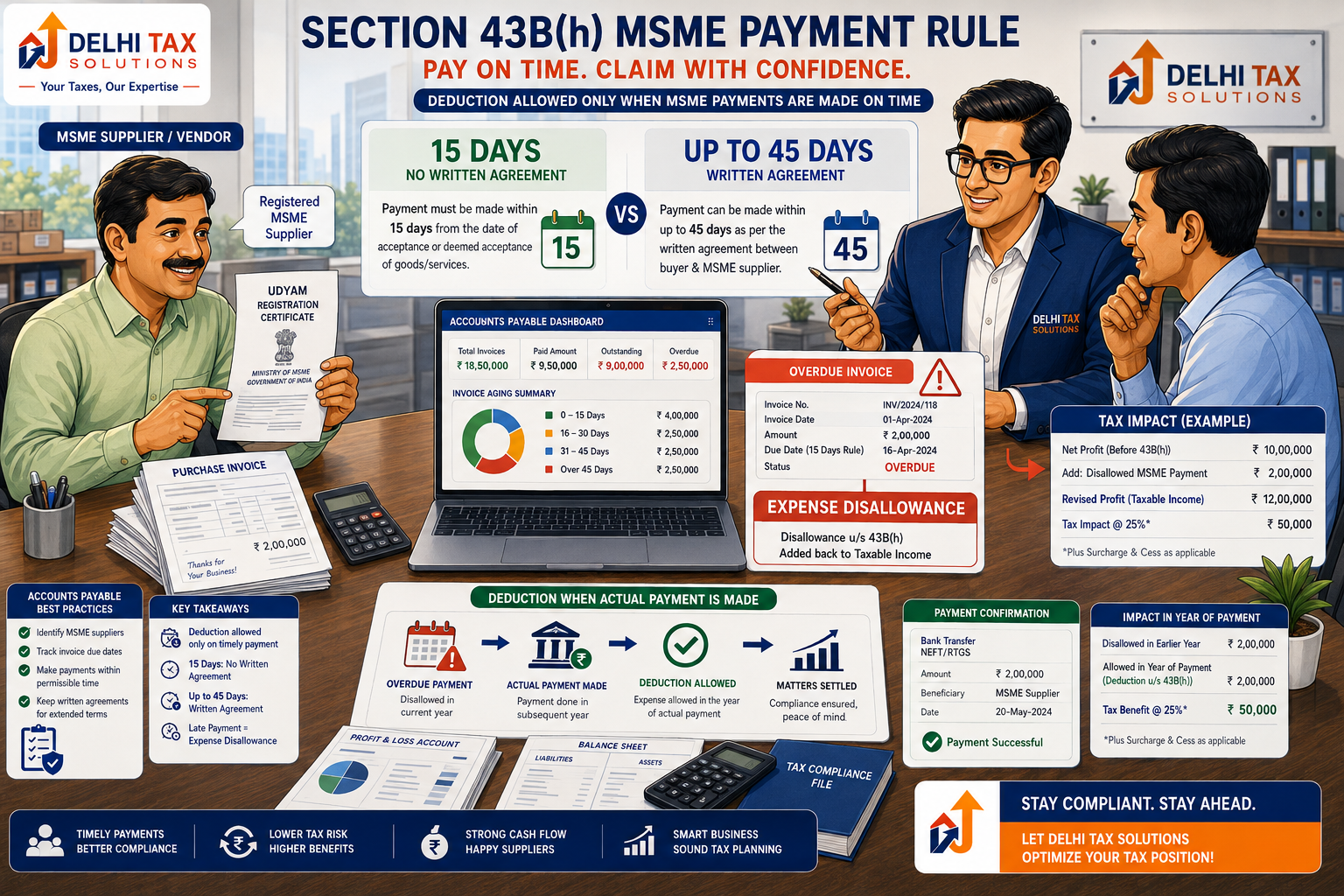
? Key Takeaways
- Section 43B(h) enforces strict statutory payment deadlines for corporate purchases from micro and small enterprises.
- Payments must be cleared within 15 days without a contract, or up to 45 days with a written agreement.
- Delayed payments result in immediate expense disallowance and add taxable profits for the financial year.
- Compliance requires verifying vendor Udyam registration certificates and tracking invoice aging schedules meticulously.
- Professional corporate tax planning protects businesses from unexpected tax liabilities during annual filings.
Managing vendor credit terms requires absolute precision for corporate enterprises and manufacturing units operating across commercial centers like Delhi NCR. The introduction of the Section 43B(h) MSME payment rule has completely transformed how businesses handle procurement cycles, tying corporate tax deductions directly to timely vendor settlements.
Historically, corporate buyers could defer payments to micro and small suppliers while claiming tax deductions on expenses incurred during the financial year. Under current statutory rules, unpaid dues to registered MSME vendors are disallowed as business deductions, creating substantial tax liabilities for companies that fail to monitor accounts payable closely.
This comprehensive compliance guide examines statutory credit limits, disallowance mechanics, and essential operational steps for corporate buyers preparing financial statements for FY 2025-26.
What is the Section 43B(h) MSME payment rule for corporate buyers?
Section 43B(h) of the Income-tax Act, 1961, mandates that any sum payable by a corporate buyer to a registered micro or small enterprise for goods or services must be cleared within statutory timeframes to qualify as an allowable business expense. Official guidelines published by the Income Tax Department establish that if payments exceed permitted credit windows, the corresponding purchase amounts are disallowed and added back to the buyer’s taxable income for that financial year. Structuring enterprise operations through proper Company Registration helps corporate directors establish robust accounting systems before engaging with registered vendors.
How do enterprises manage the 45 day MSME payment rule?
Complying with the 45 day MSME payment rule requires understanding the exact statutory limits governing commercial transactions under the Micro, Small and Medium Enterprises Development Act. Policy announcements released by the Press Information Bureau clarify that the permissible credit period depends entirely on whether a formal written agreement exists between the buyer and the vendor.
When a written contract is executed, the maximum allowable credit period is capped at 45 days. In the absence of a written agreement, the statutory payment ceiling drops strictly to 15 days from the date of acceptance or delivery of goods and services. Corporate finance teams must also align these vendor payments with broader compliance duties such as TDS deductions and GST Registration input tax credit tracking.
Evaluating the 15-day limit without a contract
Transactions conducted through standard purchase orders without a formal written credit agreement must be settled within 15 days to avoid tax penalties.
Evaluating the 45-day limit with a written agreement
Corporate buyers utilizing written contracts can extend vendor payment terms up to 45 days, provided the agreement respects maximum statutory ceilings.
What triggers disallowance for late MSME payment in audits?
Encountering a disallowance for late MSME payment occurs when year-end audit schedules reveal that vendor balances owed to micro or small enterprises remained outstanding beyond the 15 or 45-day statutory windows. Economic reports published by the Reserve Bank of India highlight that maintaining disciplined working capital cycles is vital for corporate liquidity.
Crucially, expenses disallowed under Section 43B(h) cannot be claimed on an accrual basis; they are only deductible in the financial year in which the actual payment is eventually disbursed to the supplier.
Immediate taxable profit addition
Any overdue MSME invoice remaining unpaid at the close of the financial year is added directly to the buyer’s net taxable income, increasing tax liabilities.
Deductibility upon actual payment disbursement
Disallowed expenses are not permanently lost; they become deductible in the subsequent financial year when the actual cash remittance reaches the vendor.
What are the precise rules for 43B(h) applicability buyers?
Determining 43B(h) applicability buyers requires analyzing corporate structures, enterprise classifications, and supplier registration statuses. Regulatory updates monitored by the Ministry of Corporate Affairs confirm that these rules apply specifically to corporate buyers purchasing from vendors registered under the MSME Act as micro or small enterprises.
Medium enterprises and unregistered suppliers fall outside the scope of Section 43B(h) disallowance provisions, making vendor classification a critical monthly operational task.
Target applicability for corporate buyers
Private limited companies, public companies, LLPs, and partnership firms purchasing goods or services from micro and small suppliers must comply strictly.
Exclusions for medium enterprises
Purchases sourced from suppliers classified as medium enterprises under the MSME Act are exempt from these specific statutory payment disallowance rules.
| Compliance Parameter | Without Written Agreement | With Written Agreement |
|---|---|---|
| Maximum Credit Period | 15 days from delivery or acceptance | 45 days from delivery or acceptance |
| Applicable Supplier Class | Micro and Small Enterprises only | Micro and Small Enterprises only |
| Consequence of Delay | Expense disallowance in current financial year | Expense disallowance in current financial year |
| Tax Deductibility Timing | Deductible only in year of actual payment | Deductible only in year of actual payment |
? Quick Summary
Section 43B(h) disallows business expense deductions for overdue payments to micro and small enterprise vendors exceeding 15 or 45 days, shifting tax deductions to the year of actual payment.
How do micro and small enterprise vendor classifications impact tax?
Verifying micro and small enterprise vendor classifications prevents costly accounting oversights during statutory audits. According to tax advisory cases handled by our CA team at Income Tax filing divisions, corporate buyers must maintain updated Udyam registration records for every supplier in their procurement ledger.
Checking Udyam registration status
Buyers must formally collect Udyam registration certificates from all vendors to verify whether they qualify as micro or small manufacturing or service units.
Managing enterprise classification changes
If a supplier’s turnover or investment scales up, changing their classification from small to medium alters ongoing payment compliance requirements.
Why expert CA guidance matters for corporate MSME compliance.
Navigating complex corporate vendor compliance requires professional oversight to prevent unexpected tax liabilities and avoid scrutiny notices from tax authorities. Our CA advisory team at Delhi Tax Solutions helps corporate leaders optimize their accounts payable systems and file accurate returns efficiently.
Talk to a Delhi Tax Solutions expert to get your corporate tax filings and vendor compliance reviews managed seamlessly today.
About this article: Researched using official government sources and Delhi Tax Solutions’ in-house tax advisory team. Last updated August 2026.
This article is for general informational purposes and is not a substitute for personalised professional tax advice.
Frequently Asked Questions (FAQs)
Q: What is the exact time limit for payments to micro and small enterprises under Section 43B(h)?
A: The exact time limit for payments under Section 43B(h) is 15 days from the date of delivery or acceptance if there is no written contract between the buyer and the vendor. If a formal written agreement exists specifying credit terms, the permissible payment window is extended up to a maximum of 45 days.
Q: How does the income tax department calculate disallowance for delayed vendor payments?
A: The income tax department calculates disallowance by identifying all outstanding purchase invoices due to registered micro and small enterprises at the end of the financial year that exceed the statutory 15 or 45-day limits. These overdue invoice amounts are disallowed as business expenses and added directly to the buyer’s taxable income.
Q: Which corporate buyers are subject to compliance under Section 43B(h) of the Income Tax Act?
A: All corporate buyers, including private limited companies, public limited companies, limited liability partnerships (LLPs), and partnership firms that purchase goods or services from registered micro and small enterprises, are fully subject to mandatory compliance and expense disallowance rules under Section 43B(h).
Q: What happens if a supplier does not have a formal written agreement with the buyer?
A: If a micro or small enterprise supplier does not have a formal written agreement specifying credit terms with the corporate buyer, the statutory payment window defaults strictly to 15 days. Any payment delayed beyond 15 days from delivery or acceptance results in immediate expense disallowance during financial year tax computations.
Q: Can disallowed expenses under Section 43B(h) be claimed as deductions in subsequent financial years?
A: Yes, expenses disallowed under Section 43B(h) due to delayed payments are not permanently lost; they can be claimed as allowable business deductions in the subsequent financial year. However, the deduction is permitted strictly in the year in which the actual cash payment or remittance is disbursed to the supplier.
