
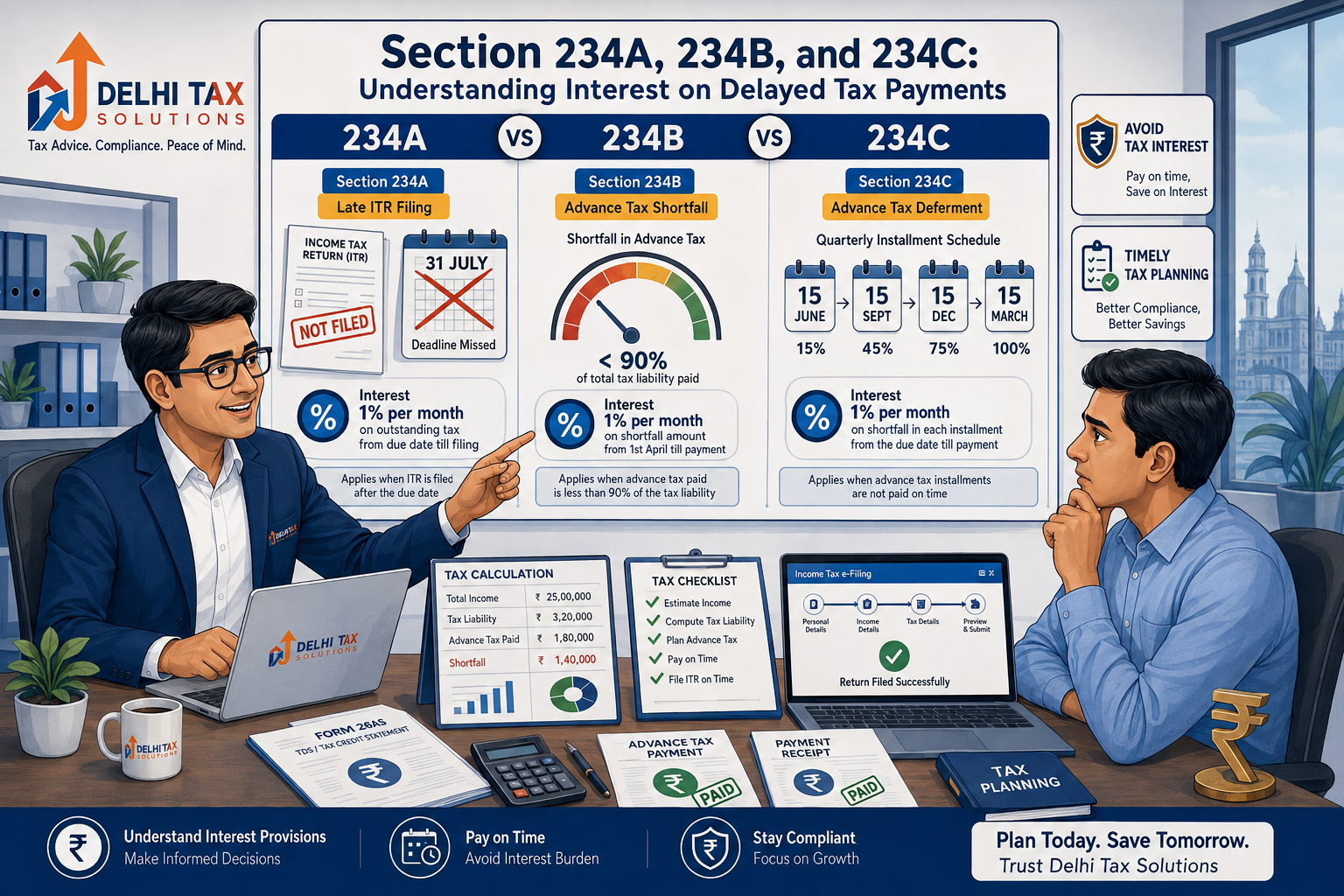
💡 Key Takeaways
- Section 234A levies a 1% monthly interest charge for delays in filing your income tax return.
- Section 234B applies a 1% monthly interest charge when advance tax paid is less than 90% of the assessed tax liability.
- Section 234C penalizes the deferment or short-payment of quarterly advance tax installments at 1% per month.
- All three sections operate concurrently, meaning a chronic non-complier can accumulate multiple compounding interest burdens.
- Proper tax planning and accurate advance tax estimations are essential to avoid these punitive charges during Income Tax Filing.
Navigating the architecture of Indian tax compliance requires more than just computing your total income and deductions; it requires strict adherence to statutory timelines. When a taxpayer misses a filing deadline or falls short of paying taxes as they accrue throughout the financial year, the Income Tax Act activates a triad of penal interest provisions: Sections 234A, 234B, and 234C. Understanding the distinct triggers, calculation methodologies, and statutory differences between these provisions is vital for both individual taxpayers and corporate entities. Mastering these rules prevents unexpected financial shocks when processing TDS Compliance and filing annual returns. Let us break down how each section operates and how you can protect your finances.
Section 234A: Interest for Default in Furnishing ITR
Trigger and Applicability
Section 234A is triggered when a taxpayer fails to furnish their income tax return within the stipulated statutory due date (e.g., July 31st for non-audit cases). If you have tax dues remaining after accounting for advance tax and TDS, and you miss the filing deadline, this section ensures you pay for the privilege of holding government funds past the legal limit. The interest for late ITR filing accumulates for every month or part of a month the return remains unfiled, starting from the day immediately following the due date.
Calculation Formula
The statutory interest rate under Section 234A is 1% per month (or part of a month). The calculation base is the total tax liability minus advance tax, TDS, TCS, and any relief claimed under Section 89. Crucially, any part of a month is counted as a full month. For example, a delay of even five days past the due date attracts a full month’s interest charge of 1%. This provision underscores why timely Income Tax Filing is non-negotiable.
Section 234B: Interest for Shortfall in Advance Tax Payment
Trigger and Applicability
While Section 234A penalizes late filing, Section 234B targets shortfalls in paying advance tax during the financial year. Under the Income Tax Act, anyone whose estimated tax liability is ₹10,000 or more in a financial year must pay advance tax in quarterly installments. Section 234B is triggered if you fail to pay advance tax, or if the total advance tax paid by you amounts to less than 90% of the assessed tax liability.
Calculation Mechanics
The interest for short advance tax payment is charged at 1% per month (or part of a month). The duration of the interest runs from the 1st of April of the assessment year up to the date of actual determination or regular assessment under Section 143(1). The principal base for this calculation is the assessed tax minus the advance tax already paid. Corporate entities undergoing formal Company Registration must monitor these advance tax thresholds meticulously to avoid severe cash flow penalties.
⚡ Core Distinction
Section 234A punishes you for *filing late*. Section 234B punishes you for *paying less than 90%* of your total advance tax liability by the end of the financial year.
Section 234C: Interest for Deferment of Advance Tax Installments
Trigger and Applicability
Even if you pay 90% of your tax by the end of the financial year (escaping Section 234B), you can still be penalized if you delayed your payments across specific quarters. Section 234C penalizes the deferment or short-payment of quarterly advance tax installments. The law mandates that taxpayers must pay specific cumulative percentages of their total tax liability by June 15, September 15, December 15, and March 15.
Quarterly Installment Benchmarks
To avoid Section 234C interest, your cumulative advance tax payments must meet these statutory thresholds:
- By June 15: At least 15% of total tax liability.
- By September 15: At least 45% of total tax liability.
- By December 15: At least 75% of total tax liability.
- By March 15: 100% of total tax liability.
If your payment falls below these milestones, interest is charged at 1% per month for a period of 3 months for the first three quarters, and 1 month for the final quarter. For business owners managing commercial assets, ensuring accurate Property Tax calculations alongside capital gains projections is essential to prevent quarterly advance tax miscalculations.
Comparative Overview: 234A vs 234B vs 234C
| Feature / Parameter | Section 234A | Section 234B | Section 234C |
|---|---|---|---|
| Primary Trigger | Delay in filing ITR past the due date. | Advance tax paid is less than 90% of assessed tax. | Shortfall in paying quarterly advance tax installments. |
| Interest Rate | 1% per month (or part of month). | 1% per month (or part of month). | 1% per month (or part of month). |
| Time Period | From due date to actual filing date. | From April 1st of AY to date of assessment. | Fixed 3-month period per quarter (1 month for Mar 15). |
| Calculation Base | Tax liability minus advance tax and TDS. | Assessed tax minus advance tax paid. | Shortfall amount in the specific quarterly installment. |
Avoiding Default and Professional Compliance
The Concurrence of Penalties
One of the most critical aspects of these provisions is that they are not mutually exclusive. If a taxpayer files their return late, failed to pay advance tax during the year, and missed quarterly milestones, the Income Tax Department will levy interest under all three sections simultaneously. This compounding stack of penalties can rapidly erode corporate profits and personal savings. External economic data published by the Press Information Bureau frequently emphasizes the government’s automated scrutiny of tax defaults.
Expert CA Advisory
Managing tax liabilities requires rigorous, proactive accounting. Regulatory bodies like the Reserve Bank of India and the Ministry of Corporate Affairs maintain stringent compliance standards that leave little room for error. If you are facing complex tax calculations, potential advance tax shortfalls, or pending return filings, do not risk accumulating heavy interest penalties. Talk to a Delhi Tax Solutions expert today. Our certified Chartered Accountants will audit your income streams, compute exact advance tax installments, and ensure your filings are completed accurately and on time.
Understanding the mechanics of Section 234A 234B 234C interest empowers you to take control of your financial planning and avoid unnecessary penalties. Whether you are managing individual investments or overseeing complex corporate structures, staying ahead of tax deadlines is the ultimate key to wealth preservation. Connect with Delhi Tax Solutions to secure professional guidance and achieve seamless, penalty-free compliance.
About this article: Researched using official government sources and Delhi Tax Solutions’ in-house tax advisory team. Last updated August 2026.
Frequently Asked Questions (FAQs)
Q: What is the difference between Section 234A, 234B, and 234C?
A: Section 234A penalizes delays in filing your income tax return. Section 234B penalizes a total advance tax payment of less than 90% of the assessed tax liability. Section 234C penalizes the deferment or short-payment of specific quarterly advance tax installments during the financial year.
Q: When does interest under Section 234A apply?
A: Section 234A interest applies when a taxpayer fails to file their income tax return by the statutory due date and has outstanding tax dues remaining. The interest is calculated at 1% per month on the net tax due, starting from the day after the due date until the return is actually filed.
Q: How is advance tax shortfall calculated under Section 234B?
A: Section 234B interest is charged at 1% per month if total advance tax paid is less than 90% of the assessed tax. The interest runs from April 1st of the assessment year until the date of regular assessment, calculated on the difference between the assessed tax and advance tax paid.
Q: What are the installment thresholds for Section 234C interest?
A: To avoid Section 234C interest, you must pay cumulative advance tax of at least 15% by June 15, 45% by September 15, 75% by December 15, and 100% by March 15 of the financial year. Falling below these thresholds triggers 1% monthly interest for the respective quarter.
Q: Can interest under Sections 234A, 234B, and 234C be waived?
A: Generally, interest under Sections 234A, 234B, and 234C is mandatory and statutory. However, the Chief Commissioner or Principal Chief Commissioner of Income Tax holds discretionary powers to waive or reduce interest under specific guidelines issued by the CBDT, such as cases of genuine hardship or unavoidable delays caused by departmental delays.
