💡 Key Takeaways: Section 129 vs 130
- Section 129 (Detention): Applied when goods are transported in contravention of rules, focusing on recovering tax and penalties for temporary release.
- Section 130 (Confiscation): Triggered when there is a proven fraudulent intent (mens rea) to evade tax, leading to absolute loss of ownership.
- Penalty Structures: Section 129 levies 200% tax or 50% of value, whereas Section 130 allows the department to confiscate goods and impose redemption fines.
- Procedural Safeguards: Transporters can contest arbitrary officer actions through Form GST MOV-09 and seek immediate legal remedies.
Imagine your delivery truck is carrying a high-value consignment across state borders. Ten miles into the journey, mobile squad officers flag down the vehicle. Upon inspection, they discover that the e-way bill expired twenty minutes prior due to traffic congestion. Panic sets in. Will the goods be temporarily held, or will the entire truck be seized permanently?
Navigating transit inspections under the Goods and Services Tax regime requires a precise grasp of enforcement provisions. The law draws a razor-sharp legal boundary between temporary detention under Section 129 and absolute confiscation under Section 130 of the CGST Act. Confusing these two sections can lead to severe financial damage and prolonged legal battles.
This comprehensive guide breaks down the core differences, statutory thresholds, and defensive steps every business owner and transporter must know to protect their working capital during highway inspections.
Understanding Section 129: Detention and Seizure
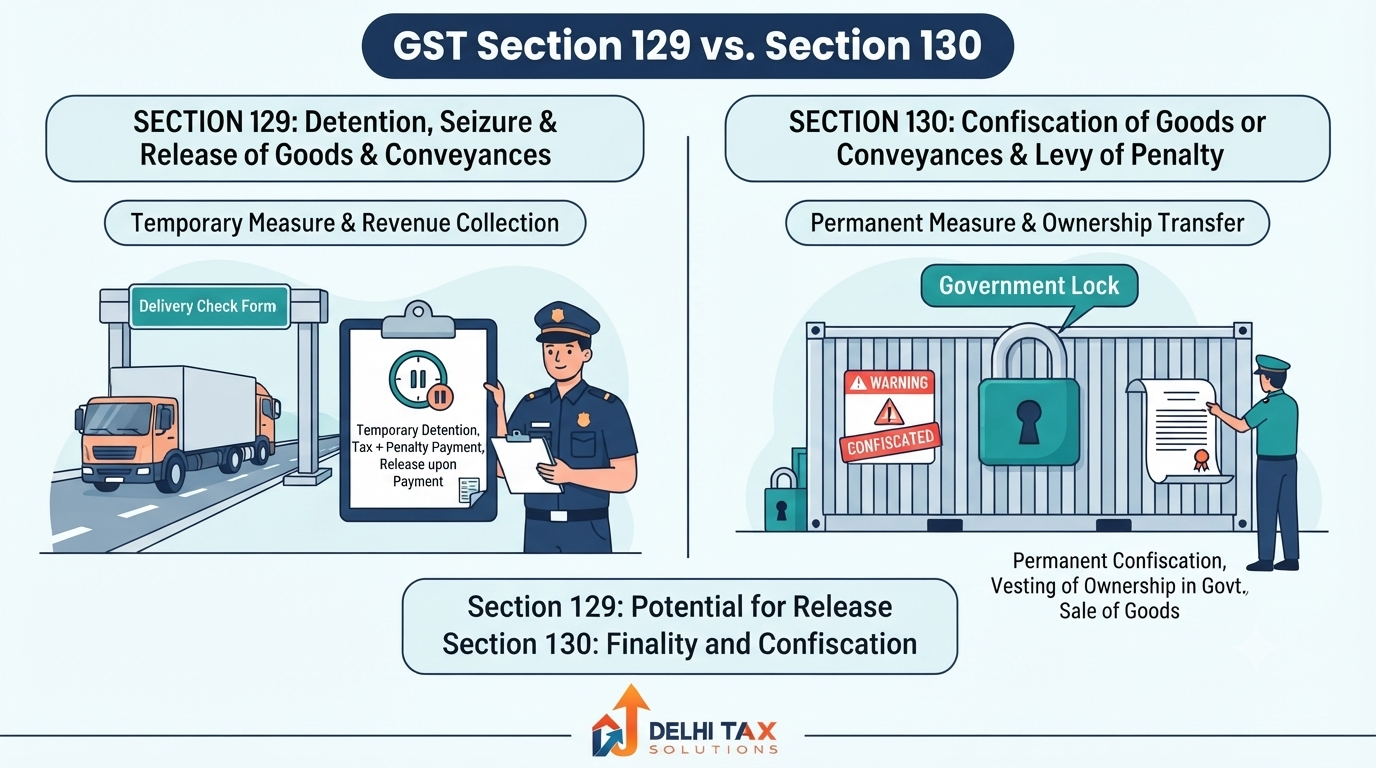
Section 129 of the CGST Act deals with the detention, seizure, and release of goods and conveyances in transit. When proper officers intercept a vehicle and discover that goods are being transported in contravention of GST provisions—such as missing documents, incorrect invoicing, or expired e-way bills—they have the statutory power to detain both the goods and the transport vehicle.
The primary objective of Section 129 is remedial, not punitive. It acts as a mechanism to secure the payment of applicable taxes and penalties without destroying the underlying commercial transaction. Once the owner or transporter pays the prescribed penalty amount or furnishes a bank guarantee, the officer is legally obligated to release the detained consignment.
Based on cases handled by our CA litigation team, most highway interceptions stem from clerical errors, typing mistakes in vehicle numbers, or minor transit delays. Quick intervention and proper documentation submission on the official GST Portal typically resolve Section 129 notices within 48 to 72 hours.
Understanding Section 130: Confiscation of Goods
While Section 129 handles temporary detention, Section 130 is far more severe. It deals with the absolute confiscation of goods and conveyances. This section is invoked when a taxpayer or transporter exhibits clear fraudulent intent—legally known as mens rea—to evade tax liabilities.
Section 130 can be triggered if an entity supplies or receives goods without a valid invoice with the intention to evade tax, deliberately conceals goods, fails to maintain proper books of accounts, or uses fraudulent documents. Under this section, ownership of the goods vests entirely with the government, and the taxpayer faces steep redemption fines over and above standard penalties.
According to rulings from the Central Board of Indirect Taxes, an officer cannot arbitrarily jump straight to Section 130 without first establishing tangible evidence of tax evasion intent. Initiating confiscation proceedings casually without proving fraudulent intent is routinely struck down by High Courts across India.
Key Differences Between Section 129 and 130
Recognizing when an inspection crosses the threshold from a simple documentation default into an evasion investigation is critical for formulating your legal defense. The structural differences between the two sections impact your financial liability and procedural options directly.
| Legal Parameter | Section 129 (Detention) | Section 130 (Confiscation) |
|---|---|---|
| Core Objective | Temporary hold to secure unpaid tax and penalty. | Permanent seizure due to proven intent to evade tax. |
| Requirement of Intent | Intent to evade tax is not mandatory (procedural lapses apply). | Proving fraudulent intent (mens rea) is strictly mandatory. |
| Financial Liability | 200% tax for taxable goods or 50% of invoice value. | Market value tax plus heavy redemption fines. |
| Release Mechanism | Immediate release upon payment of fine or security bond. | Goods vest in government; release depends on redemption fine. |
If you are managing routine supply chains, ensuring your GST registration details and e-way bill portals are seamlessly integrated prevents these disputes entirely. For background on maintaining compliant invoicing, reviewing our Letter of Undertaking guidelines provides additional safeguards.
Penalty Structures and Release Procedures
When an officer issues a detention order under Form GST MOV-06, they calculate financial penalties according to strict statutory formulas. For taxable goods, the penalty under Section 129(1)(a) is 200% of the tax payable. If the owner of the goods does not come forward, the penalty under Section 129(1)(b) jumps to 50% of the value of the goods reduced by the tax already paid.
To avoid lingering litigation, taxpayers often pay the disputed penalty under protest to release the vehicle. Once paid, the officer issues Form GST MOV-05, permitting the truck to resume its journey. However, paying under protest allows your consultant to file formal appeals later to recover erroneous collections.
Facing Vehicle Detention or GST Notices?
An arbitrary Section 130 confiscation notice or delayed Section 129 release order can disrupt your supply chain and trap crucial working capital.
The expert tax litigation team at Delhi Tax Solutions specializes in drafting rapid legal replies, challenging unlawful seizures, and streamlining your corporate compliance and tax filings.
Safeguards Against Arbitrary Seizures
Tax authorities do not possess absolute immunity during transit inspections. Judicial precedents consistently reinforce that minor documentation discrepancies—such as a spelling error in a buyer’s address or a minor technical glitch in e-way bill validity—cannot be weaponized under Section 130 to confiscate goods.
If an officer attempts to bypass Section 129 and invoke confiscation directly without establishing fraudulent intent, taxpayers have grounds to approach the High Court via a writ petition. Maintaining digital audit trails, GPS tracking logs on vehicles, and immediate communication with your tax advisor ensures you stay protected.
Mastering the nuances of Section 129 and Section 130 ensures your logistics operations run smoothly without fear of arbitrary harassment. Proactive compliance is your best defense against highway disputes. Connect with a Delhi Tax Solutions expert to audit your transport documentation today. Staying prepared protects your bottom line tomorrow.
Frequently Asked Questions (FAQs)
+ Q: What is the difference between detention and confiscation under GST?
A: Detention under Section 129 is a temporary hold of goods and vehicles due to minor documentary errors or procedural lapses, aimed at recovering taxes and penalties. Confiscation under Section 130 is a permanent penalty where ownership transfers to the government because tangible fraudulent intent (mens rea) to evade tax has been proven by the inspecting authorities.
+ Q: Can goods be confiscated under Section 130 without proving intent to evade tax?
A: No, multiple High Court rulings establish that Section 130 cannot be invoked for simple clerical or procedural errors. The department must legally prove the existence of mens rea—a deliberate, fraudulent intent to evade tax liabilities—before taking steps to confiscate goods and conveyances permanently.
+ Q: What is the penalty for transporting goods with an expired e-way bill under Section 129?
A: When goods are intercepted with an expired e-way bill, officers typically detain the consignment under Section 129. If the owner comes forward, the penalty is equal to 200% of the applicable tax for taxable goods. If the owner does not claim the goods, the penalty increases to 50% of the total invoice value minus tax paid.
+ Q: How can a transporter secure the release of a detained vehicle?
A: A transporter or owner can secure the immediate release of a detained vehicle by paying the assessed tax and penalty amount online via the GST portal, or by furnishing a security bond or bank guarantee equivalent to the penalty amount determined in Form GST MOV-06 or MOV-09.
+ Q: What is Form GST MOV-06 used for during transit inspection?
A: Form GST MOV-06 is the official order of detention issued by the proper tax officer when irregularities are found during transit inspection. It outlines the specific reasons for holding the consignment and details the estimated tax and penalty payable before the goods can be released.
About this article: Researched using official government sources, real-time competitor and search-trend analysis, and Delhi Tax Solutions’ in-house tax advisory team. Last updated September 2026.
Disclaimer: This article is for general informational purposes and is not a substitute for personalised professional tax advice. Please consult a qualified tax advisor or Chartered Accountant to ensure full compliance.