💡 Key Takeaways: Section 128A GST Waiver Scheme
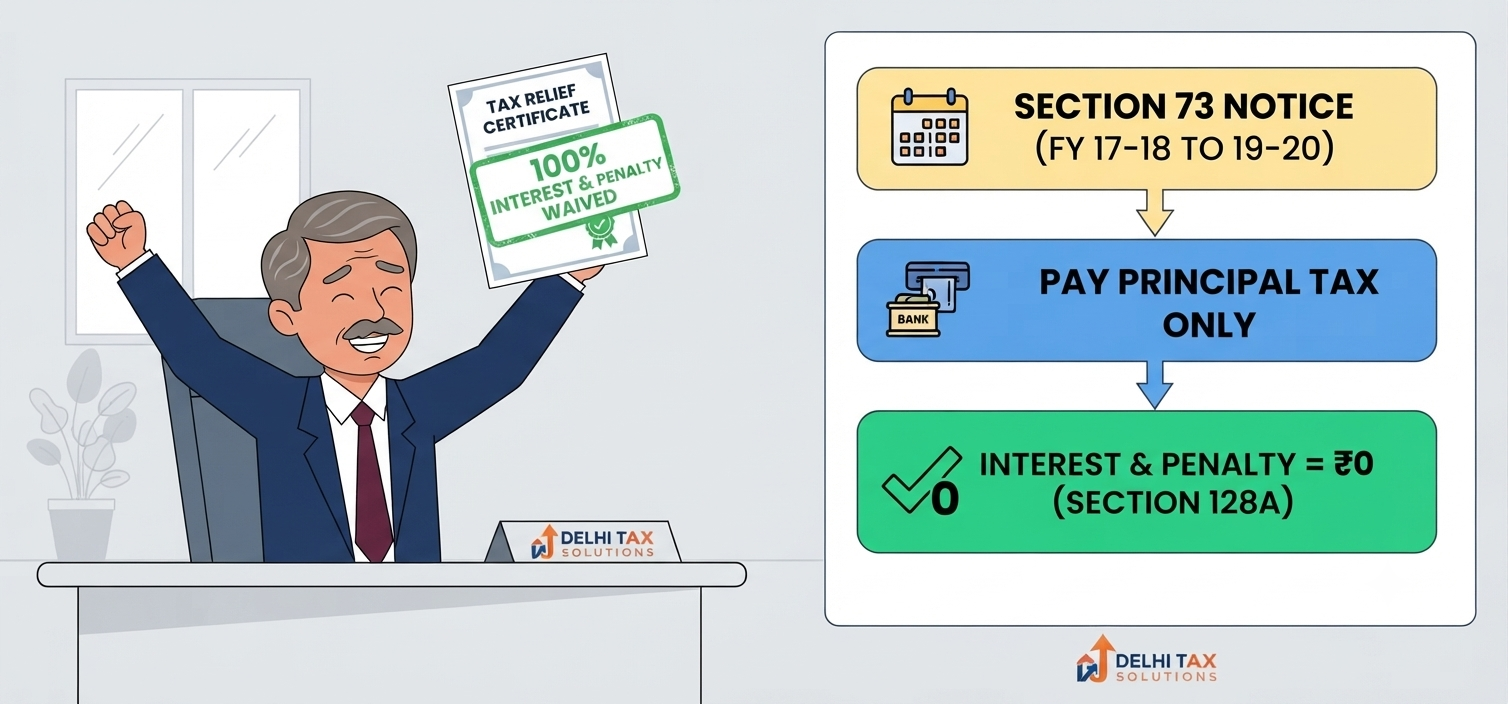
- 💡 100% Relief on Interest & Penalty: Section 128A waives the full interest and penalty amount for qualifying tax demands if the full principal tax demand is paid.
- 💡 Applicable Financial Years: The scheme specifically covers non-fraud demand notices issued for FY 2017-18, FY 2018-19, and FY 2019-20.
- 💡 Restricted to Section 73: The waiver applies strictly to demands raised under Section 73 (Non-Fraud) and does not cover cases involving fraud under Section 74.
- 💡 No Refund for Prior Payments: If a taxpayer has already paid interest and penalties before the notification of Section 128A, no refund will be issued by the department.
- 💡 Withdrawal of Appeals Mandatory: Taxpayers who have filed appeals against Section 73 orders must withdraw their appeals to claim benefit under this amnesty scheme.
In a historic move to clear the massive backlog of GST litigation and provide huge relief to honest taxpayers, the Central Government inserted Section 128A into the CGST Act following the key recommendations of the 53rd GST Council meeting. This conditional waiver scheme acts as a landmark amnesty program for businesses struggling with legacy demands from the initial years of GST implementation.
Navigating the statutory provisions of a section 128a waiver of interest penalty can save your business lakhs of rupees in accumulated interest and statutory fines. In this comprehensive guide, we unpack the eligibility criteria, coverage period, step-by-step procedures, and key exclusions under Section 128A.
What is Section 128A of the CGST Act?
Section 128A provides a statutory framework for waiving interest and penalties payable on tax demand notices issued under Section 73 of the CGST Act. During the transitional phase of GST (FY 2017-18 through FY 2019-20), many taxpayers made inadvertent calculation errors, ITC reconciliation mistakes, or delay-in-filing faults due to complex portal glitches and evolving laws.
Recognizing that these defaults were non-fraudulent, the legislature introduced Section 128A. Under this scheme, if a taxpayer pays the full amount of tax demanded in the Show Cause Notice (SCN) or adjudication order on or before the notified cutoff date, 100% of the interest under Section 50 and 100% of the penalty under Section 122/125 are completely waived.
Scope and Covered Financial Years
The benefit under Section 128A is not open-ended; it is strictly targeted toward the initial years of GST implementation. The scheme covers notices and orders issued for the following periods:
- Financial Year 2017-18
- Financial Year 2018-19
- Financial Year 2019-20
To qualify for the waiver, the tax demand must fall under any of the following three legal scenarios for the covered financial years:
- A Show Cause Notice (SCN) issued under Section 73(1) where no final order has been passed yet.
- An adjudication order passed under Section 73(9) by the proper officer where no appeal order has been issued.
- An order passed by the Appellate Authority (Section 107) or Revisional Authority (Section 108) under Section 73 proceedings.
Eligibility Criteria: Who Can Claim the Section 128A Waiver?
To successfully claim a complete waiver of interest and penalty, a taxpayer must fulfill the following mandatory conditions:
1. Payment of Principal Tax Demand
The taxpayer must deposit the entire principal tax liability stated in the notice or order before the statutory deadline specified by the government. Partial payment of tax will disentitle the taxpayer from receiving a waiver on the remaining portion.
2. Withdrawal of Pending Appeals and Writs
If the taxpayer has contested the demand by filing an appeal before the Appellate Authority, Appellate Tribunal, High Court, or Supreme Court, they must formally withdraw the appeal or writ petition before claiming relief under Section 128A. Proof of withdrawal must be submitted on the official portal.
3. Non-Fraud Classification
The demand notice must be strictly issued under Section 73 (non-fraud cases). If the demand was originally raised under Section 74 involving allegations of fraud, willful misstatement, or suppression of facts, Section 128A benefits cannot be claimed.
💡 Pro Tip: Re-determination of Fraud Notices
If an Appellate Authority or Tribunal determines that a notice issued under Section 74 was improper because fraud was not proven, and directs the demand to be re-determined under Section 73, the taxpayer becomes eligible to claim the Section 128A waiver!
Exclusions: Who Cannot Benefit From Section 128A?
The statute clearly demarcates cases where Section 128A cannot be invoked. You are ineligible for the interest and penalty waiver in the following situations:
- Demands Involving Erroneous Refunds: Demands pertaining to erroneous refunds issued by the department cannot be settled under this waiver scheme.
- Section 74 Proceedings: Demands raised for deliberate tax evasion, fake invoicing, or fraudulent ITC claims under Section 74 are explicitly excluded.
- Already Paid Interest and Penalties: If you have already settled the interest and penalty amounts prior to the notification of Section 128A, the law explicitly prohibits any refund of those amounts.
- Subsequent Financial Years: Demands for FY 2020-21 onwards cannot be settled under Section 128A.
For official circulars, notifications, and form mechanics regarding Section 128A, you can visit the official Central Board of Indirect Taxes and Customs (CBIC) portal.
Step-by-Step Procedure to Apply for Section 128A Waiver
Taxpayers seeking to benefit from Section 128A must follow these operational steps on the GST portal:
- Verify Pending Notices: Log into the GST Portal and navigate to ‘View Additional Notices and Orders’ to identify pending Section 73 SCNs or orders for FY 2017-18 to 2019-20.
- Pay Principal Tax: Deposit the exact principal tax amount using Form GST DRC-03 or through the designated payment gateway for the specific order.
- File Application Form: Submit the dedicated online application form prescribed for Section 128A waiver along with details of tax payment and proof of appeal withdrawal (if applicable).
- Order of Closure: Upon successful verification of the tax payment and withdrawal proof, the proper officer will issue a formal order concluding all proceedings without levying interest or penalty.
💡 Need Guidance to Claim Your Section 128A Waiver?
Calculating the correct principal tax liability and filing appeal withdrawal applications can be tricky. A single procedural error could cause you to lose your eligibility for a 100% interest and penalty waiver.
Maximize your tax relief with Delhi Tax Solutions. Our experienced GST advisory team will audit your pending SCNs, verify payment challans, file waiver applications, and ensure smooth conclusion of your legacy tax disputes.
Frequently Asked Questions (FAQs)
+ 💡 Q: What is Section 128A of the CGST Act?
A: Section 128A is an amnesty provision introduced via the Finance Act 2024 that provides a 100% waiver of interest and penalty for non-fraud demand notices (Section 73) pertaining to FY 2017-18, 2018-19, and 2019-20, provided the principal tax is paid in full.
+ 💡 Q: Does Section 128A apply to demand notices under Section 74?
A: No. Section 128A strictly excludes cases of fraud, willful misstatement, or suppression of facts issued under Section 74. It is applicable exclusively to non-fraud demands under Section 73.
+ 💡 Q: Can I get a refund if I have already paid the interest and penalty?
A: No. The law explicitly clarifies that no refund will be granted for interest and penalties that have already been paid prior to the notification of Section 128A.
+ 💡 Q: Is it necessary to withdraw pending appeals to claim Section 128A benefit?
A: Yes. If you have filed an appeal against a Section 73 order before any court or tribunal, you must formally withdraw the appeal and submit proof of withdrawal on the GST portal to avail of the waiver.
About this article: Based on Section 128A of the CGST Act, introduced via the Finance (No. 2) Act, 2024. Updated for 2026.
Disclaimer: This article is for educational and informational purposes only and does not constitute formal legal advice. Please consult a qualified GST professional to execute waiver applications on the portal.