⚠️ Key Takeaways: Section 122 GST Penalty
- 21 Specific Offences: Section 122(1) explicitly outlines 21 distinct statutory breaches, including issuing fake invoices, non-payment of collected tax, and fraudulent ITC claims.
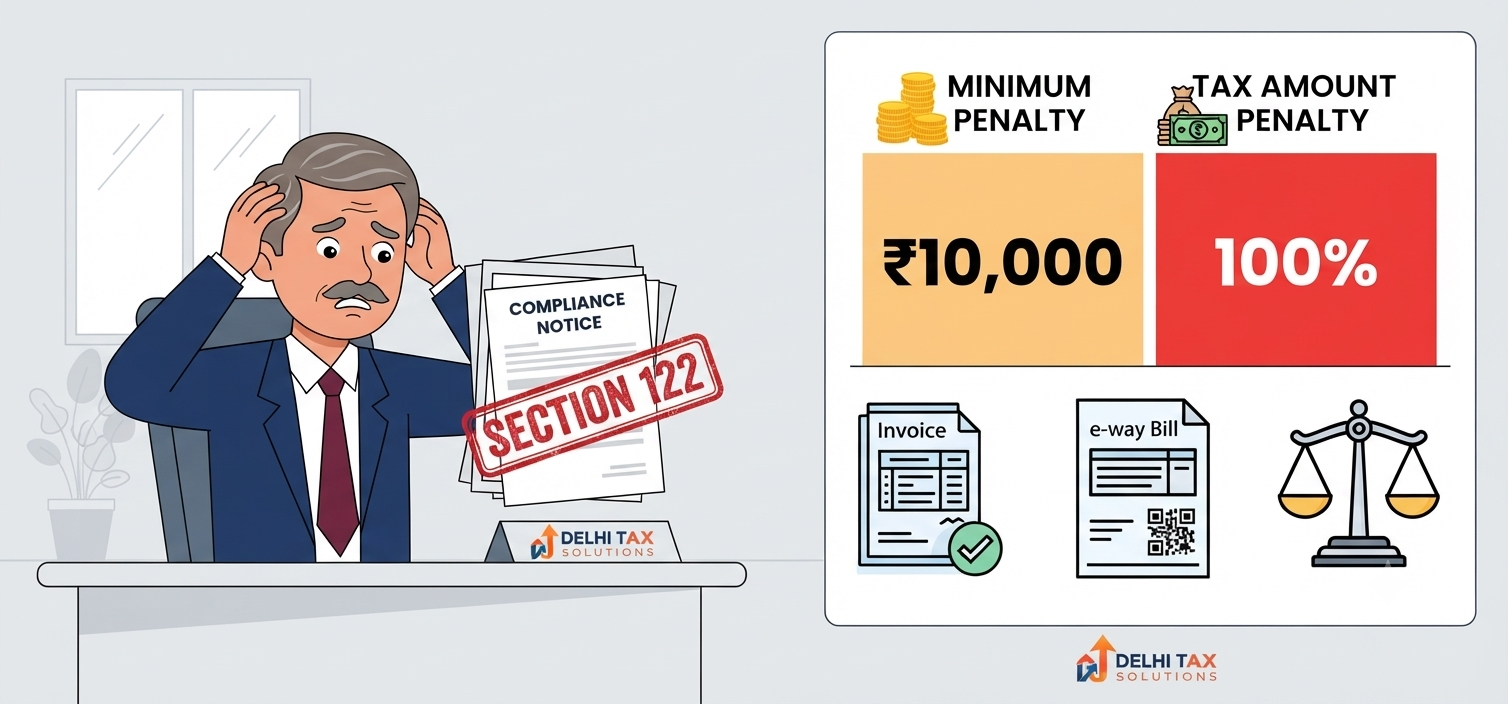
- Dual Penalty Rule: The standard penalty under Section 122(1) is ₹10,000 or 100% of the tax amount involved, whichever is higher.
- Penalties for Non-Taxpayers: Under Section 122(3), any person who aids, abets, or assists in committing GST fraud can face a personal penalty of up to ₹25,000.
- Beneficial Owner Liability: Section 122(1A) targets masterminds behind fake invoice rackets, holding beneficial owners directly liable for 100% tax penalties.
Under the Indian Goods and Services Tax (GST) law, tax authorities rely not only on demand and recovery provisions but also on strict penal clauses to deter non-compliance. While demand notices for unpaid tax are covered under Section 74 (Fraud Demands), the statutory infractions and misconduct committed by taxpayers are penalized under Chapter XIX of the CGST Act, primarily governed by Section 122.
A section 122 penalty can be triggered even if there is no direct tax evasion—such as transporting goods without mandatory documents or failing to maintain required accounts. Understanding how Section 122 operates is vital for businesses, tax professionals, and logistics providers to prevent heavy monetary fines and legal disputes.
The 21 Specified Offences Under Section 122(1)
Section 122(1) of the CGST Act lists 21 specific acts of commission or omission that attract penal action. These 21 offences can be broadly categorized into four primary groups:
1. Invoicing & Supply Violations
- Supplying goods or services without issuing an invoice, or issuing a false/incorrect invoice.
- Issuing an invoice or tax bill without making any actual supply of goods or services (popularly known as circular trading or fake invoicing).
- Issuing an invoice using another registered person’s GSTIN fraudulently.
2. Tax Collection & Refund Fraud
- Collecting GST from customers but failing to deposit it with the government within 3 months from the due date.
- Collecting tax in violation of GST provisions (e.g., non-registered persons collecting tax) and failing to deposit it within 3 months.
- Fraudulently obtaining a GST refund by misrepresenting facts or fabricating documents.
- Failing to deduct TDS (Tax Deducted at Source) under Section 51 or TCS under Section 52, or deducting less than required.
3. Input Tax Credit (ITC) Violations
- Availing or utilizing Input Tax Credit (ITC) without actual physical receipt of goods or services.
- Fraudulently claiming ITC in violation of statutory rules laid down by the Central Board of Indirect Taxes and Customs (CBIC).
- Distributing ITC in violation of ISD (Input Service Distributor) rules under Section 20.
4. Records, Logistics, & Compliance Failures
- Falsifying or destroying financial books, accounts, and business records to evade tax.
- Failing to maintain accounting records and invoices as required under the CGST Act.
- Transporting taxable goods without valid documents (e.g., moving goods without an generated E-way bill).
- Suppressing total taxable turnover to deliberately underreport tax liability.
- Failing to register under GST despite exceeding the mandatory aggregate turnover threshold.
- Tampering with or destroying evidence attached during tax proceedings or inspections.
Quantum of Penalty Under Section 122
The penalty amounts under Section 122 are structured based on the nature of the offence and whether the offender is directly involved or assisting in the breach.
| Subsection | Applicable Offence Category | Prescribed Statutory Penalty |
|---|---|---|
| Section 122(1) | Committing any of the 21 specified offences directly. | Higher of ₹10,000 OR 100% of tax evaded / ITC wrongfully availed / refund erroneously claimed. |
| Section 122(1A) | Beneficial owners who cause the commission of fraud or retain financial benefits. | 100% of the tax amount involved (Equal to the primary offender). |
| Section 122(2)(a) | Short payment or non-payment of tax for reasons other than fraud. | Higher of ₹10,000 OR 10% of tax due. |
| Section 122(2)(b) | Short payment or non-payment of tax with fraud intent. | Higher of ₹10,000 OR 100% of tax due. |
| Section 122(3) | Aiding, abetting, transporting illicit goods, or failing to attend summons. | Up to ₹25,000. |
Penalties on Non-Taxpayers & Third Parties (Section 122(3))
A common misconception is that GST penalties apply exclusively to registered taxpayers. Section 122(3) expands the scope to include accountants, transporters, warehouse operators, or any third party who participates in or aids tax fraud.
A penalty of up to ₹25,000 applies under Section 122(3) to any person who:
- Aids or abets any of the 21 specified offences under Section 122(1).
- Acquires, transports, stores, or receives goods that they know are liable to confiscation under GST law.
- Receives or deals with the supply of services in contravention of GST rules.
- Fails to appear when issued a legal summons by a GST officer under Section 70.
- Fails to issue a valid tax invoice when legally required to do so.
Taxpayers can regularly check notifications and administrative instructions regarding summons and penalties on the official GST Portal.
Section 122 vs. Section 73/74: Key Differences
It is important to differentiate between Section 122 penalties and tax recovery demands under Sections 73, 74, or Section 74A (Unified Demands). While Section 73 and Section 74 focus on recovering the unpaid tax principal along with mandatory interest under Section 50, Section 122 is a purely punitive provision levied for committing specific statutory offences.
In practice, when a tax officer issues a Show Cause Notice (SCN) for fraudulent tax evasion, they invoke Section 74/74A for recovering the tax along with Section 122 for imposing the penalty for the underlying offence.
Facing a Penalty Notice Under Section 122?
A Section 122 penalty notice can result in severe financial loss, confiscation of goods, and personal liability for business owners. Distinguishing between procedural lapses and deliberate evasion is critical for an effective legal defense.
Protect your business from heavy penalties with Delhi Tax Solutions. Our experienced GST litigators help you challenge improper penalty notices, represent your case before tax authorities, and ensure full statutory compliance.
Frequently Asked Questions (FAQs)
+ Q: What is the minimum penalty under Section 122 of CGST Act?
A: For any of the 21 specified offences under Section 122(1), the minimum penalty is ₹10,000. However, if 100% of the tax amount involved exceeds ₹10,000, the higher amount will be levied as the penalty.
+ Q: Can a non-registered person be penalized under Section 122?
A: Yes. Under Section 122(3), any person—whether registered under GST or not—who aids, abets, transports illicit goods, or fails to appear upon receiving a summons can be penalized up to ₹25,000.
+ Q: What is the penalty for issuing fake invoices under Section 122?
A: Issuing fake invoices without actual supply attracts a penalty equal to 100% of the tax amount passed on, subject to a minimum of ₹10,000. Both the issuer and the beneficial owner (under Section 122(1A)) are liable for 100% penalty.
+ Q: What happens if I fail to attend a GST summons under Section 70?
A: Ignoring a legally issued GST summons without a valid reason is an offence under Section 122(3)(d), making you liable to pay a personal penalty of up to ₹25,000.
About this article: Based on Section 122 of the CGST Act, 2017. Updated for 2026.
Disclaimer: This article is for educational and informational purposes only and does not constitute formal legal advice. Please consult a qualified GST advisor to defend against penal proceedings.