💡 Key Takeaways:
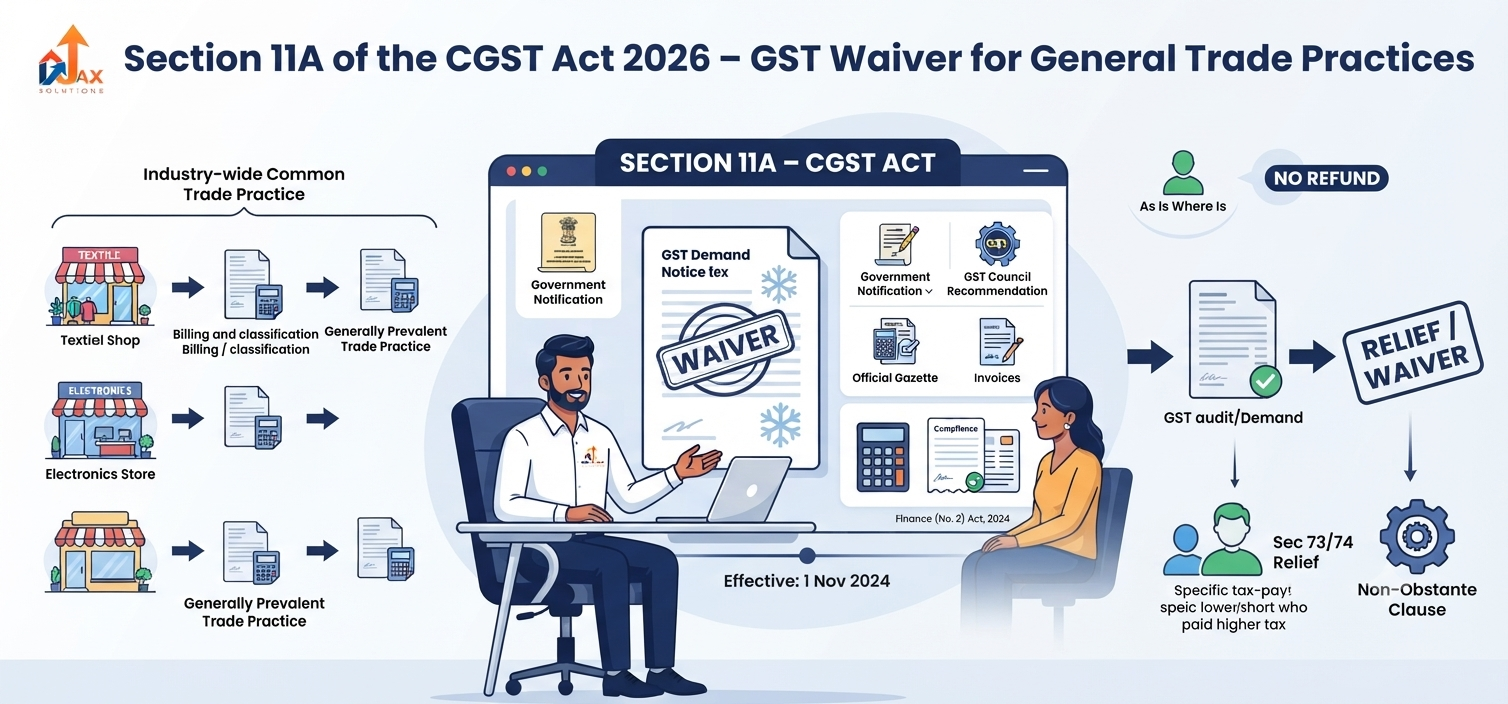
- Section 11A empowers the government to waive uncollected or short-levied GST resulting from general trade practices.
- Introduced via the Finance (No. 2) Act, 2024, effective November 1, 2024, to reduce industry litigation.
- Relief operates on an “as is where is” basis; businesses that already paid higher taxes receive no refunds.
- The provision overrides conflicting clauses through a powerful non-obstante mechanism.
Navigating indirect tax ambiguities often exposes businesses to retrospective compliance risks when trade practices clash with strict statutory interpretations. Recognizing the need for administrative fairness, the government introduced a powerful legislative tool to address widespread compliance discrepancies without penalizing honest taxpayers.
Section 11A of the CGST Act establishes a legal mechanism to regularize situations where central tax was either not levied or was short-levied due to generally prevalent industry practices. For MSMEs, manufacturers, and service providers, understanding this provision is vital for defending against legacy audit demands and managing cash flows effectively.
This comprehensive guide explores the mechanics of Section 11A, examining its statutory scope, procedural conditions, impact on demand notices, and expert insights from our practice.
What is Section 11A of the CGST Act?
Section 11A of the CGST Act is a statutory provision that empowers the Central Government, upon recommendations from the GST Council, to issue official notifications directing that central tax which was not levied or was short-levied as a result of a generally prevalent trade practice shall not be required to be paid. This provision resolves historical classification or valuation disputes by granting administrative relief on an “as is where is” basis across entire industry sectors.
Understanding the Core Mechanics of the Waiver
The operational framework of Section 11A relies on specific legislative triggers designed to balance state revenue collection with corporate stability.
The Non-Obstante Override Clause
As detailed in Section 11A of the CGST Act, the provision begins with a non-obstante clause, meaning it overrides any conflicting recovery mechanisms contained within the broader tax statute. This ensures that when an official notification is issued, it legally supersedes routine tax recovery demands.
Proper record-keeping during your initial company registration in India helps enterprises substantiate historical trade practices when industry-wide clarifications are issued.
Generally Prevalent Practice Standard
To qualify for relief, the government must be satisfied that a specific billing or valuation practice was widely followed across a trade or industry sector due to genuine ambiguity. Isolated billing errors or individual taxpayer oversights do not qualify; the practice must reflect a generalized market norm endorsed by common commercial behavior.
The “As Is Where Is” Principle and Refund Restrictions
A critical dimension of Section 11A is its strict boundary regarding financial restitution for compliant businesses.
Freezing Past Liabilities Without Cash Refunds
When the government issues a notification under Section 11A regularizing a short-levy, the past period is frozen as it stands. Businesses that followed the prevailing practice and paid lower or zero tax are shielded from differential demands. However, the statute explicitly bars any cash refund of central tax that has already been collected and paid by scrupulous taxpayers who charged the higher rate.
Filing and Portal Reconciliation
Managing compliance updates requires seamless interaction with the official GST Portal. Maintaining transparent documentation ensures your monthly filings reflect regulatory adjustments correctly.
Securing professional guidance through timely GST registration online safeguards your enterprise against sudden classification disputes.
Impact on Audit Demands Under Sections 73 and 74
Tax audit notices frequently originate from discrepancies between expected tax rates and actual industry invoicing practices.
Halting Retrospective Scrutiny
Prior to the introduction of this section, tax authorities routinely issued show-cause notices under Section 73 and Section 74 of the CGST Act, demanding differential tax with heavy interest and penalties. Section 11A complements exemption provisions by halting these demands for covered periods once an official notification is published.
Reduction of Legal Litigation
By providing an administrative resolution route, the provision significantly curtails prolonged tribunal litigation. Tax tribunals can dispose of pending appeals by referencing government notifications issued under this section, freeing up judicial bandwidth.
Summary Comparison Table: Standard Demands vs. Section 11A Relief
To help corporate finance teams evaluate compliance exposure, the table below compares regular audit recovery mechanisms with Section 11A waivers.
| Compliance Parameter | Standard Audit Recovery (Sec 73/74) | Section 11A Waiver Regularization |
|---|---|---|
| Trigger Basis | Individual audit discrepancies or misclassifications. | Generally prevalent industry-wide trade practices. |
| Tax Liability | Mandatory recovery of differential tax plus interest. | Whole or excess central tax waived via notification. |
| Penalty & Interest | Imposed automatically based on statutory timelines. | Waived entirely for the regularized period and supply type. |
| Refund Eligibility | Not applicable to standard demand dispute resolutions. | Explicitly barred for taxpayers who paid higher tax. |
| Enforcement Authority | State and central adjudicating tax officers. | Central Government upon GST Council recommendation. |
What Our CA Team Sees in Practice: Common Audit Pitfalls
In our indirect tax practice, we frequently observe businesses misinterpreting Section 11A as a blanket pardon for all historical tax defaults. Taxpayers must realize that relief is never automatic; it requires an explicit government notification specifying the exact supply category, trade practice description, and applicable timeline.
Another recurring pitfall involves companies attempting to claim refunds on past tax payments after an industry-wide notification is published. Because the statute explicitly prohibits refunds on taxes already deposited, internal accounting teams must verify eligibility criteria carefully before altering pricing or invoicing structures.
In a Nutshell
Section 11A waives short-levied tax resulting from general trade practices but offers zero refunds to businesses that already paid higher taxes.
Conclusion
Mastering Section 11A of the CGST Act is essential for protecting business working capital against unexpected retrospective tax liabilities. Remember that relief requires formal notification, applies strictly on an “as is where is” basis, and overrides standard audit demands.
Proactive compliance monitoring ensures your enterprise remains shielded from evolving regulatory interpretations. Do not let complex tax recovery rules disrupt your business growth. Speak with a Delhi Tax Solutions expert today to review your historical invoicing and tax risk profile.
You can explore additional financial insights across our tax and finance blogs. Staying informed protects your business against unexpected tax liabilities.
About this article: Researched using official government sources, real-time competitor and search-trend analysis, and Delhi Tax Solutions’ in-house tax advisory team. Last updated September 2026.
Disclaimer: This article is for general informational purposes and is not a substitute for personalised professional tax advice.
Frequently Asked Questions (FAQs)
Q: What is Section 11A of the CGST Act and why was it introduced?
A: Section 11A of the CGST Act is a legislative provision introduced via the Finance (No. 2) Act, 2024, effective November 1, 2024, designed to empower the government to waive the recovery of central tax that was not levied or was short-levied due to generally prevalent industry trade practices, thereby reducing unnecessary litigation and providing fairness in tax administration.
Q: How does a generally prevalent trade practice qualify for a tax waiver under Section 11A?
A: To qualify for a waiver under Section 11A, the Central Government must be officially satisfied that a specific billing, valuation, or classification practice was widely followed across an entire industry sector due to genuine ambiguity. Once satisfied, the government issues an official notification in the Official Gazette upon recommendations from the GST Council specifying the covered supplies and time period.
Q: Are businesses that already paid the higher tax eligible for refunds under Section 11A?
A: No, businesses that already collected and paid the higher rate of central tax are not eligible for cash refunds under Section 11A. The provision operates strictly on an “as is where is” basis, meaning past payments remain locked in, and relief is limited to waiving unpaid or short-levied differential tax for entities that followed the prevailing industry practice.
Q: How does Section 11A impact pending demand notices issued under Section 73 or Section 74?
A: Section 11A incorporates a powerful non-obstante clause that overrides conflicting provisions within the CGST Act. When the government issues a formal notification regularizing a specific trade practice for a designated period, pending audit recovery demands, show-cause notices, and associated penalty proceedings initiated under Section 73 or 74 for those supplies are rendered non-enforceable.
Q: What procedural steps must the government take to issue a waiver notification?
A: The procedural mechanism requires two vital steps: first, the GST Council must thoroughly review the industry practice and formulate a formal recommendation; second, the Central Government must issue an explicit notification in the Official Gazette specifying the exact description of supplies, the applicable retrospective or prospective time frame, and any conditional compliance requirements.
