
💡 Key Takeaways
- Residential status under Section 6 of the Income Tax Act is determined solely by physical stay in India during a financial year, independent of citizenship.
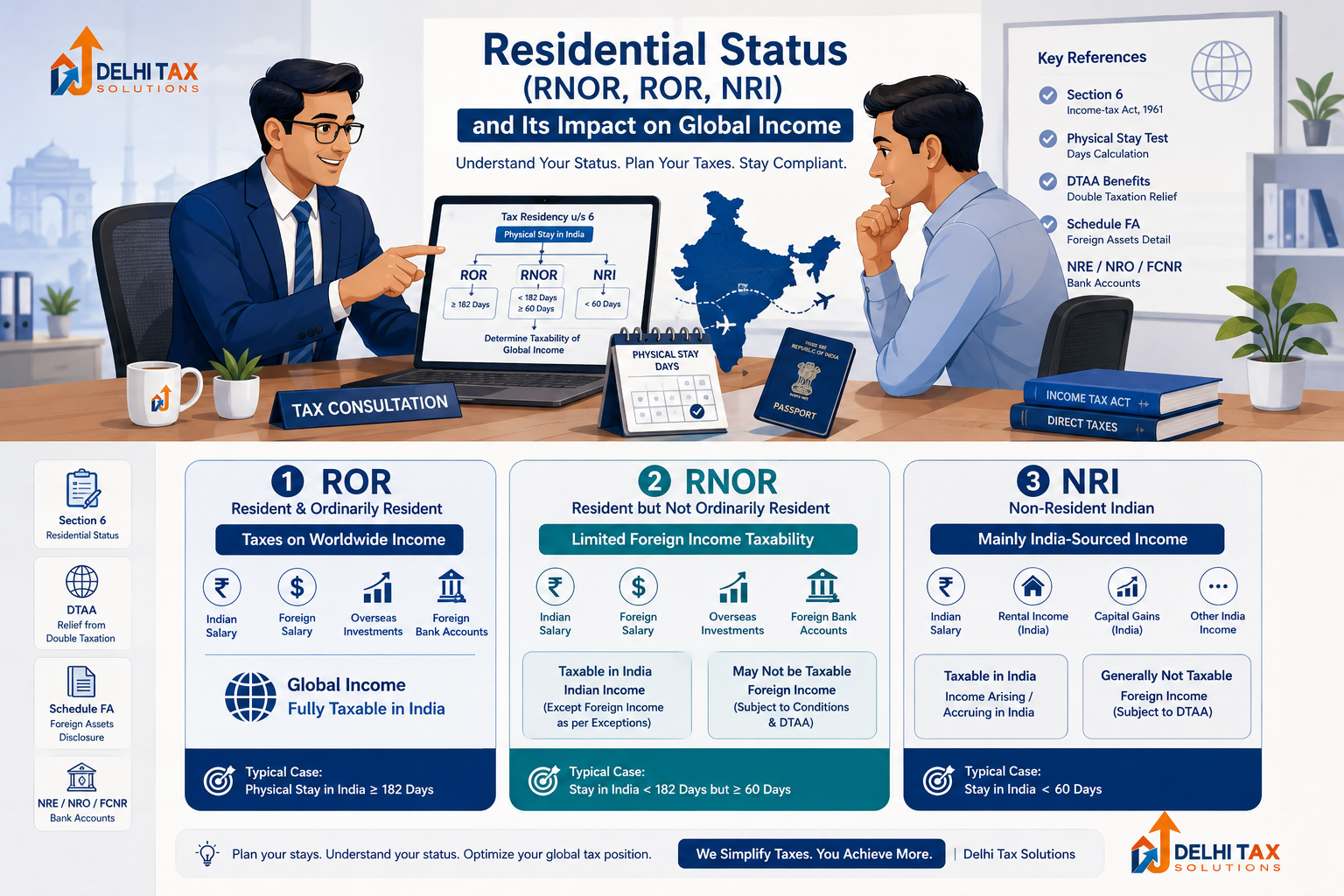
- Resident and Ordinarily Residents (ROR) are taxed on worldwide global income and must report foreign assets.
- Non-Resident Indians (NRIs) and Resident but Not Ordinarily Residents (RNOR) are taxed primarily on income earned, accrued, or received in India.
- RNOR status provides a 1-to-3-year tax shelter window for returning expats to reorganize foreign investments tax-free.
- Accurate tax classification ensures seamless Income Tax Filing without unexpected double taxation.
For individuals with cross-border income, foreign assets, or plans to move between countries, determining your residential status RNOR ROR NRI in India is the single most important step in tax planning. Under Section 6 of the Income Tax Act, tax liability is driven entirely by physical presence rather than nationality or visa type. Miscalculating your physical stay can expose your global earnings to Indian taxation or lead to compliance penalties. Whether you are managing domestic earnings or structuring offshore entities via Company Registration, understanding these rules guarantees full statutory compliance while optimizing tax exposure.
Determining Your Residential Status: Basic & Additional Rules
Step 1: The Basic Test (Resident vs. Non-Resident)
An individual is classified as an Indian Resident for a financial year if they satisfy either of the following basic conditions:
- Physical presence in India for 182 days or more during the financial year; OR
- Physical presence in India for 60 days or more during the financial year AND 365 days or more across the 4 preceding financial years.
Note: For Indian citizens or Persons of Indian Origin (PIO) visiting India, or citizens leaving India for employment, the 60-day threshold is relaxed to 182 days (or 120 days if Indian-sourced taxable income exceeds ₹15 Lakhs).
Step 2: The Additional Test (ROR vs. RNOR)
If an individual qualifies as a Resident, they must then be tested to determine whether they are a Resident and Ordinarily Resident (ROR) or a Resident but Not Ordinarily Resident (RNOR). A resident becomes an ROR only if they fulfill both of the following additional conditions:
- They have been a resident of India in at least 2 out of the 10 preceding financial years; AND
- They have stayed in India for 730 days or more during the 7 preceding financial years.
If a resident fails to meet even one of these additional conditions, they are classified as an RNOR.
Taxability of Global Income Across Statuses
1. Resident and Ordinarily Resident (ROR)
For an ROR, Indian income tax applies to worldwide earnings. Regardless of where money is earned or received, foreign salary, offshore capital gains, rental returns on overseas properties, and international dividend income must be declared in India. RORs are also mandated to report all foreign bank accounts and assets in Schedule FA during return filing.
2. Resident but Not Ordinarily Resident (RNOR)
RNOR status offers crucial tax relief. Foreign income earned outside India is non-taxable in India for an RNOR, unless it is derived from a business controlled from India or a profession set up in India. This acts as a protective buffer for returning NRIs during their transition period.
3. Non-Resident Indian (NRI)
An NRI is taxed strictly on income that accrues, arises, or is received directly in India. Foreign salary, offshore investments, and overseas rental yields are completely tax-exempt in India. However, Indian income like local rental yields subject to Property Tax, bank interest, or domestic dividends remain fully taxable.
⚡ RNOR Advantage
Returning expats can maintain RNOR status for 1 to 3 years depending on prior stay patterns, allowing them to bring foreign savings to India and liquidate offshore assets without Indian tax liability.
| Type of Income | ROR Taxability | RNOR Taxability | NRI Taxability |
|---|---|---|---|
| Income earned & received in India | Taxable | Taxable | Taxable |
| Income earned outside, received in India | Taxable | Taxable | Taxable |
| Foreign business (controlled from India) | Taxable | Taxable | Non-Taxable |
| Pure Foreign Income (earned & received abroad) | Taxable (Worldwide) | Non-Taxable | Non-Taxable |
Key Regulatory and Compliance Considerations
TDS Rules for Cross-Border Payments
Payments made to NRIs (such as property sale proceeds or bank interest) are subject to stringent TDS Compliance rules under Section 195. Deductors must withhold tax at peak applicable rates unless a lower withholding certificate is obtained from the revenue authorities.
Business Operations & GST Implications
NRIs establishing business ties or freelance operations in India must monitor threshold limits. Providing cross-border consultancy or digital services may trigger mandatory GST Registration regardless of physical residency.
Professional Advisory and Strategic Guidance
Navigating RBI and Ministry Regulations
Tracking physical stay requires precise documentation, including passport stamp logs, boarding passes, and bank statements. Guidelines issued by the Income Tax Department and press updates from the Press Information Bureau emphasize strict verification of physical stay days. Foreign exchange inward remittances and account conversions (NRE/NRO/FCNR) are governed under frameworks established by the Reserve Bank of India, while corporate directorships require adherence to the Ministry of Corporate Affairs regulations.
Consulting Chartered Accountants
Misclassifying your residential status can result in double taxation or severe penalties for failing to disclose foreign assets. If you are relocating to India, working remotely across borders, or managing dual-country investments, expert guidance is vital. Talk to a Delhi Tax Solutions expert today. Our certified Chartered Accountants will calculate your exact physical stay, optimize your RNOR transition, ensure DTAA relief, and file flawless tax returns.
Understanding how residential status is determined gives you complete control over your cross-border tax liability. Connect with Delhi Tax Solutions to safeguard your international income and maintain seamless tax compliance.
About this article: Researched using official government sources and Delhi Tax Solutions’ in-house tax advisory team. Last updated August 2026.
Frequently Asked Questions (FAQs)
Q: How is residential status determined for an individual under Section 6?
A: Residential status is calculated based on the number of days an individual is physically present in India during the financial year (April 1 to March 31). Meeting the 182-day rule or the 60-day/365-day rule classifies an individual as a Resident.
Q: What is the difference between ROR, RNOR, and NRI status in India?
A: RORs are full residents taxed on global worldwide income. RNORs are residents who do not meet historical stay conditions and are exempt from Indian tax on foreign income. NRIs do not meet basic stay conditions and are taxed only on Indian-sourced income.
Q: Is global income taxable for an NRI or RNOR in India?
A: No. Pure foreign income earned and received outside India is not taxable for NRIs or RNORs. Global income is taxable in India only for individuals who qualify as ROR (Resident and Ordinarily Resident).
Q: What are the tax benefits of holding RNOR status upon returning to India?
A: RNOR status grants returning expats a 1-to-3-year tax shelter window during which their offshore investments, foreign interest, and overseas asset sales remain completely exempt from Indian income tax.
Q: How does physical stay calculation affect foreign asset reporting?
A: Foreign asset reporting in Schedule FA is mandatory only for individuals who qualify as ROR. RNORs and NRIs are not required to disclose foreign bank accounts or overseas properties in their Indian tax returns.
