💡 Key Takeaways:
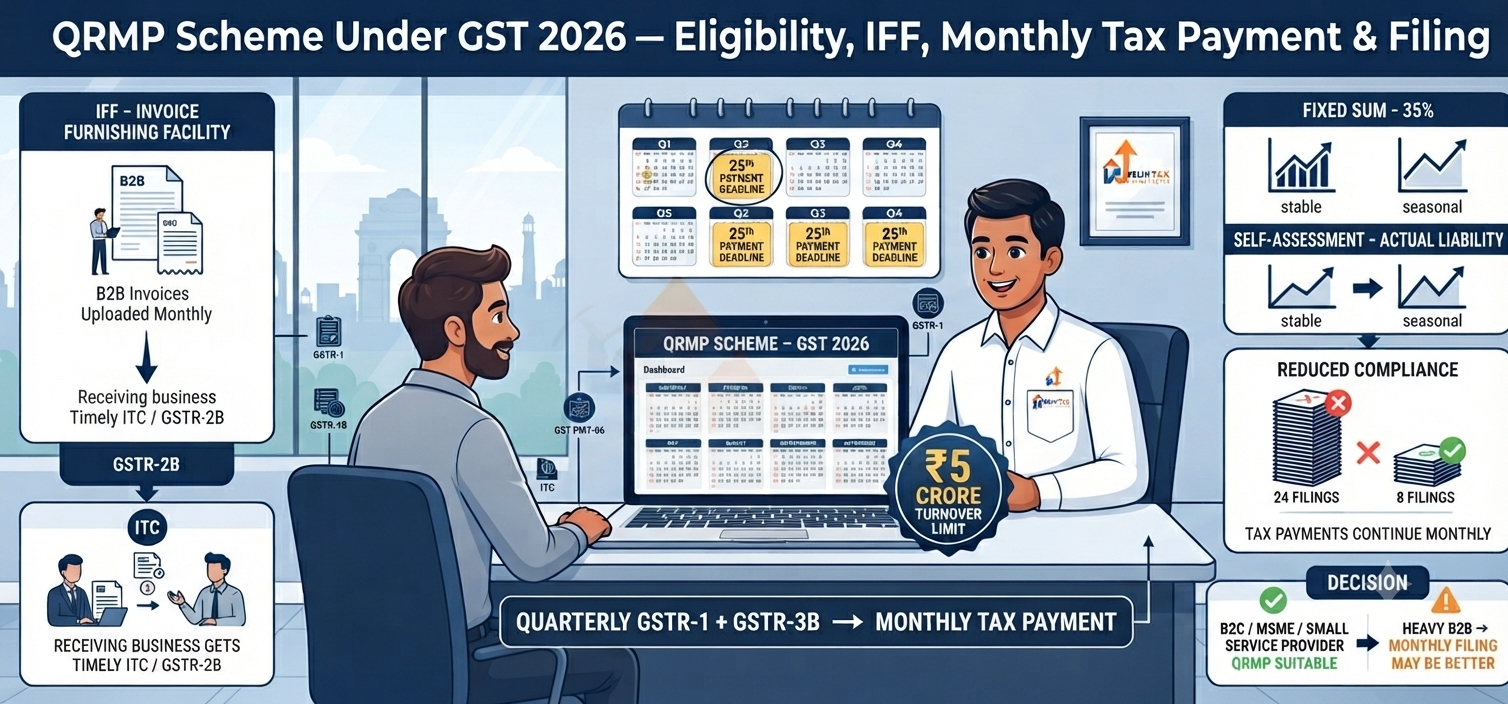
- You file returns 4 times a year, but pay tax 12 times a year.
- The Invoice Furnishing Facility (IFF) lets you upload B2B invoices monthly so your buyers can claim ITC on time.
- You can choose between the Fixed Sum Method (auto-calculated 35%) or the Self-Assessment Method to pay your monthly tax dues.
Managing Goods and Services Tax compliance in India can feel like a full-time job. Between filing GSTR-1, reconciling GSTR-2B, and paying your GSTR-3B liability, small business owners often spend more time on paperwork than on growth. Enter the QRMP scheme. Introduced by the CBIC, this facility is a lifeline for MSMEs and startups, bringing down compliance frequency while keeping tax flow disciplined.
Let’s break down exactly what this scheme entails for FY 2025-26, whether you qualify, and how to use the GST portal to your advantage.
What is the QRMP Scheme Under GST?
The Quarterly Return Filing and Monthly Payment of Taxes (QRMP) scheme is a compliance initiative under the GST framework tailored for small taxpayers. Under this system, eligible businesses file their GSTR-1 and GSTR-3B returns once every quarter, but they continue to pay their calculated tax liabilities every month using form GST PMT-06.
It essentially separates the data reporting from the tax paying. Less data entry. Fewer deadlines. Better peace of mind.
QRMP Scheme Eligibility Criteria (FY 2025-26)
Not everyone can jump onto the quarterly bandwagon. The government has set specific thresholds to ensure this benefits true MSMEs. To opt into the scheme, your business must meet the following criteria:
- Turnover Limit: Your PAN-based aggregate annual turnover must be up to ₹5 crore in the current and preceding financial year. (According to GST Council guidelines).
- Up-to-date Filings: You must have filed your last due GSTR-3B return before opting in.
- Registration Type: You must be a regular taxpayer. Those under the Composition Scheme cannot opt for QRMP.
Note: If you cross the ₹5 crore aggregate annual turnover threshold mid-year, you will automatically become ineligible for the QRMP scheme from the very next quarter.
How the Invoice Furnishing Facility (IFF) Works
The biggest problem with quarterly GST filing used to be buyer pushback. If you filed quarterly, your B2B clients had to wait three months to see the input tax credit (ITC) reflect in their GSTR-2B. To solve this, the GST network introduced the Invoice Furnishing Facility (IFF).
The IFF allows you to upload your B2B invoices (up to a limit of ₹50 lakh per month) for the first two months of the quarter. This means your buyers get their ITC on time, and you don’t lose business to competitors who file monthly.
No paperwork headache. Fully online. Done in days. The IFF is technically optional, but highly recommended if you deal with registered businesses.
Monthly Tax Payment: Fixed Sum vs Self-Assessment
For the first two months of any quarter, you must pay your tax liability by the 25th of the following month using the PMT-06 challan. You have two ways to calculate this:
| Feature | Fixed Sum Method | Self-Assessment Method |
|---|---|---|
| How it works | The portal auto-generates a challan equal to 35% of the cash paid in the last quarter (or 100% of the last month). | You calculate actual outward liability, minus available ITC in GSTR-2B, and pay the exact balance. |
| Best for | Service providers or businesses with consistent, steady month-to-month sales. | Seasonal businesses or startups with fluctuating monthly revenue. |
| Interest Risk | No interest is charged even if actual liability is higher, provided the 35% is paid on time. | Interest applies if you miscalculate and pay less than your actual liability. |
What Our CA Team Sees in Practice
“At Delhi Tax Solutions, a common mistake we see MSME clients make is adopting the QRMP scheme simply to ‘save accountant fees,’ without considering their customer base. If 90% of your revenue comes from strict B2B clients, managing the IFF every month can end up taking almost as much effort as a regular GSTR-1 filing. We usually recommend QRMP for B2C retailers, e-commerce sellers, and small service providers. If you have heavy B2B volume, regular monthly filing often prevents reconciliation disputes with buyers.”
How to Opt In or Opt Out on the GST Portal
The window to opt into the QRMP scheme is highly specific. You can exercise this option between the 1st of the second month of the preceding quarter to the last day of the first month of the quarter you are applying for.
To opt in: Log in to the official GST Portal. Navigate to Services > Returns > Opt-in for Quarterly Return. Select the relevant financial year, and save your preference. This preference will roll over automatically to future quarters unless you choose to opt out or your turnover exceeds the ₹5 crore threshold.
If you’re unsure if this transition makes sense for your books, our experts can help you assess your compliance structure before you start a business or change your tax profile.
Late Fees & Interest Under QRMP
Just because your return filings are quarterly doesn’t mean the government is lenient on delays. If you miss your quarterly GSTR-3B deadline (usually the 22nd or 24th of the month following the quarter, depending on your State), late fees will apply.
As per the CGST Act, late fees are applied at ₹50 per day (₹25 CGST + ₹25 SGST) for regular returns, capped at ₹5,000 per quarter. For nil returns, this is reduced to ₹20 per day, capped at ₹500. Additionally, any delayed tax payments will attract an interest rate of 18% p.a.
Conclusion
The QRMP scheme is a fantastic tool designed to foster ease of doing business for India’s MSME sector. By shifting the bulk of data reporting to a quarterly cadence while preserving monthly revenue flow for the government, it strikes a practical balance. Whether you choose the Fixed Sum method for sheer simplicity or rely on the IFF to keep your B2B buyers happy, understanding these mechanics is key to seamless GST registration and compliance. Need help optimizing your tax cycle? Contact the experts at Delhi Tax Solutions today.
Disclaimer: The information provided in this article is based on the GST laws and CBIC notifications effective as of 2026. Tax regulations are subject to change. This content is for informational purposes only and does not constitute formal legal or tax advice. We strongly advise consulting with a qualified Chartered Accountant at Delhi Tax Solutions regarding your specific business scenarios.
Frequently Asked Questions (FAQs)
Q: What is the QRMP scheme eligibility limit in 2026?
A: To be eligible for the QRMP scheme in FY 2025-26, your business must have an aggregate annual turnover of up to ₹5 crore (based on your PAN) in both the preceding financial year and the current financial year. If your turnover crosses this threshold at any point, you automatically migrate back to the regular monthly filing cycle.
Q: How do I pay monthly tax under the QRMP scheme?
A: Even though you file returns quarterly, you must deposit your tax liability for the first two months of the quarter using form GST PMT-06. You can choose to pay either 35% of the previous quarter’s cash tax liability (Fixed Sum Method) or calculate your exact monthly liability minus ITC (Self-Assessment Method). Payment is due by the 25th of the following month.
Q: Is the Invoice Furnishing Facility (IFF) mandatory for QRMP taxpayers?
A: No, the Invoice Furnishing Facility (IFF) is strictly an optional facility. However, if you supply goods or services to registered B2B buyers, it is highly recommended to use the IFF to upload those specific invoices. This ensures your buyers can claim their Input Tax Credit (ITC) promptly without waiting for your quarterly GSTR-1 filing.
Q: Can I switch back to monthly returns if QRMP doesn’t suit my business?
A: Yes, you have full flexibility to opt out of the QRMP scheme. You can change your preference back to monthly filing on the GST portal during the designated window: between the 1st of the second month of the preceding quarter and the last day of the first month of the new quarter.
Q: Do I have to pay interest if I use the Fixed Sum Method and my actual tax was higher?
A: No. One of the biggest advantages of the Fixed Sum Method is that as long as you pay the system-generated 35% challan on time by the 25th, the government will not charge any interest for the first two months, even if your actual tax liability when filing the quarterly GSTR-3B turns out to be higher.
