
💡 Key Takeaways:
- GST on services follows destination principles anchored to the location of the recipient.
- Section 12 applies when both the service supplier and recipient are located within India.
- Section 13 governs cross-border transactions involving international clients or service providers.
- Qualifying as an export of service requires fulfilling five strict statutory conditions.
Determining tax jurisdiction for intangible deliverables presents complex challenges for modern businesses. Unlike physical merchandise, digital solutions, consulting, and software development lack tangible transit routes. Establishing the exact tax destination dictates whether transactions attract domestic state taxes or integrated levies.
Section 12 and Section 13 of the IGST Act govern how service transactions are mapped geographically across state and national borders. Miscalculating these parameters triggers mismatched GSTR-1 filings, interest penalties, and rejected tax refunds. Service agencies must align their invoicing protocols with statutory location rules.
This comprehensive guide details the legal provisions for determining the place of supply of services. We will explore domestic B2B defaults, cross-border rules, export conditions, and real-world compliance advice straight from our practice.
What is Place of Supply of Services Under GST?
The place of supply of services establishes the legal consumption jurisdiction where a professional or intangible deliverable is deemed to be received, determining whether CGST and SGST or Integrated GST applies. Under Section 12 of the IGST Act, tax jurisdiction for domestic transactions relies primarily on whether the recipient is registered under GST, shifting the tax anchor from the service provider’s establishment to the client’s registered business domicile.
Domestic Services When Both Parties Are in India (Section 12)
When both the service supplier and the customer reside within Indian territory, the transaction falls squarely under the purview of Section 12 of the IGST Act.
The B2B and B2C Default Mechanics
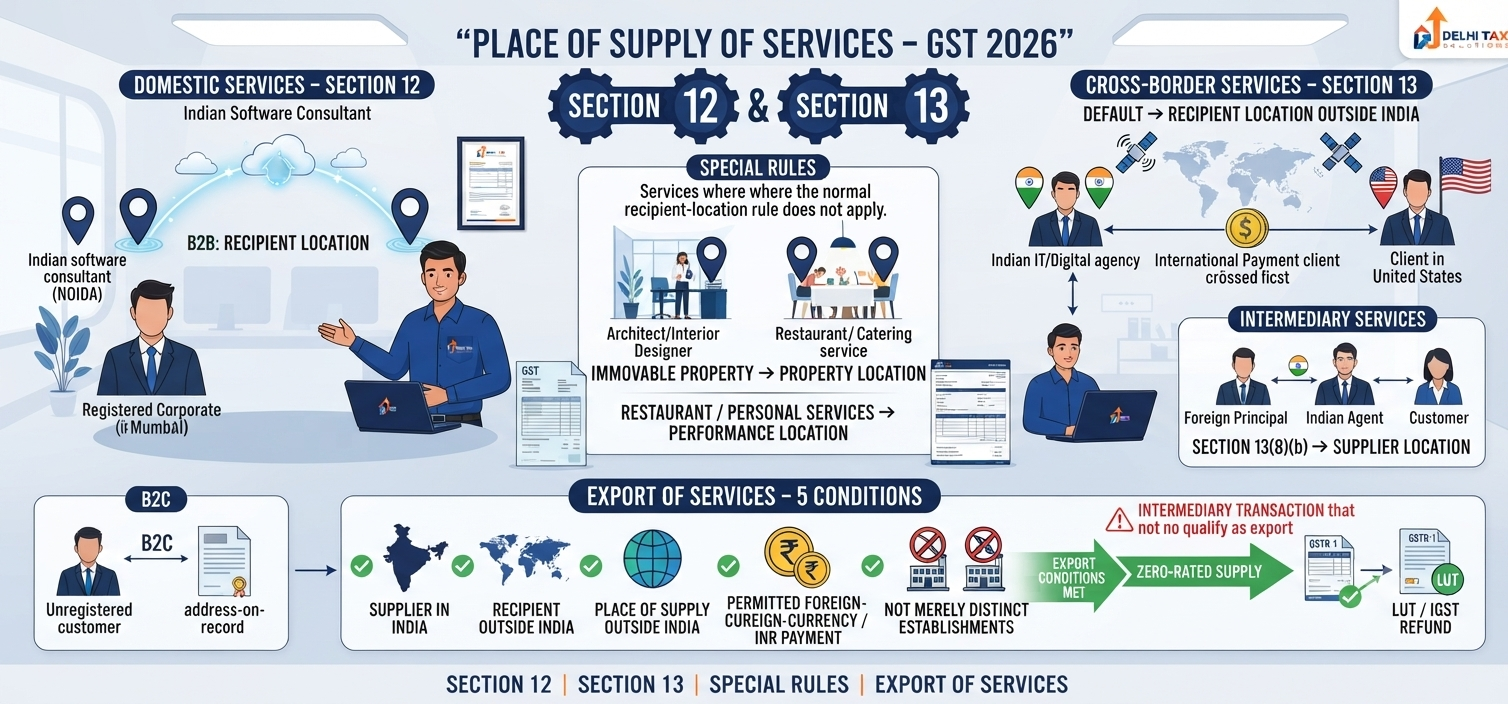
Under Section 12(2)(a) of the IGST Act, for a registered business customer (B2B), the place of supply is the location of such registered person. If a software consultant in Noida provides IT advisory services to a registered corporate entity in Mumbai, the supply is deemed to be received in Maharashtra, attracting IGST.
Conversely, for unregistered consumers (B2C) under Section 12(2)(b), the place of supply is the location of the recipient where the address on record exists, or the supplier’s location if no address is available. Proper documentation during your initial company registration in India ensures your billing location parameters align correctly with client master records.
Specialized Performance-Based Exceptions
Certain domestic services override the general B2B rule. For instance, services directly relating to immovable property—such as architectural design or interior decoration—take their place of supply where the property is physically situated, as outlined in Section 12 of the IGST Act.
Similarly, restaurant, catering, and personal grooming services are pegged strictly to the physical location where the services are actually performed.
Cross-Border Transactions and International Clients (Section 13)
When either the service supplier or the recipient is located outside India, the domestic provisions no longer apply, shifting governance to Section 13 of the IGST Act.
The International Recipient Default Rule
Under Section 13(2) of the IGST Act, the default place of supply for cross-border services is the location of the recipient of services. However, if the recipient’s location is not available in the ordinary course of business, the place of supply defaults to the location of the service supplier.
For Indian freelancers and agencies providing digital marketing to clients in the United States, establishing the foreign client’s business domicile is vital for proving international status.
Special Rules for Intermediary and Banking Services
Section 13 introduces strict overrides for specific sectors. Under Section 13(8)(b), the place of supply for intermediary services—where an agent facilitates the supply of goods or services between two parties without taking ownership—is strictly the location of the supplier of services.
This provision creates significant compliance hurdles for Indian marketing agencies acting as brokers for foreign principals, as local tax authorities often deny export status, mandating standard domestic tax collection instead.
Mastering Export of Service Conditions Under the IGST Act
Many digital agencies and IT firms assume that any invoice raised to a foreign client automatically qualifies as a tax-free export. However, statute law imposes rigorous prerequisites.
The Five Statutory Prerequisites
As per Section 2(6) of the IGST Act, an export of service requires the simultaneous fulfillment of five mandatory conditions:
- The supplier of service must be located in India.
- The recipient of service must be located outside India.
- The place of supply of service must be outside India.
- The payment for such service must be received by the supplier in convertible foreign exchange or in Indian rupees wherever permitted by the Reserve Bank of India.
- The supplier of service and the recipient of service must not be merely establishments of a distinct person.
Filing and Compliance via the Portal
Securing timely GST registration online allows service exporters to file monthly GSTR-1 returns reporting zero-rated supplies, enabling seamless IGST refunds or LUT-based bond clearances via the official GST Portal.
Summary Comparison Table: Section 12 vs. Section 13 Rules
To help corporate finance teams audit intangible supply invoices accurately, the table below contrasts domestic and cross-border service taxation provisions.
| Compliance Parameter | Domestic Services (Section 12) | Cross-Border Services (Section 13) |
|---|---|---|
| Geographic Scope | Both supplier and recipient located in India. | Either supplier or recipient located outside India. |
| Default B2B Rule | Location of the registered recipient of services. | Location of the recipient of services outside India. |
| Immovable Property | Location where the property is physically situated. | Location where the property is physically situated. |
| Intermediary Services | Governed by standard B2B recipient rules. | Location of the service supplier (Section 13(8)(b)). |
| Tax Treatment | CGST + SGST or IGST based on state codes. | Zero-rated supply if all export conditions are met. |
What Our CA Team Sees in Practice: Common Audit Pitfalls
In our indirect tax practice, we frequently observe service startups facing departmental audits due to minor documentation failures on foreign remittances. The most common compliance error involves receiving payments in Indian rupees from domestic nostro accounts of foreign entities without proper RBI authorization, invalidating export claims.
Another recurring audit trigger involves IT service providers misclassifying intermediary commission income as direct export of software development services. Tax authorities examine master service agreements meticulously to verify whether the Indian entity acts as a principal or a commissioned broker.
In a Nutshell
Service taxation relies on recipient location. To claim an export of service, you must satisfy all five Section 2(6) conditions including foreign exchange realization.
Conclusion
Mastering the place of supply of services under Section 12 and Section 13 of the IGST Act is vital for maintaining flawless compliance and protecting your enterprise margins. Remember that domestic transactions anchor to recipient registrations, international deals follow foreign domicile rules, and service exports demand strict adherence to foreign exchange realization mandates.
Proactive invoice auditing ensures smooth input tax credit matching and hassle-free tax refunds. Do not let complex cross-border tax rules slow down your agency growth. Speak with a Delhi Tax Solutions expert today to review your service contracts and compliance framework.
You can explore additional financial insights across our tax and finance blogs. Staying informed protects your business against unexpected tax liabilities.
About this article: Researched using official government sources, real-time competitor and search-trend analysis, and Delhi Tax Solutions’ in-house tax advisory team. Last updated September 2026.
Disclaimer: This article is for general informational purposes and is not a substitute for personalised professional tax advice.
Frequently Asked Questions (FAQs)
Q: What is the place of supply for services under the GST law?
A: The place of supply for services under the GST law establishes the legal consumption jurisdiction where a service deliverable is deemed to be received. Under Section 12 of the IGST Act for domestic transactions, the tax jurisdiction relies on whether the recipient is registered, anchoring the tax levy to the client’s registered business location rather than the supplier’s office.
Q: How do Section 12 and Section 13 of the IGST Act differ for service providers?
A: Section 12 of the IGST Act governs domestic service transactions where both the service supplier and the recipient are located within India, using recipient registration status as the primary tax anchor. Section 13 applies when either the supplier or the recipient is located outside India, governing international cross-border service taxation and export parameters.
Q: What are the strict conditions required to qualify as an export of service under GST?
A: Under Section 2(6) of the IGST Act, qualifying as an export of service requires fulfilling five mandatory conditions simultaneously: the supplier must be in India, the recipient outside India, the place of supply outside India, payment received in convertible foreign exchange, and the supplier and recipient must not be distinct establishments.
Q: How is the place of supply determined for professional consulting and IT services?
A: For professional consulting and IT services provided on a B2B basis domestically, the place of supply under Section 12(2)(a) is the location of the registered corporate recipient. For international B2B consulting clients located abroad, Section 13(2) dictates that the place of supply is the location of the recipient outside India.
Q: Why are intermediary services taxed differently under cross-border transactions?
A: Under Section 13(8)(b) of the IGST Act, the place of supply for cross-border intermediary services—where an agent facilitates transactions between third parties—is explicitly designated as the location of the service supplier in India. Consequently, intermediary services do not qualify as exports, attracting standard domestic tax levies despite foreign clients.
