
💡 Key Takeaways:
- GST is a destination-based consumption tax where revenue goes to the consuming state.
- Section 10 of the IGST Act dictates tax jurisdiction based on physical goods delivery.
- Bill-to-ship-to transactions treat the third party as the principal recipient for tax mapping.
- Imports and exports follow Section 11 provisions based on customs frontier entry and exit.
Navigating indirect taxation in India requires understanding where consumption legally occurs. Unlike the old origin-based excise tax regime, modern indirect taxation operates on a destination-based principle. For manufacturers, wholesalers, and e-commerce sellers, determining the exact tax jurisdiction dictates whether to charge Integrated GST or combined Central and State taxes.
Section 10 and Section 11 of the IGST Act govern how commercial transactions are mapped geographically. Getting these calculations wrong results in mismatched GSTR returns, delayed input credits, and statutory interest penalties. Logistics teams must link shipping addresses directly to invoice generation parameters.
This comprehensive guide details the statutory provisions for determining the place of supply of goods. We will explore movement rules, non-movement cases, bill-to-ship-to chains, and real-world compliance advice straight from our practice.
What is Place of Supply of Goods Under GST?
The place of supply of goods defines the precise geographical location where a commercial delivery terminates, establishing which state government collects the consumption tax revenue. Under Section 10 of the IGST Act, tax jurisdiction is anchored to the physical destination where goods are delivered to the buyer or a designated third party on the buyer’s direction, overriding the location of the supplier or the billing address.
Goods Involving Movement (Section 10(1)(a))
The vast majority of commercial transactions involve the physical transport of merchandise from a supplier’s warehouse or factory floor to a customer’s retail outlet or distribution center.
The Terminal Point of Movement Rule
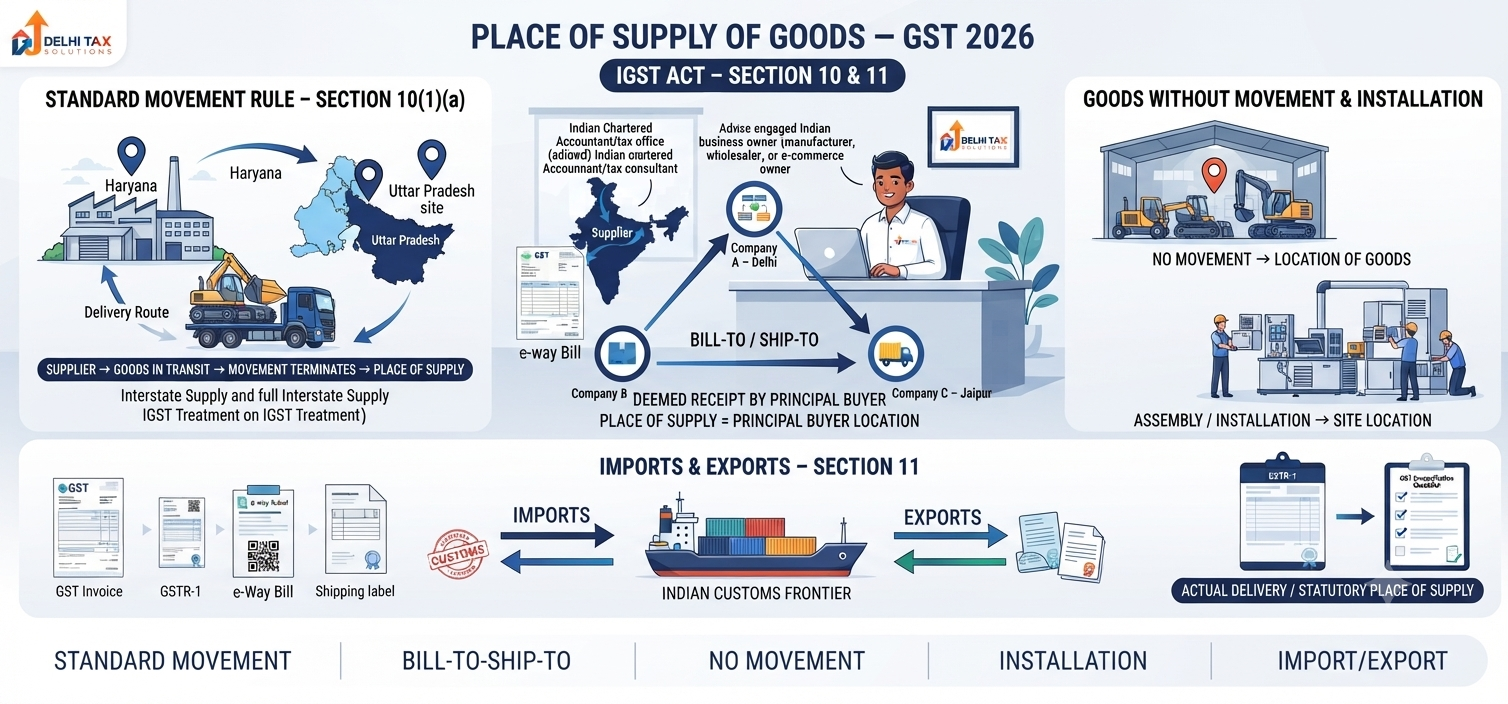
Under Section 10(1)(a) of the IGST Act, where the supply involves the movement of goods—whether carried by the supplier, the recipient, or a third-party logistics courier—the place of supply is strictly the location where the movement of goods terminates for delivery to the recipient.
For example, if a manufacturing unit in Faridabad ships machinery to a buyer’s plant in Noida, the delivery termination point is Noida (Uttar Pradesh). Because the supplier is in Haryana and the delivery terminates in Uttar Pradesh, the transaction constitutes an interstate supply, requiring the levy of igst place of supply rules.
Third-Party Carrier and Ex-Works Dispatch
When goods are sold on an ex-works basis, where the buyer arranges their own transport vehicle, the dispatch location does not determine the tax jurisdiction. The place of supply remains the final destination where the carrier unloads the consignment.
Proper documentation during your initial company registration in India ensures your logistics e-way bills accurately capture final delivery coordinates.
Bill-to-Ship-to Transactions (Section 10(1)(b))
Triangular commercial arrangements, commonly known as bill-to-ship-to transactions, occur frequently in wholesale supply chains and corporate procurement networks.
Deemed Delivery and Principal Recipient Mechanics
Under Section 10(1)(b) of the IGST Act, where the goods are delivered by the supplier to a third-party recipient on the direction of a third person (the principal buyer), the goods are deemed to have been received by the third person.
In this tri-party structure, the place of supply is considered the principal buyer’s principal place of business, regardless of where the physical delivery truck unloads the merchandise.
Practical Example of Triangular Supply Chains
Suppose Company A in Delhi places an order with Company B in Mumbai for raw materials, directing Company B to ship the stock directly to a processing plant operated by Company C in Jaipur.
Under Section 10(1)(b), the first transaction between Mumbai and Delhi is mapped to Delhi (where Company A resides). The subsequent movement from Delhi to Jaipur is treated as a separate intra-state or inter-state supply depending on Company A and Company C’s registrations.
Securing timely GST registration online allows trading entities to manage multi-state supply chains without running afoul of triangulation audits.
Goods Without Movement and Assembly (Section 10(1)(c) & (d))
Certain commercial transactions involve stationary assets or heavy industrial equipment that require specialized on-site installation before delivery is complete.
Goods Delivered Without Transport
Under Section 10(1)(c), if the supply does not involve the physical movement of goods—such as when a buyer purchases machinery already installed inside a rented warehouse and takes over the lease—the place of supply is the location of the goods at the time the delivery is handed over to the recipient.
Assembly, Installation, and Site Delivery
Under Section 10(1)(d), where goods are assembled or installed at a specific site, the place of supply is strictly the location where such assembly or installation takes place. If a contractor supplies modular office partitions from Pune and installs them in a corporate tower in Gurugram, the tax jurisdiction is Haryana.
Summary Comparison Table: IGST Section 10 Delivery Rules
To help corporate tax teams audit logistics invoices efficiently, the table below consolidates the statutory rules under Section 10 of the IGST Act across all delivery frameworks.
| Delivery Scenario | Statutory Provision | Determining Tax Jurisdiction |
|---|---|---|
| Standard Movement | Section 10(1)(a) | Location where the movement of goods terminates for delivery. |
| Bill-to-Ship-to | Section 10(1)(b) | Principal place of business of the third-party buyer directing delivery. |
| Stationary Goods | Section 10(1)(c) | Location of the goods at the time of delivery handover. |
| Installed Equipment | Section 10(1)(d) | Exact physical site where assembly or installation takes place. |
| Imports / Exports | Section 11 | Location outside India for exports; customs clearance port for imports. |
What Our CA Team Sees in Practice: Common Audit Pitfalls
In our indirect tax practice, we frequently observe businesses triggering departmental scrutiny during annual GST audits due to mismatched shipping details. The most common compliance error involves treating the billing address as the place of supply instead of the actual physical delivery destination.
For instance, corporate headquarters in Delhi often issue purchase orders with their office billing address while instructing vendors to ship inventory directly to a distribution warehouse in Chennai. Entering Delhi as the destination code on the e-way bill instead of Tamil Nadu causes severe GSTR-2B credit mismatches for the recipient.
Another recurring audit trigger involves incorrect handling of export transactions under Section 11. Exporters must ensure shipping bills filed with customs match their GSTR-1 outward taxable supplies perfectly to claim IGST refunds seamlessly through the official GST Portal.
In a Nutshell
GST is destination-based. Always map your place of supply to the physical unloading point or statutory delivery rule rather than the corporate billing address.
Conclusion
Mastering the place of supply of goods under Section 10 and 11 of the IGST Act is essential for maintaining accurate compliance and protecting your business working capital. Remember that standard deliveries anchor to termination points, triangular orders follow bill-to-ship-to rules, and heavy installations tie to physical site locations.
Proactive e-way bill reconciliation ensures smooth input tax credit matching for your commercial partners. Do not let complex logistics tax rules slow down your enterprise. Speak with a Delhi Tax Solutions expert today to review your dispatch protocols and compliance health.
You can explore additional financial insights across our tax and finance blogs. Staying informed protects your business against unexpected tax liabilities.
About this article: Researched using official government sources, real-time competitor and search-trend analysis, and Delhi Tax Solutions’ in-house tax advisory team. Last updated September 2026.
Disclaimer: This article is for general informational purposes and is not a substitute for personalised professional tax advice.
Frequently Asked Questions (FAQs)
Q: What is the place of supply of goods under the GST regime?
A: The place of supply of goods under Section 10 of the IGST Act establishes the geographical location where consumption legally occurs, determining whether state-level or integrated tax applies. For standard shipments involving movement, the place of supply is strictly the location where the movement of goods terminates for delivery to the final recipient.
Q: How is tax determined in a bill-to-ship-to transaction under Section 10?
A: Under Section 10(1)(b) of the IGST Act, in a bill-to-ship-to transaction where goods are delivered to a third party on the direction of a principal buyer, the goods are deemed to be received by the principal buyer. Consequently, the place of supply is mapped to the principal place of business of the third person who ordered the goods, regardless of where the delivery truck unloads.
Q: What happens to place of supply when goods do not move from the supplier’s warehouse?
A: Under Section 10(1)(c) of the IGST Act, if a commercial transaction does not involve the physical movement of goods—such as when a buyer acquires stock already stored inside a third-party cold storage facility and takes over ownership—the place of supply is the actual physical location where the goods are situated at the time of delivery handover to the recipient.
Q: How are imports and exports treated under Section 11 of the IGST Act?
A: Under Section 11 of the IGST Act, the place of supply for goods imported into India is the location of the importer receiving the consignment past customs clearance. Conversely, for goods exported from India, the place of supply is legally established as the location outside India where the goods are ultimately destined after crossing the Indian customs frontier.
Q: Does the billing address determine the tax jurisdiction or the physical delivery location?
A: The corporate billing address does not determine the place of supply for physical goods. Under Indian GST law, tax jurisdiction is strictly tied to the physical destination where goods delivery terminates or where assembly takes place, ensuring that consumer state tax revenues match actual physical consumption patterns across state borders.