
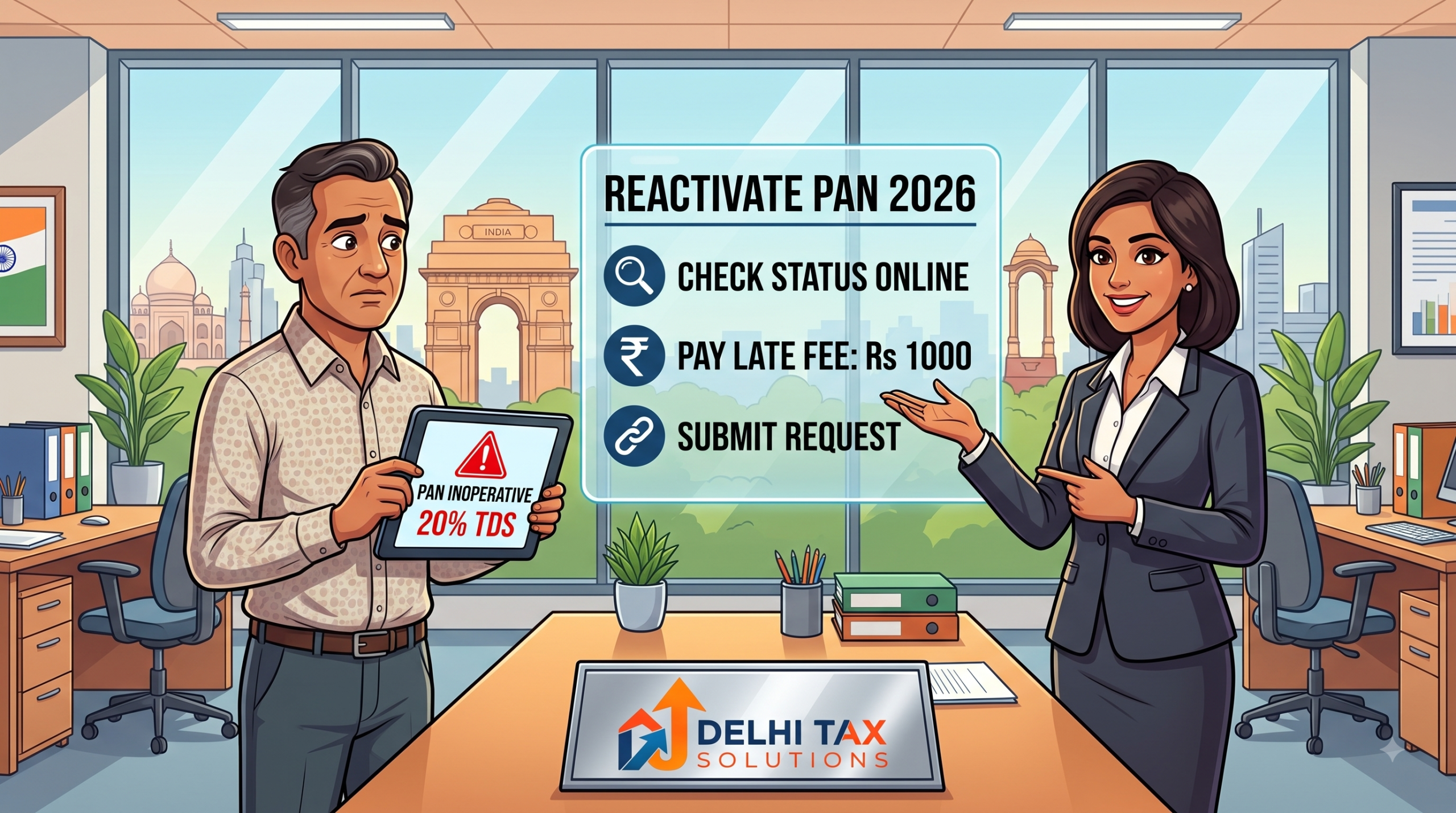
💡 Key Takeaways
- Failing to link your PAN with Aadhaar renders your primary tax identifier completely inoperative.
- Rule 162 of the tax regulations enforces strict financial blocks on unlinked PAN numbers.
- Banks and buyers must deduct a punitive 20% TDS on all transactions for inoperative accounts.
- You cannot file income tax returns or receive pending refunds while your status remains disabled.
- Paying a statutory ₹1,000 late fee under Section 234H allows you to reactivate your PAN online.
Discovering that your primary financial identifier is blocked can freeze your entire monetary ecosystem without warning. If you missed government deadlines to connect your biometric documents, you are urgently searching for the exact PAN inoperative rules 2026. Ignoring this status carries immediate consequences that disrupt daily banking, hold your tax refunds hostage, and double your tax deductions on monthly salary or business invoices.
Under the updated regulatory framework, tax authorities enforce strict cross-verification between identity databases. An inactive status converts your ten-digit tax code into a liability. Employers struggle to process compliant payroll, while financial institutions flag your accounts during mandatory compliance checks. This comprehensive guide outlines the legal consequences, explains how to check your status, and details the exact steps required to restore your financial credentials.
What Are the PAN Inoperative Rules 2026?
According to the official PAN inoperative rules 2026, a Permanent Account Number (PAN) becomes legally disabled if a taxpayer fails to complete biometric linking with Aadhaar past statutory deadlines. An inoperative status blocks pending tax refunds, halts return processing, and triggers a flat 20% Tax Deducted at Source (TDS) under Section 206AA. To resolve this status, taxpayers must submit a fee payment of ₹1,000 under Section 234H and complete online validation via the government portal.
Why Does a PAN Become Inoperative? (Rule 162 Regulations)
Understanding the legal foundation helps taxpayers navigate compliance requirements effectively. Under the Rule 162 PAN regulations, the Central Board of Direct Taxes (CBDT) mandates complete integration between personal identity numbers and tax records to eliminate duplicate filings and tax evasion across India.
The Statutory Linking Requirement
Section 139AA of the Income Tax Act requires every eligible individual holding a tax card to intimate their Aadhaar details. When a taxpayer misses the published deadline, the system automatically changes the record status from active to inoperative. This change is not a complete cancellation; the number remains allocated to you, but its functional legal validity is temporarily suspended.
Exempt Categories Under the Rules
Not every cardholder is subject to mandatory linking penalties. According to official CBDT circular guidelines, specific categories remain exempt from inoperative consequences. Non-resident Indians (NRIs) without an Aadhaar enrollment, non-citizens residing in India, individuals aged 80 years or older, and residents of specified states (Assam, Meghalaya, and Jammu & Kashmir) do not face automatic card disabling under current rules.
Consequences of an Inoperative PAN (High TDS & Financial Blocks)
An inoperative tax card immediately creates administrative roadblocks across banking, employment, and investment activities. The Income Tax Department restricts several core portal services until compliance is fully restored [1].
Punitive Deductions Under Section 206AA
The most severe financial penalty involves tax deduction rates. When your card becomes inoperative, banks, employers, and clients must enforce a high TDS rate inoperative PAN penalty. Under Section 206AA, tax deduction rates automatically jump to a flat 20% (or the prescribed schedule rate, whichever is higher). This rate applies even if your annual earnings sit comfortably below the basic exemption threshold.
Banking and Refund Restrictions
Financial institutions rely on active tax records for customer verification. An inactive card prevents you from opening new bank accounts, applying for credit cards, or investing in mutual funds exceeding ₹50,000. Furthermore, the portal will not process pending income tax refunds or pay statutory interest on delayed payouts while your identifier remains disabled.
| Compliance Feature | Active Tax Status | Inoperative Tax Status |
|---|---|---|
| TDS Deduction Rate | Standard Slab Rate (1% to 10%) | Higher Rate (Flat 20%) |
| ITR Return Filing | Fully Allowed | Blocked / Rejected |
| Tax Refund Issuance | Processable to Bank Account | Completely Frozen |
| High-Value Banking | Seamless Transactions | Restricted / Flagged |
How to Perform a PAN Card Status Check Online
Verifying your current standing takes only a couple of minutes through public online utilities. You do not need complex account credentials to execute a PAN card status check.
Step-by-Step Portal Verification
Visit the official government e-filing portal homepage. Locate the “Quick Links” section on the left sidebar and click on “Verify PAN Status.” Enter your ten-digit tax code, full legal name, date of birth, and active mobile number. Click continue to receive a 6-digit One-Time Password (OTP). Enter the OTP to view your real-time status message immediately.
Interpreting Status Results
If the screen displays “Active and Operative,” your records are completely compliant. If the message reads “Active but Inoperative,” your card is disabled due to missing PAN Aadhaar linking. You must proceed with fee payment to restore your status.
[LINK GAP — no live page found: suggested topic: PAN Reactivation Guide]
How to Reactivate Inoperative PAN (Step-by-Step)
Restoring an inactive card requires following a specific statutory sequence. Taxpayers must reactivate inoperative PAN records by submitting required fees before requesting biometric validation.
Paying the Penalty Fee Under Section 234H
Log into your account on the tax portal. Navigate to the “e-Pay Tax” facility and create a new payment challan. Select Minor Head 500 (Other Receipts) under the relevant assessment year. Pay the prescribed Section 234H late fee of ₹1,000 using net banking, UPI, or debit cards. Download the payment receipt after transaction completion.
Submitting the Linkage Request
Once the fee payment updates in the government system (usually within 4 to 5 hours), return to the “Link Aadhaar” section under your profile dashboard. Enter your identity number and confirm the payment challan details. Submit the request for biometric validation. According to official announcements from the Press Information Bureau, automated backend verification takes up to 30 days to re-enable your active card status [2].
⚡ Quick Summary
An inoperative tax card triggers a 20% flat TDS deduction and blocks tax refunds. You can fix this status by paying a ₹1,000 late fee under Section 234H on the e-filing portal and submitting an online linking request. Full reactivation takes approximately 30 days.
Impact of Inoperative PAN on Business & Corporate Compliance
For commercial enterprises and startups in Delhi/NCR, an inactive tax card creates severe operational bottlenecks. Business compliance relies on fully active tax identifiers across multiple government departments.
Corporate MCA Filings and Banking
When executing a new Company Registration, director tax numbers must be fully active. The Ministry of Corporate Affairs automatically rejects statutory form uploads if key managerial personnel hold disabled tax cards [3]. Furthermore, corporate bank accounts face operational freezes during periodic KYC updates.
GST Registrations and Vendor TDS
Direct taxes and indirect taxes share connected compliance databases. Your tax number serves as the foundational root for your GST Registration on the GST Portal [4]. An inactive card creates credit mismatches on monthly supply returns. Additionally, when filing quarterly TDS Returns, deducting taxes on vendors holding disabled cards requires deducting at higher rates, complicating corporate accounting. Consulting our expert team for professional Income Tax / ITR Filing services ensures your entire corporate structure remains compliant.
Conclusion
Understanding the PAN inoperative rules 2026 is vital for maintaining personal and business financial health. An inactive status triggers an immediate 20% TDS penalty, blocks annual return filings, and freezes pending tax refunds. Thankfully, the reactivation process is straightforward. By paying the ₹1,000 late fee under Section 234H and submitting your validation request online, you restore your active tax standing within 30 days.
Do not wait for financial accounts to freeze or tax deductions to double. Check your card status today and complete your compliance updates early. Talk to a Delhi Tax Solutions expert to get your corporate filings updated or to resolve complex compliance challenges smoothly.
About this article: Researched using official government sources and Delhi Tax Solutions’ in-house tax advisory team. Last updated August 2026.
Disclaimer: This article is for general informational purposes and is not a substitute for personalised professional tax advice.
Frequently Asked Questions (FAQs)
+ Q: What happens if my PAN becomes inoperative in 2026?
A: If your PAN becomes inoperative, you lose the ability to file annual income tax returns and your pending tax refunds remain completely frozen. Furthermore, financial institutions and clients must deduct Tax Deducted at Source (TDS) at an inflated penalty rate of 20% on all financial transactions under Section 206AA. You will also face restrictions when executing high-value banking operations or opening demat accounts.
+ Q: How can I check if my PAN card is active or inoperative?
A: You can check your status online without logging into the portal. Visit the official Income Tax Department website and click on the ‘Verify PAN Status’ quick link. Enter your ten-digit tax code, legal name, date of birth, and mobile number. Complete the 6-digit OTP verification sent to your phone, and the system will instantly display whether your record is active or inoperative.
+ Q: What is the penalty fee to reactivate an inoperative PAN card?
A: To reactivate an inoperative tax card, you must pay a statutory late fee of ₹1,000 under Section 234H. This fee is paid online through the ‘e-Pay Tax’ facility on the government e-filing portal using Minor Head 500 (Other Receipts) under the relevant assessment year before you can submit your online validation request.
+ Q: How long does it take for an inoperative PAN to become active again?
A: Once you pay the ₹1,000 fee under Section 234H and submit your linking request on the portal, it takes approximately 15 to 30 days for the Central Board of Direct Taxes (CBDT) backend to complete biometric authentication and officially update your status from inoperative back to active.
+ Q: Can banks freeze my account if my PAN is inoperative?
A: Yes, banks and financial institutions are required to conduct routine KYC verifications. If they discover your tax card is inoperative during these checks, they can restrict account operations, block high-value electronic transfers, or apply the mandatory 20% TDS rate to interest earnings until you provide certified proof of reactivation.
