💡 Key Takeaways:
- File Form GST CMP-04 online on the GST portal to opt out of the composition scheme.
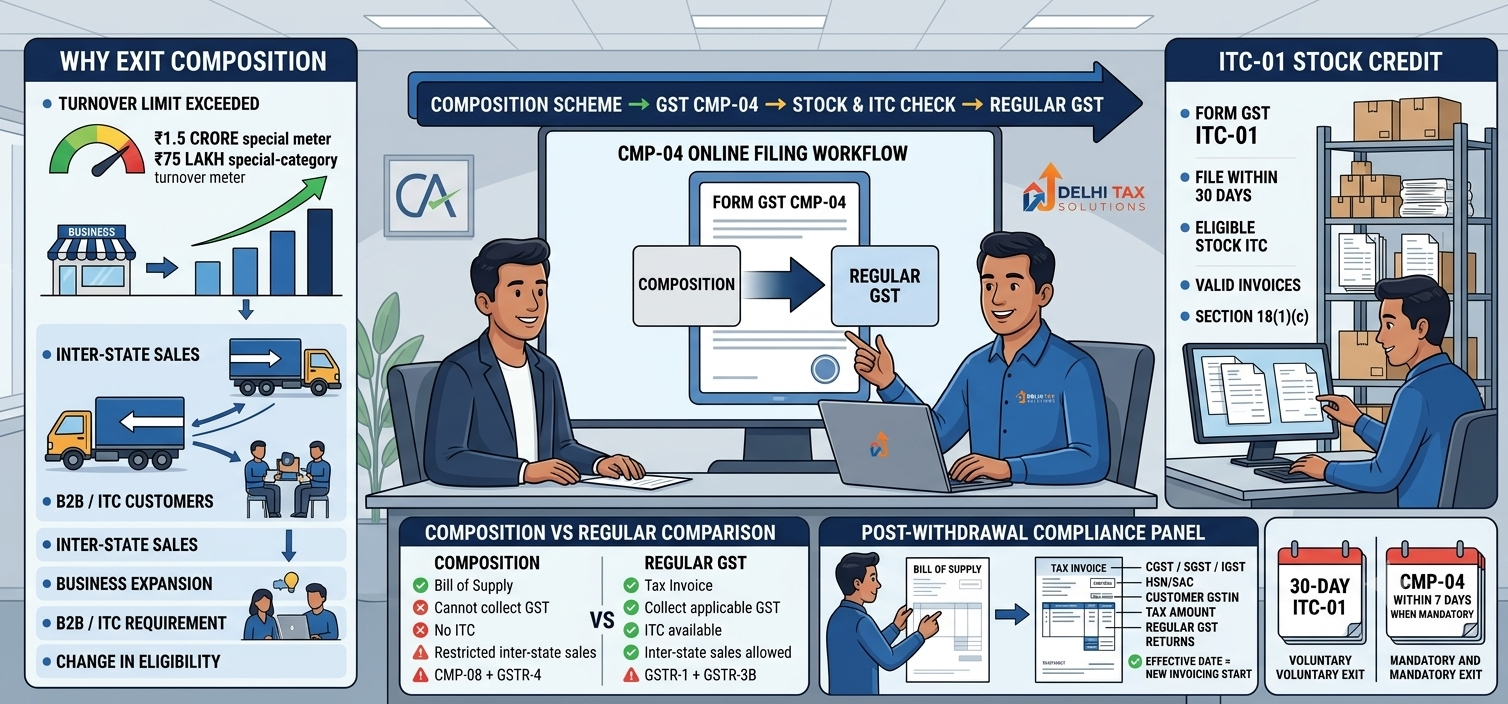
- Mandatory exit is required within 7 days if aggregate turnover exceeds ₹1.5 crore (₹75 lakh for special states).
- Voluntary withdrawal can be done at any time during the financial year before opting out.
- Claim Input Tax Credit (ITC) on unutilized stock by filing Form GST ITC-01 within 30 days.
- Issue proper Tax Invoices and collect GST immediately after your withdrawal application date.
Is your growing business constrained by the restrictions of the GST composition levy? Crossing turnover thresholds or expanding into inter-state trade requires a quick transition to the regular tax scheme. Failing to follow statutory procedures during this shift can lead to blocked input credits and heavy legal penalties. Learning how to opt out of composition scheme quickly ensures complete tax compliance and protects your business margins.
Transitioning from a simplified tax mechanism to a regular GST profile involves specific filing timelines and stock accounting rules. Under Central Board of Indirect Taxes and Customs guidelines, businesses must notify tax authorities formally using digital forms. This guide breaks down the exact steps to submit cmp-04, recover input tax credit, and manage invoicing without hassle.
Understanding How to Opt Out of Composition Scheme in GST
To opt out of the GST composition scheme, log in to the official GST portal, navigate to Services > Registration > Application for Withdrawal from Composition Levy, and submit Form GST CMP-04. If withdrawing voluntarily, you can file at any time during the financial year. If withdrawing due to exceeding turnover thresholds or non-compliance, you must file CMP-04 within 7 days of the event.
When and Why Businesses Must Switch to Regular GST Scheme
The GST composition scheme offers lower tax rates and reduced paperwork for small taxpayers. However, it imposes strict statutory limits. You must switch to regular tax status when your business model expands beyond these restrictions or when statutory thresholds are breached.
Statutory and Mandatory Thresholds
Under Section 10 of the CGST Act, statutory withdrawal becomes mandatory under specific conditions. You must exit the scheme immediately if your aggregate turnover exceeds ₹1.5 crore in a financial year (or ₹75 lakh in special category northeastern states and Himachal Pradesh). Service providers operating under Notification 2/2019-Central Tax face a lower turnover limit of ₹50 lakh. Furthermore, starting inter-state outward sales, selling goods through e-commerce operators collecting TCS, or manufacturing notified items like ice cream, pan masala, or tobacco automatically voids composition eligibility.
Strategic Business Growth
Many business owners also choose voluntary withdrawal to unlock business growth. Composition dealers cannot collect GST from buyers or pass on Input Tax Credit (ITC). This limitation makes B2B buyers reluctant to purchase from composition suppliers. Moving to the regular tax regime allows you to issue valid Tax Invoices, collect tax seamlessly, and claim ITC on business purchases.
Step-by-Step Guide to Filing Form GST CMP-04 Online
Withdrawing from the composition levy is completely online. Taxpayers can complete the process through the official GST Portal without visiting a physical tax office. Follow this step-by-step walkthrough to submit Form GST CMP-04 online accurately.
Step 1: Access the GST Portal
Log in to your account using your valid admin credentials. Ensure your corporate details and active email address are up to date.
Step 2: Navigate to Withdrawal Form
Go to the top navigation bar. Click on Services > Registration > Application for Withdrawal from Composition Levy.
Step 3: Select Category and Reason
The system displays your existing GSTIN and trade name. Select the primary reason for withdrawal from the drop-down menu. Choose either voluntary withdrawal or threshold breach under statutory rules. If mandatory, input the exact date on which your eligibility ceased.
Step 4: Verification and Digital Signature
Check the verification box. Select the authorized signatory from the dropdown. Enter your current filing location. Sign the application digitally using a Digital Signature Certificate (DSC) or an Electronic Verification Code (EVC) sent to your registered mobile number.
Step 5: Confirmation and Status Tracking
Upon submission, the portal generates a unique Application Reference Number (ARN). Your status updates to a regular taxpayer automatically, or upon system validation by your jurisdictional tax officer.
Claiming Input Tax Credit on Unsold Stock via Form GST ITC-01
One major advantage when you opt out of composition is the legal right to claim Input Tax Credit on your existing stock. Under Section 18(1)(c) of the CGST Act, a taxpayer transitioning to the regular scheme can claim ITC on inputs held in stock, inputs contained in semi-finished or finished goods, and capital goods on the day immediately preceding the withdrawal date.
Deadlines and Documentation
To claim this credit, you must file Form GST ITC-01 declaration on the GST portal within 30 days of opting out. The credit applies only to stock invoices issued within 12 months prior to the withdrawal date. Invoices older than one year are ineligible for ITC recovery.
CA Certification Rules
Prepare a detailed stock inventory containing invoice numbers, supplier GSTINs, description of goods, quantities, tax paid, and eligible ITC amounts. If your total ITC claim exceeds ₹2 lakh, CGST rules require you to upload a verification certificate certified by a practicing Chartered Accountant or Cost Accountant. Once verified, the approved credit transfers directly to your Electronic Credit Ledger for future tax offsets.
Composition Scheme vs Regular Scheme Comparison
Understanding the operational and financial differences between these two tax mechanisms helps ensure a smooth operational transition. Review our comprehensive breakdown below:
| Compliance Feature | GST Composition Scheme | Regular GST Tax Regime |
|---|---|---|
| Tax Rates | 1% (Traders/Manufacturers), 5% (Restaurants), 6% (Services) | Standard rates (5%, 12%, 18%, 28%) based on HSN code |
| Input Tax Credit (ITC) | Strictly blocked; cannot claim ITC on purchases | Full ITC available on business purchases and unutilized stock |
| Invoicing Document | Bill of Supply (Cannot collect tax from buyers) | Tax Invoice (Collect tax directly from customers) |
| Inter-state Sales | Not allowed (Restricted to intra-state supply) | Allowed without any geographic restrictions |
| Filing Returns | Quarterly statement (CMP-08) + Annual Return (GSTR-4) | Monthly/Quarterly GSTR-1 and GSTR-3B + Annual GSTR-9 |
Post-Switch Compliance and Immediate Invoicing Rules
Completing your GST composition scheme withdrawal requires immediate changes to your daily accounting and business operations. Continuing old billing practices post-withdrawal causes non-compliance under tax laws.
Shift to Tax Invoices
First, replace your “Bill of Supply” documents with standard “Tax Invoices.” Every invoice issued from the effective date of withdrawal must show itemized tax rates (CGST, SGST, or IGST), the buyer’s GSTIN, and appropriate HSN/SAC codes. Update your accounting software immediately to reflect these billing changes.
Filing Regular Returns
Second, update your compliance calendar. Regular taxpayers must file monthly or quarterly GSTR-1 (outward supplies) and GSTR-3B (summary return and tax payment) according to their chosen filing frequency. If you need assistance setting up your new compliance system, explore our GST Registration and Filing Services for specialized support.
Updating Signage and Branding
Finally, remove the statement “Composition taxable person, not eligible to collect tax on supplies” from your business signboards, bill books, and website footers. Display your updated regular GSTIN status clearly at your principal place of business.
Mastering Your GST Transition with Expert Guidance
Transitioning out of the composition scheme expands your business potential by opening doors to inter-state sales, B2B contracts, and full Input Tax Credit utilization. While the transition process is straightforward, meeting mandatory CMP-04 deadlines and executing stock audits for ITC-01 requires detailed tax knowledge.
Prevent compliance delays, blocked credits, or penalty notices by planning your switch carefully. For personalized assistance with CMP-04 filings, ITC valuation, or regular return compliance, reach out to our expert team through our GST Advisory Hub today.
Conclusion: Opting out of the GST composition scheme is a critical step for scaling businesses. By filing Form GST CMP-04 within statutory deadlines, properly claiming ITC via ITC-01 on your unutilized stock, and swiftly switching your billing documentation to standard Tax Invoices, you ensure seamless compliance. Partner with Delhi Tax Solutions to navigate your transition smoothly, protect your input credits, and expand your market reach without legal roadblocks.
Frequently Asked Questions (FAQ)
Q: What is the deadline to file Form GST CMP-04 to opt out of the composition scheme?
A: If you are opting out voluntarily, you can file Form GST CMP-04 at any time during the financial year before switching to the regular tax scheme. However, if you are exiting because your turnover crossed statutory limits (₹1.5 crore or ₹50 lakh for services) or due to non-eligibility, you must file CMP-04 within 7 days of the event.
Q: Can I claim Input Tax Credit (ITC) on unsold stock after switching to the regular scheme?
A: Yes, under Section 18(1)(c) of the CGST Act, you can claim ITC on inputs held in stock, semi-finished goods, and finished stock on the day preceding your withdrawal. To claim this credit, you must file Form GST ITC-01 on the GST portal within 30 days of opting out, supported by valid tax invoices under 1 year old.
Q: What happens if my turnover crosses ₹1.5 crore during the financial year?
A: Once your aggregate turnover crosses ₹1.5 crore (or ₹75 lakh in special category states), your composition scheme eligibility ceases automatically under Section 10. You must issue Tax Invoices immediately, stop issuing Bills of Supply, and file Form GST CMP-04 within 7 days to transition your account to regular status without incurring penalties.
Q: Is it possible to opt back into the composition scheme after opting out?
A: Yes, eligible taxpayers can opt back into the composition scheme in subsequent financial years. You must submit Form GST CMP-02 on the GST portal before the beginning of the financial year (prior to March 31st) for which you want to opt in, provided your annual turnover remains within statutory limits.
Q: How do I change my invoicing method immediately after opting out of composition?
A: Starting on your effective date of withdrawal, stop issuing Bills of Supply and start issuing standard Tax Invoices. Your new invoices must show applicable GST rates (CGST, SGST, or IGST), calculate tax values separately, display customer GSTINs for B2B sales, and remove all text stating you are a composition dealer not eligible to collect tax.
About this article: Researched using official government sources, real-time competitor analysis, and Delhi Tax Solutions’ in-house tax advisory team. Last updated September 2026. This article is for general informational purposes and is not a substitute for personalised professional tax advice.