
? Key Takeaways
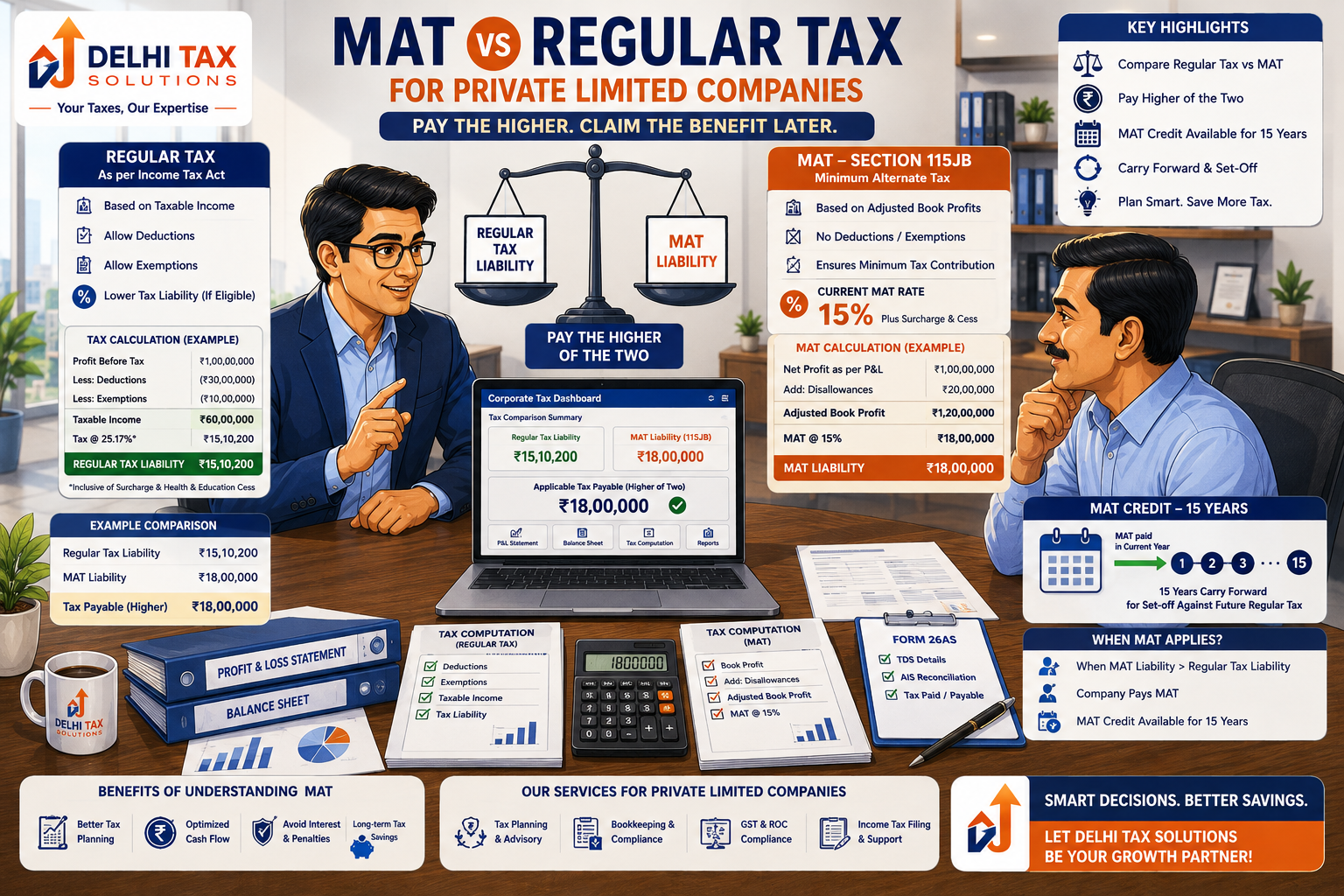
- Minimum Alternate Tax ensures zero-tax corporate entities contribute a baseline tax share.
- Evaluating MAT vs regular tax private limited company frameworks prevents excessive corporate cash outflows.
- The standard statutory MAT rate is fifteen percent plus applicable surcharge and cess.
- Unutilized tax credits can be carried forward for up to fifteen subsequent assessment years.
- Companies adopting concessional taxation regimes under specific sections may be exempt from MAT.
Navigating corporate taxation obligations requires careful financial forecasting for growing enterprises across commercial hubs like Delhi NCR. Analyzing MAT vs regular tax private limited company obligations ensures that directors maintain optimal cash flows while complying with statutory mandates under the Income-tax Act, 1961.
Many profitable corporate entities leverage deductions, exemptions, and accelerated depreciation to reduce their net taxable income to zero. To prevent high-earning corporations from avoiding tax contributions entirely, the legislature introduced Minimum Alternate Tax. Understanding how this parallel computation works is essential for every corporate finance team.
This comprehensive guide examines computation mechanisms, credit carry-forward windows, and statutory rates for businesses preparing for FY 2025-26 filings.
What is MAT vs regular tax for private limited companies?
Minimum Alternate Tax represents a statutory mechanism designed to ensure that every profitable corporate entity pays a minimum percentage of its book profits as income tax, regardless of exemptions claimed. Official guidelines published by the Income Tax Department establish that corporations must compute their tax liability under both regular tax provisions and MAT rules, paying whichever amount is higher. Establishing robust corporate entities through proper Company Registration helps new business owners establish legal recognition before evaluating taxation structures.
What is the minimum alternate tax rate and how does it apply?
The standard minimum alternate tax rate for domestic companies stands at fifteen percent of book profits, exclusive of applicable surcharges and health and education cess. Policy updates released by the Press Information Bureau confirm that this rate applies uniformly across eligible corporate structures that report substantial accounting profits while enjoying deductions under regular provisions.
When computing corporate liabilities, finance managers must also account for statutory obligations such as TDS and indirect levies managed through GST Registration compliance frameworks.
Calculating book profits under Section 115JB
Book profit is derived from the company’s profit and loss account prepared in accordance with Schedule III of the Companies Act, subject to specific statutory additions and subtractions.
Adding surcharges and cess
The base fifteen percent rate is augmented by standard corporate surcharges scaling from seven to twelve percent based on net income brackets, plus a four percent health and education cess.
How does MAT credit carry forward work for corporate assessees?
Managing MAT credit carry forward provisions allows corporate entities to offset excess tax paid under MAT against regular tax liabilities in future years when normal tax exceeds the alternate tax. Economic directives issued by the Reserve Bank of India emphasize that proper credit tracking preserves working capital for growing businesses.
Taxpayers can accumulate and carry forward this credit for up to fifteen assessment years immediately succeeding the year in which the credit materialized.
Understanding the fifteen-year carry forward window
Unutilized MAT credit does not lapse immediately; companies have a generous fifteen-year operational window to offset the differential tax against future regular tax liabilities.
Eligibility conditions for claiming credit
MAT credit can only be claimed in a financial year when the regular tax liability exceeds the minimum alternate tax liability computed for that specific period.
Is there MAT applicability new tax regime companies need to follow?
Evaluating MAT applicability new tax regime companies reveals distinct exemptions for corporations that have opted for concessional tax rates under specific sections like 115BAA or 115BAB. Regulatory announcements tracked by the Ministry of Corporate Affairs show that companies choosing these special low tax regimes are completely exempt from Minimum Alternate Tax.
However, opting out of concessional regimes or failing to meet qualifying conditions instantly restores standard MAT provisions.
Exemptions under concessional corporate tax sections
Firms taxed under Section 115BAA or 115BAB enjoy lower corporate rates without the burden of computing book profit liabilities under Section 115JB.
Strategic selection between regimes
Corporate boards must evaluate whether accumulated tax incentives outweigh the benefits of switching to concessional regimes.
| Comparison Parameter | Regular Tax Regime | Minimum Alternate Tax (MAT) |
|---|---|---|
| Basis of Calculation | Net taxable income after deductions | Adjusted book profit as per accounting statements |
| Standard Tax Rate | 22% or 25% plus surcharge and cess | 15% plus applicable surcharge and cess |
| Deductions & Incentives | Fully applicable based on chapter VI-A | Disregarded during book profit computation |
| Credit Carry Forward | Not applicable for regular tax | Available for up to 15 assessment years |
? Quick Summary
Minimum Alternate Tax imposes a 15% levy on corporate book profits when regular tax liability drops to zero, with provisions to carry forward excess tax credits for fifteen years.
How do book profits differ from regular taxable income?
Distinguishing book profit from regular taxable income is critical because corporate accounting standards and tax statutes follow different recognition principles. According to tax advisory cases handled by our CA team at Income Tax filing divisions, startup founders frequently miscalculate these alternate ledgers.
Accounting profit computation principles
Book profit starts with net profit before tax as shown in financial statements, adjusted for provisions like deferred tax, proposed dividends, and unabsorbed depreciation.
Taxable income computation principles
Regular taxable income incorporates strict statutory disallowances, specific depreciation rates prescribed under tax rules, and allowable business expenses.
Why expert CA guidance matters for private limited tax compliance.
Navigating complex corporate tax computations requires professional oversight to prevent costly computational errors and avoid scrutiny notices from tax authorities. Our CA advisory team at Delhi Tax Solutions helps corporate leaders optimize their tax structures and file accurate returns efficiently.
Talk to a Delhi Tax Solutions expert to get your corporate tax filings and compliance reviews managed seamlessly today.
About this article: Researched using official government sources and Delhi Tax Solutions’ in-house tax advisory team. Last updated August 2026.
This article is for general informational purposes and is not a substitute for personalised professional tax advice.
Frequently Asked Questions (FAQs)
Q: What is the current minimum alternate tax rate for private limited companies in India?
A: The current minimum alternate tax rate for domestic private limited companies in India is established at fifteen percent of their adjusted book profits. This baseline rate is further augmented by applicable corporate surcharges ranging from seven to twelve percent depending on turnover thresholds, plus a mandatory four percent health and education cess.
Q: How can private limited companies utilize MAT credit carry forward provisions?
A: Private limited companies can utilize MAT credit carry forward provisions by offsetting excess tax paid under Minimum Alternate Tax against regular income tax liabilities in future financial years. This credit can be claimed specifically during assessment years when the calculated regular tax liability exceeds the minimum alternate tax liability for that period.
Q: Is MAT applicable to companies opting for the concessional new tax regime?
A: No, Minimum Alternate Tax is not applicable to corporate entities that have opted for concessional taxation regimes under specific statutory sections such as Section 115BAA or Section 115BAB. Companies choosing these special low tax rates are completely exempt from computing book profit liabilities under Section 115JB.
Q: What is the difference between book profit and taxable profit under MAT calculations?
A: Book profit is derived from the company’s financial profit and loss statement prepared under the Companies Act, adjusted for specific statutory items like provisions and dividends. In contrast, regular taxable profit is calculated using strict income tax provisions, specific depreciation schedules, and allowable business deductions under the law.
Q: How long can a company carry forward its unutilized Minimum Alternate Tax credit?
A: A corporate entity can carry forward its unutilized Minimum Alternate Tax credit for up to fifteen consecutive assessment years immediately succeeding the financial year in which the tax credit initially arose. If the credit remains unabsorbed after this fifteen-year statutory window expires, it lapses permanently.
