
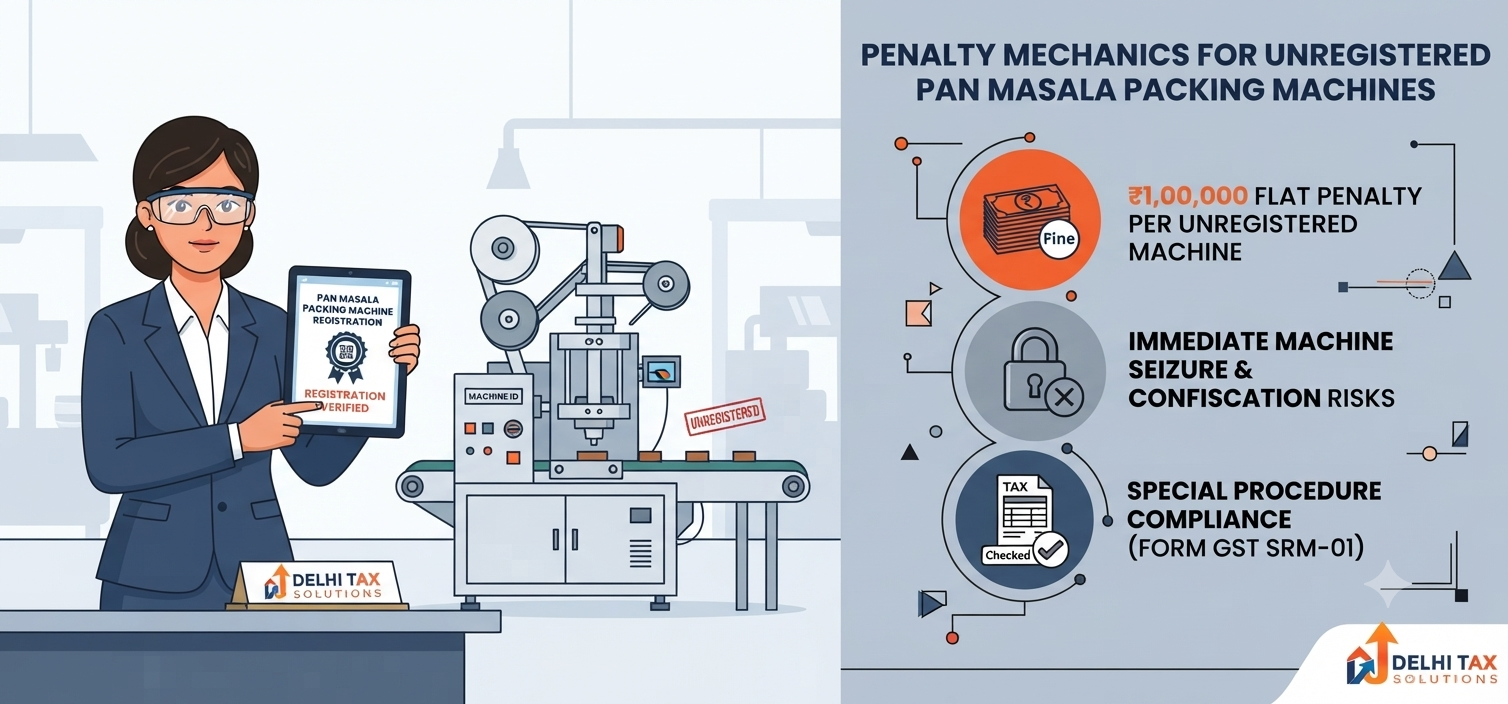
💡 Key Takeaways: Machine Registration Penalty (Section 122A)
- Legal Mandate (Section 122A): Inserted via the Finance Act to curb revenue leakage, Section 122A imposes severe penalties on manufacturers who fail to register packing machines used for specified goods like pan masala and tobacco.
- ₹1,00,000 Penalty per Machine: Any registered person manufacturing specified goods using an unregistered packing machine faces a mandatory penalty of ₹1 Lakh for every unregistered machine operating in their premises.
- Confiscation Risks: In addition to the monetary penalty, any unregistered machine used in the manufacturing process is liable for immediate seizure and potential confiscation under the Act.
- Special Procedure Rules: Manufacturers must electronically register existing and newly installed machines in Form GST SRM-01, log operating capacities, and submit monthly production returns in Form GST SRM-02.
Revenue evasion in sectors producing high-duty consumer commodities—specifically pan masala, gutkha, hookah tobacco, and unmanufactured tobacco—has historically posed significant compliance challenges for tax administration in India. To plug these loopholes, the GST Council introduced specialized track-and-trace procedures backed by stringent statutory penalties.
Central to this enforcement architecture is Section 122A of the Central Goods and Services Tax (CGST) Act. Section 122A creates a dedicated penalty framework targeting the non-registration of manufacturing and packing equipment, shifting compliance from simple invoice accounting to physical machine-level monitoring.
Scope and Objective of Section 122A
Section 122A was introduced to penalize failure to comply with special procedures notified under Section 148 of the CGST Act regarding the registration of machines used in the manufacture of specified goods.
The primary objectives of Section 122A include:
- Preventing Clandestine Removal: Blocking off-the-record production cycles carried out on unrecorded packing lines.
- Machine-Capacity Correlation: Matching theoretical plant output (calculated via machine speeds and operating hours) with reported sales in GSTR-1 and GSTR-3B.
- Enforcing Track-and-Trace: Establishing a digital logbook connecting physical machinery to the GST common portal.
Penalties and Seizure Mechanics under Section 122A
The penalty structure under Section 122A is strict and cumulative, designed to act as a powerful deterrent against non-compliance:
| Violation Parameter | Statutory Penalty / Action | Legal Provision |
|---|---|---|
| Non-Registration of Machine | Flat penalty of ₹1,00,000 (Rupees One Lakh) per unregistered machine. | Section 122A(1) |
| Seizure & Confiscation | Unregistered machine is subject to immediate seizure and confiscation. | Section 122A(2) |
| Relief / Option to Redemption | Option to pay penalty within specified period and register the machine prior to final confiscation order. | Proviso to Section 122A(2) |
It is important to note that the ₹1,00,000 penalty under Section 122A is charged in addition to any penalty applicable under Chapter XV (Demands and Recovery) or general penalty provisions under Section 122/Section 125 of the CGST Act.
Mandatory Reporting Forms & Timelines (GST SRM Series)
To avoid triggering Section 122A penalties, manufacturers of specified tobacco and pan masala products must strictly comply with the electronic reporting workflows on the GST Portal:
- Form GST SRM-01 (Registration of Machines): Must be filed electronically within 30 days of the notification coming into effect (or within 30 days of installing any new packing machine). Details include make, model, serial number, year of manufacture, packing capacity, and number of tracks.
- Form GST SRM-02 (Monthly Production Log): Must be submitted by the 10th of the following month, detailing machine-wise operating hours, electricity consumption, raw material inputs, and net pouches produced.
- Form GST SRM-03 (Disposal / Scrapping Notice): Required prior to selling, scrapping, or decommissioning any registered packing machine.
Impact on the Pan Masala and Tobacco Supply Chain
For businesses operating in the specified goods sector, Section 122A necessitates complete operational integration between factory shop floors and corporate tax accounting:
- Real-Time Asset Audits: Manufacturing plants must maintain an accurate physical ledger of all functional, standby, and under-maintenance packing machinery.
- Inter-Departmental Coordination: Plant engineering teams must inform the tax compliance department immediately upon the installation, modification, or removal of any packing track or pouch-packing unit.
- Risk of Factory Shutdown: Because Section 122A permits the physical seizure of unregistered machinery, non-compliance can immediately freeze factory operations and trigger compounding losses.
Manufacturing Tobacco or Pan Masala Products?
Failure to register even a single standby or leased packing machine can result in severe financial penalties and machine confiscation orders from GST inspection officers.
The industrial compliance specialists at Delhi Tax Solutions assist manufacturing enterprises with GST SRM registration, physical machine audit reconciliations, and departmental defense against Section 122A show-cause notices.
Frequently Asked Questions (FAQs)
+ Q: Does Section 122A apply to all manufacturing industries under GST?
A: No. Section 122A applies specifically to registered persons manufacturing goods notified under Section 148 special procedures. Primarily, this covers pan masala, gutkha, hookah tobacco, smoking mixtures, and unmanufactured tobacco products.
+ Q: Are non-operational or standby machines required to be registered under Section 122A?
A: Yes. Any packing machine present within the registered factory premises—whether fully operational, on standby, or undergoing maintenance—must be declared in Form GST SRM-01 to avoid penalty and seizure risks.
+ Q: What happens if a seized machine is needed back for factory operations?
A: The proviso to Section 122A(2) allows the owner to prevent final confiscation by paying the prescribed penalty of ₹1,00,000 per machine and fulfilling all pending registration formalities within the timeline specified in the order.
+ Q: Is there a deadline for registering newly purchased packing machines?
A: Yes. Newly installed packing machines must be registered electronically in Form GST SRM-01 within 24 hours of installation or within the specific timeframe prescribed under notified rules before commercial production begins.
About this article: Based on Section 122A and Section 148 of the Central Goods and Services Tax (CGST) Act, inserted via the Finance Act, 2024, along with relevant Central Tax notifications. Updated for 2026.
Disclaimer: This article is strictly for educational purposes and should not be construed as legal or professional tax advice. Please consult a qualified tax advisor or Chartered Accountant to ensure full compliance for your specific manufacturing unit.