
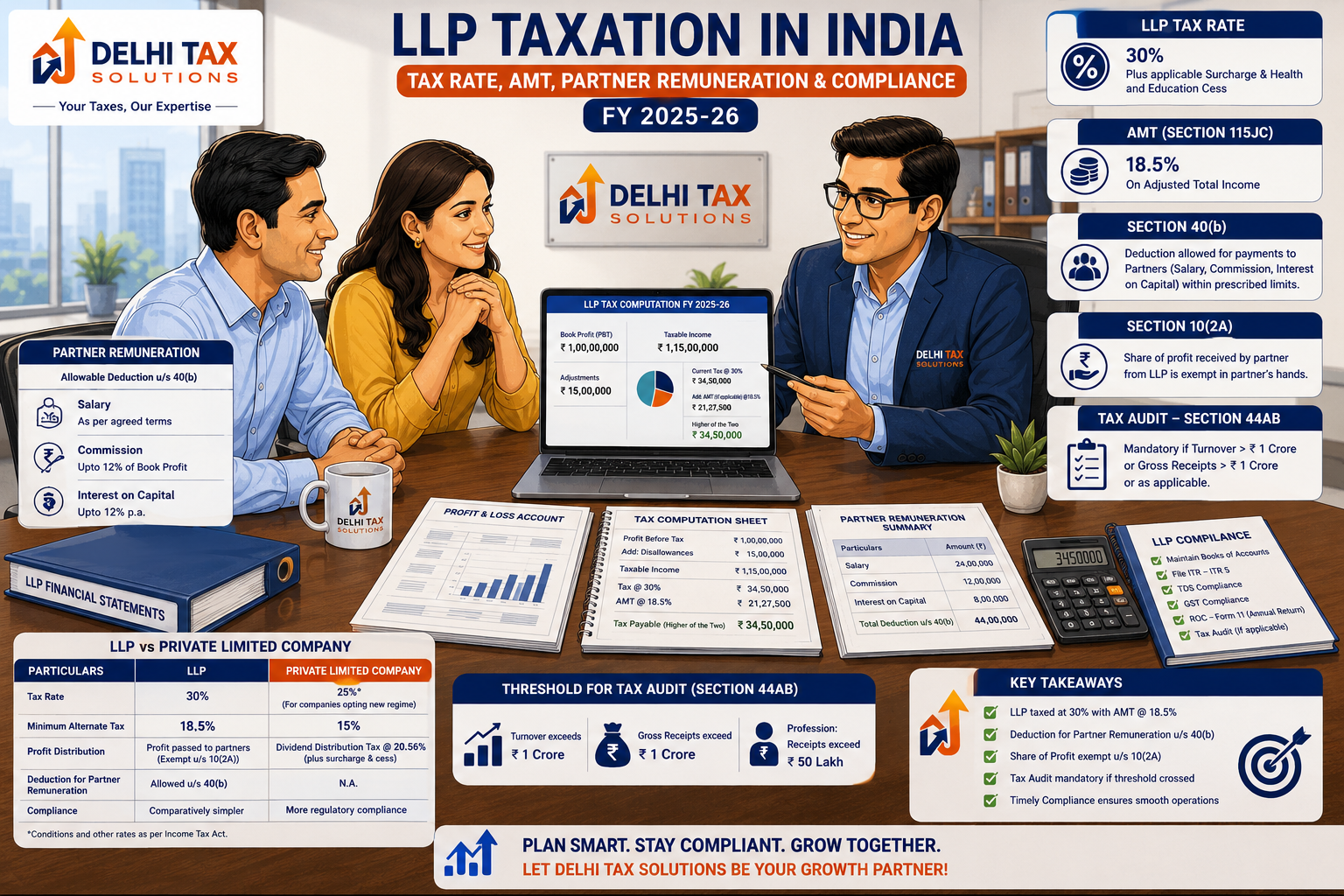
? Key Takeaways
- Limited Liability Partnerships are taxed at a flat rate of 30% plus applicable surcharge and cess.
- Profits distributed to partners are tax-free in their hands, avoiding double taxation burdens.
- Alternate Minimum Tax under Section 115JC applies at 18.5% on adjusted total income.
- Partner remuneration and interest payments are deductible subject to strict statutory ceilings under Section 40(b).
- Proper corporate structuring and filing safeguards businesses from expensive audit penalties and scrutiny notices.
Structuring business entities correctly is a critical first step for entrepreneurs scaling operations across commercial hubs like Delhi NCR. When evaluating legal structures, understanding LLP taxation India mechanics is essential for optimizing cash flows and ensuring full regulatory compliance. Limited Liability Partnerships offer operational flexibility combined with distinct corporate governance benefits.
Navigating the nuances of direct tax statutes requires careful attention to flat tax rates, partner deductions, and mandatory return filings. Operating emerging enterprises successfully demands precise management of Income Tax liabilities alongside operational duties such as GST Registration and TDS compliance.
This comprehensive advisory analysis explores statutory tax rates, surcharge computations, profit distribution rules, and audit thresholds for financial filings in FY 2025-26.
What is the flat income tax rate applicable to LLPs?
Under the Income-tax Act, 1961, limited liability partnerships are taxed at a flat base rate of 30% on their total taxable income. Official guidelines published by the Income Tax Department confirm that this LLP tax rate applies uniformly across commercial sectors, regardless of annual turnover volumes. Founders establishing new ventures through professional Company Registration services must evaluate these direct tax obligations alongside operational overheads.
In addition to the base tax rate, a surcharge of 12% is levied if the total taxable income exceeds ?1 crore. A health and education cess of 4% is further added to the combined tax and surcharge amount.
How does LLP vs company tax comparison shape structures?
Conducting an accurate LLP vs company tax comparison helps founders choose the optimal legal vehicle for their business model. Regulatory updates monitored by the Press Information Bureau highlight key structural distinctions between partnership firms and corporate entities under Indian tax statutes.
Evaluating corporate tax rate differences
Private limited companies may qualify for lower base rates of 22% or 25% under specific conditions, whereas partnerships maintain a flat 30% rate.
Analyzing dividend and profit distribution
Corporate dividends are taxable for shareholders, whereas LLP profit shares are completely exempt in the hands of individual partners.
| Tax Parameter | Limited Liability Partnership (LLP) | Private Limited Company |
|---|---|---|
| Base Income Tax Rate | Flat 30% across all turnover levels | 22% to 30% depending on elections |
| Surcharge Threshold | 12% if total income exceeds ?1 crore | Tiered surcharge based on income brackets |
| Distribution Tax Burden | No tax on profit shares given to partners | Dividend distribution taxed at slab rates |
| Alternate Minimum Tax | Subject to AMT under Section 115JC | Subject to MAT under Section 115JB |
? Quick Summary
LLPs face a flat 30% tax rate plus surcharge and cess, with profits exempt for partners, whereas private companies have variable rates and taxable dividend distributions.
How does alternate minimum tax LLP calculation operate?
Comprehending the rules governing alternate minimum tax LLP provisions ensures firms avoid unexpected tax shortfalls. Oversight frameworks monitored by the Ministry of Corporate Affairs and direct tax norms require partnerships to compute their tax liability under normal provisions as well as under Section 115JC.
Computing adjusted total income
Partnerships must calculate their adjusted total income by adding back specific deductions claimed under Chapter VI-A or section 10AA.
Applying the statutory 18.5% rate
If the regular income tax payable is less than 18.5% of the adjusted total income, the entity must pay AMT at 18.5% plus applicable surcharge and cess.
What rules govern LLP profit distribution tax exemptions?
Understanding the framework surrounding LLP profit distribution tax mechanics reveals significant tax planning advantages for partners. Economic policy reports published by the Reserve Bank of India emphasize that business profits taxed at the entity level are distributed to partners completely tax-free under Section 10(2A) of the Income-tax Act.
Exemption of profit shares under Section 10(2A)
The share of profit received by a partner from an LLP is exempt from income tax because the partnership has already paid tax on its earnings.
Distinguishing profit share from remuneration
While profit shares are tax-exempt, partner salaries and interest on capital received from the partnership are taxable as business income in partner returns.
When is a tax audit for LLP India mandatory?
Executing statutory compliance requires monitoring turnover thresholds to determine audit triggers. According to tax advisory cases handled by our CA team at Delhi Tax Solutions, partnerships must get their accounts audited by a qualified chartered accountant if their annual gross receipts or turnover exceed specified monetary limits.
Evaluating business turnover thresholds
A mandatory tax audit under Section 44AB applies if the annual gross turnover or receipts of the partnership exceed ?1 crore in the financial year.
Filing Form 3CD audit reports
Audited financial statements and Form 3CD tax reports must be electronically filed on the income tax portal ahead of statutory due dates.
Why expert CA guidance matters for partnership compliance.
Managing partnership taxation requires professional oversight to ensure seamless compliance with direct tax reporting standards. Our CA advisory team at Delhi Tax Solutions helps business owners structure their partnership accounts and file annual returns effortlessly.
Talk to a Delhi Tax Solutions expert to get your LLP tax filings and statutory compliance reviews managed seamlessly today.
About this article: Researched using official government sources and Delhi Tax Solutions’ in-house tax advisory team. Last updated August 2026.
This article is for general informational purposes and is not a substitute for personalised professional tax advice.
Frequently Asked Questions (FAQs)
Q: What is the flat income tax rate applicable to LLPs in India for FY 2025-26?
A: Limited liability partnerships in India are taxed at a flat base rate of 30% on their total taxable income for FY 2025-26. Additionally, a surcharge of 12% is applicable if the total taxable income exceeds ?1 crore, along with a 4% health and education cess calculated on the total of income tax and surcharge.
Q: How does Alternate Minimum Tax under Section 115JC impact LLP tax liability?
A: Under Section 115JC, partnerships must compute their adjusted total income and pay an Alternate Minimum Tax at the rate of 18.5% if their regular income tax liability falls below this threshold. This ensures that entities claiming substantial tax deductions still pay a minimum prescribed tax to the exchequer.
Q: What are the allowable limits for partner salary and interest deductions under Section 40(b)?
A: Section 40(b) permits partnerships to claim deductions for interest paid to partners up to a maximum statutory rate of 12% per annum, and partner remuneration subject to specific book-profit slab limits—such as up to ?1.5 lakh or 90% of book profit for the first ?3 lakh, and 60% on the remaining balance.
Q: Is profit distributed by an LLP to its partners taxable in the hands of the partners?
A: No, the share of profit received by partners from a limited liability partnership is completely exempt from income tax under Section 10(2A). Because the partnership entity has already paid income tax on its earnings at the flat rate of 30%, distributing profits avoids double taxation for the individual partners.
Q: When is a tax audit mandatory for a limited liability partnership in India?
A: A tax audit under Section 44AB is mandatory for a limited liability partnership if its annual gross turnover or business receipts exceed ?1 crore during the financial year. Partnerships in specific professional services or retail businesses meeting alternative turnover criteria must also engage a chartered accountant to conduct audits.
