
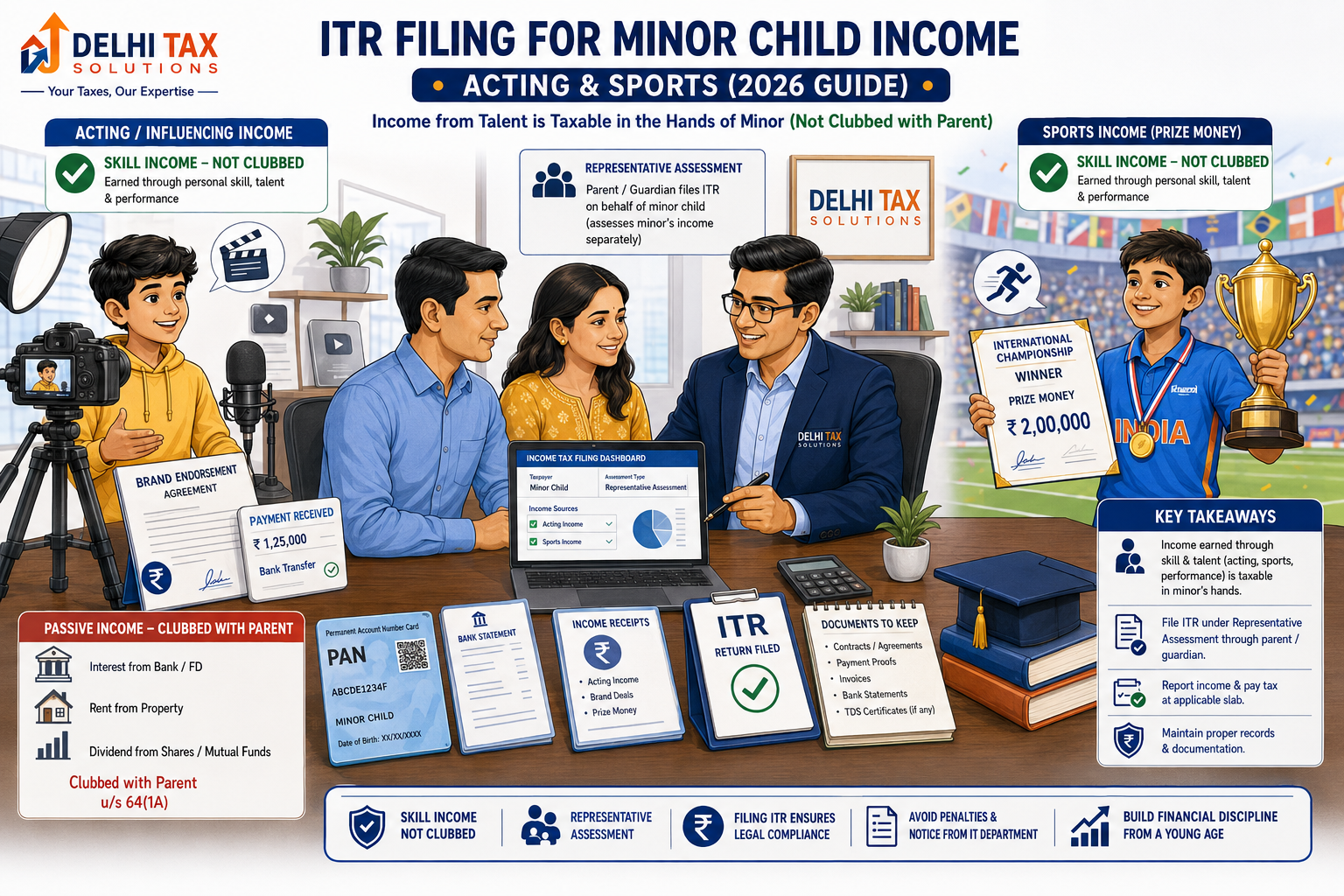
💡 Key Takeaways
- Generally, a minor’s passive income (like bank interest) is clubbed with their parent’s income.
- Income earned through a minor’s personal skill, talent, or manual work is strictly not clubbed.
- Child actors, athletes, and influencers must file independent tax returns using their own PAN cards.
- A parent or legal guardian must register as a ‘Representative Assessee’ to file the return on the child’s behalf.
- If you invest the child’s active earnings, the subsequent interest generated will be clubbed back with the parent’s income.
In today’s fast-paced digital economy, teenagers and children are building lucrative careers well before turning eighteen. From starring in national television commercials to winning international sporting tournaments and managing viral social media channels, minors are generating substantial wealth. However, this early financial success inevitably attracts regulatory scrutiny. Many parents mistakenly assume they must simply add their child’s earnings directly to their own annual tax returns. While this holds true for passive investments, Indian tax law makes a highly specific, generous distinction for active income generated through a child’s unique talent. Mastering the exact mechanics of ITR filing for minor child income acting sports is crucial for parents aiming to protect their child’s wealth while remaining perfectly compliant. Let us explore the statutory framework governing minor taxation, ensuring your next Income Tax Filing handles your child’s success flawlessly.
The General Rule: Clubbing of Minor’s Income
Understanding Section 64(1A)
The core philosophy of the Indian tax system regarding minors is found under Section 64(1A) of the Income Tax Act. The general rule dictates that any income accruing to a minor child must be “clubbed” (added) to the total income of the parent whose income is higher. The government implemented this rule to prevent high-net-worth individuals from transferring assets to their children purely to evade taxes. If a grandfather gifts ₹10 Lakh to his minor grandson, and that money is placed in a Fixed Deposit, the resulting interest is heavily taxed in the hands of the higher-earning parent.
The Minor Income Tax Exemption Limit
When a child’s passive income is clubbed with a parent’s return, the parent can claim a highly specific relief under Section 10(32). The minor income tax exemption limit allows the parent to exempt up to ₹1,500 per minor child per financial year. While this limit is relatively low and outdated compared to modern inflation, it remains a statutory deduction. However, this minor income tax exemption limit only applies to passive income that is actively being clubbed, not the active income we are discussing next.
The Exception: Own Skill and Talent
Defining the Clubbing Exception Minor’s Own Skill Income
The Income Tax Act creates a massive firewall to protect the active labor of children. The clubbing exception minor’s own skill income dictates that if a minor earns money through their manual work, or through an activity involving their personal skill, talent, or specialized knowledge, that specific income cannot be clubbed with the parents. Whether it is coding software, painting, singing, or playing professional cricket, the government taxes this income independently in the hands of the minor themselves.
How Child Actor Tax India Works
Navigating child actor tax India relies entirely on this skill exception. When a ten-year-old child stars in a movie and receives a ₹20 Lakh acting fee, that money is generated purely through the child’s artistic talent. It is not an asset transfer from the parents. Therefore, the ₹20 Lakh is assessed as the child’s independent income. The child will enjoy their own basic exemption limit (currently ₹3 Lakh under the new tax regime) before any tax liability kicks in.
| Source of Minor’s Income | Tax Treatment | Who Pays the Tax? |
|---|---|---|
| Bank Interest from Gifted FDs | Clubbed with Parent | The parent with the higher total income. |
| Rent from a gifted property | Clubbed with Parent | The parent with the higher total income. |
| Acting fees / Brand Endorsements | Not Clubbed (Skill Exception) | The Minor (Filed separately via PAN). |
| Prize money from Sports / eSports | Not Clubbed (Skill Exception) | The Minor (Filed separately via PAN). |
| Interest earned on invested acting fees | Clubbed with Parent | The parent with the higher total income. |
⚡ In a Nutshell
If a minor earns money through their own talent (acting, sports, coding), it is taxed separately under their own name. If they earn money passively (like interest on a bank account gifted by relatives), it gets added to their parent’s taxable income.
Executing ITR Filing for Minor Child Income
Procuring a PAN Card for the Minor
Before initiating ITR filing for minor child income acting sports, the child must possess a valid Permanent Account Number (PAN). According to the Income Tax Department, there is no minimum age requirement to apply for a PAN card. Parents must apply on the minor’s behalf, providing their own proof of identity alongside the minor’s birth certificate. The minor’s PAN card will typically bear the parent’s signature instead of the child’s until the child turns eighteen.
Registering as a Representative Assessee
Minors cannot legally sign legal tax documents or enter into contracts. Therefore, a parent or legal guardian must log into the Income Tax portal and register themselves as a ‘Representative Assessee’ for the child. Once the tax department approves this linkage, the parent can legally file, sign, and verify the ITR on the minor’s behalf. Failing to establish this formal digital link will prevent you from uploading the child’s tax return successfully.
Taxing Passive Returns on a Minor’s Wealth
The Secondary Income Trap
Parents often face confusion regarding what happens after the child earns the money. Let us say the child actor earns ₹10 Lakh, pays their taxes independently, and the parent invests the remaining ₹9 Lakh into a Fixed Deposit in the child’s name. The initial ₹10 Lakh was protected by the clubbing exception minor’s own skill income rule. However, the subsequent ₹70,000 annual interest generated by that Fixed Deposit is not earned through the child’s active skill. Therefore, that secondary ₹70,000 interest income will be clubbed with the parent’s income.
Corporate Structuring for High-Earning Minors
When child prodigies begin earning massive revenues through global brand endorsements, merchandise, or YouTube channels, managing their personal taxes becomes incredibly complex. If the child’s annual revenue crosses the statutory threshold of ₹20 Lakh for services, the parent acting as their representative must ensure formal GST Registration is obtained in the minor’s name. In highly lucrative scenarios, parents may consult the Ministry of Corporate Affairs to explore forming a Private Limited Company or an LLP (with parents as designated partners) to manage the minor’s commercial affairs more efficiently via a formal Company Registration.
The Role of Expert CA Advice for Minors
Navigating Brand Endorsements and TDS
Production houses and advertising agencies will routinely deduct TDS (Tax Deducted at Source) at 10% under Section 194J when paying child actors. Parents must actively track these deductions via the minor’s Form 26AS. If the minor’s total income falls below the taxable threshold, executing a separate ITR filing for minor child income acting sports is the only way to claim that deducted TDS as a refund. Proper TDS Compliance ensures the child recovers every rupee they rightfully earned.
Managing Wealth Across Jurisdictions
Young athletes frequently compete internationally, earning prize money in foreign currencies. The Press Information Bureau frequently highlights young chess prodigies and athletes winning global accolades. Repatriating these foreign earnings back to India triggers strict regulatory oversight from the Reserve Bank of India under FEMA guidelines. A certified Chartered Accountant can seamlessly reconcile these foreign winnings, claim foreign tax credits (DTAA), and manage the child’s evolving wealth portfolio.
Managing the wealth of a child prodigy is a tremendous responsibility. Understanding the specific mechanics behind the clubbing exception minor’s own skill income ensures you do not overpay taxes by unnecessarily inflating your own income bracket. Establishing a separate tax identity for your child validates their hard work and sets up a clean financial foundation for their adult life. If your child is generating substantial income through acting, sports, or digital media, do not attempt to navigate the representative assessee process alone. Talk to a Delhi Tax Solutions expert to get your child’s taxes structured and filed flawlessly. Securing professional CA guidance today protects your family’s wealth and guarantees total compliance with the tax department.
About this article: Researched using official government sources and Delhi Tax Solutions’ in-house tax advisory team. Last updated August 2026.
Frequently Asked Questions (FAQs)
Q: Is a child actor’s income clubbed with their parents’ income?
A: No, a child actor’s income is not clubbed with their parents’ income. Under Section 64(1A) of the Income Tax Act, any income earned by a minor through their personal skill, talent, or manual work (such as acting, singing, or professional sports) is exempt from the clubbing provisions and is taxed independently in the hands of the minor.
Q: What is the minor income tax exemption limit under Section 10(32)?
A: The minor income tax exemption limit under Section 10(32) allows a parent to claim a deduction of up to ₹1,500 per child per financial year. However, this exemption only applies when the minor’s passive income (like bank interest on gifted money) is being clubbed with the parent’s income. It does not apply to income earned through the minor’s own skills.
Q: Can a minor hold their own PAN card in India?
A: Yes, a minor can hold their own Permanent Account Number (PAN) card in India. There is no minimum age limit to apply. However, because a minor cannot sign legal documents, the parent or legal guardian must sign the PAN application form and provide their own identification documents alongside the child’s birth certificate.
Q: How is child actor tax India calculated?
A: Child actor tax India is calculated exactly like an adult professional’s tax. The child files an independent tax return using their own PAN. They are entitled to the standard basic exemption limit (e.g., ₹3 Lakh under the new tax regime). If their acting income exceeds this limit, they pay income tax according to the standard applicable slab rates.
Q: What happens if I invest my child’s acting income in fixed deposits?
A: While the initial acting income is not clubbed with the parent’s income, any subsequent interest generated from investing that money is treated differently. Because the interest itself is passive income and not earned through the child’s active skill, the interest income will be clubbed back with the higher-earning parent’s total income for tax purposes.
