💡 Key Takeaways:
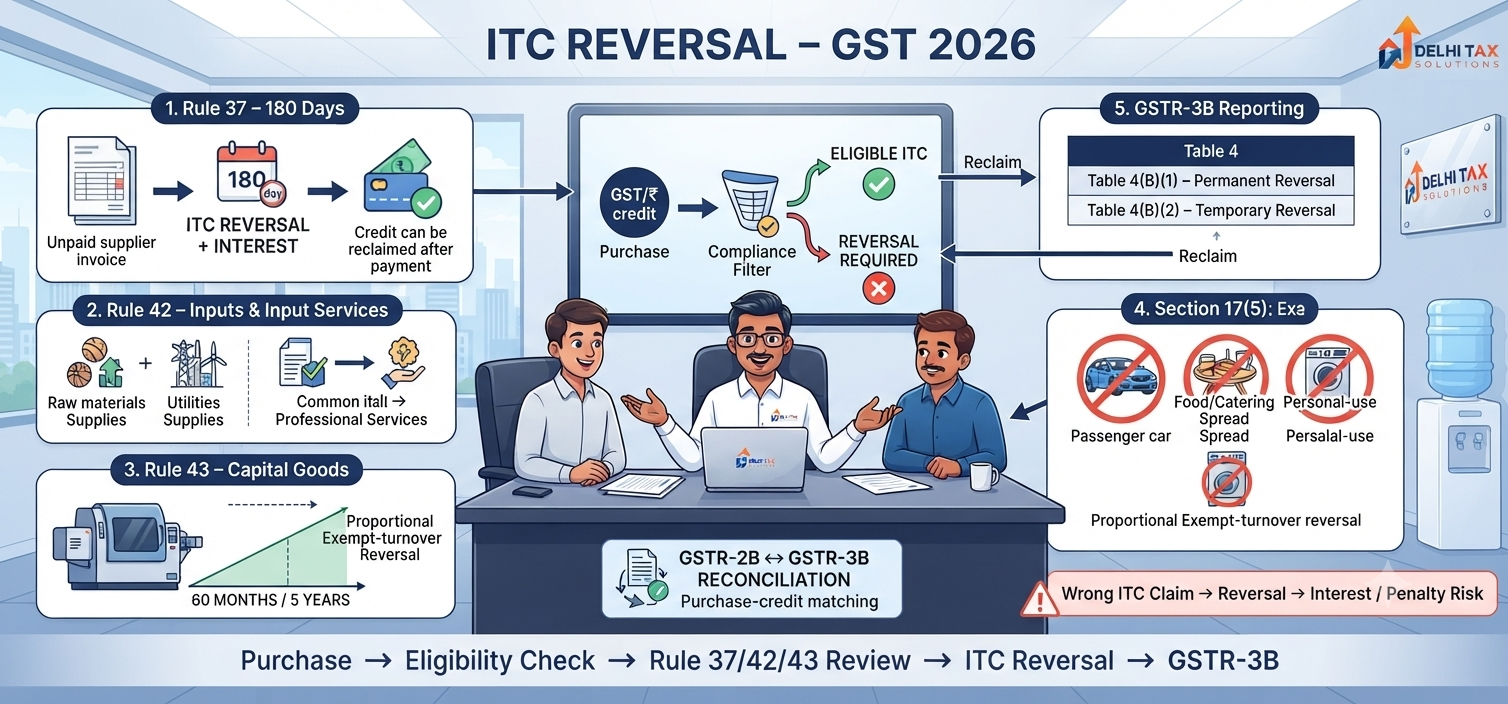
- ITC reversal is mandatory when inputs or capital goods support exempt supplies or personal use.
- Rule 42 governs common credit apportionment for inputs and input services on a monthly basis.
- Rule 43 applies to capital goods, spreading tax credit reversals over a 60-month useful life.
- Non-payment to suppliers within 180 days triggers Rule 37 reversal with Section 50 interest.
- Report permanent reversals in GSTR-3B Table 4(B)(1) and temporary reversals in Table 4(B)(2).
Input tax credit mechanisms keep Indian businesses competitive by preventing tax cascading. Claiming ineligible credits creates major tax audit penalties. Failing to perform timely tax credit reversals leads directly to automated system notices under Central Goods and Services Tax rules.
Tax authorities identify discrepancies between tax credits auto-populated in GSTR-2B and claims submitted in GSTR-3B returns. Business taxpayers must calculate reversals accurately every tax period. Correct compliance requires knowing exactly when tax rules mandate credit adjustments. This guide explains exact credit reversal conditions under Indian tax law. You will learn Rule 42 formulas for common inputs, Rule 43 mechanics for capital equipment, and mandatory reporting steps for GSTR-3B filings.
What is Input Tax Credit Reversal under Indian GST?
Every registered tax entity claiming credits must reconcile purchases monthly. Taxpayers cannot retain tax benefits on purchases that do not directly generate taxable outward sales.
When is Reversal of Input Tax Credit Mandatory under Law?
Indian tax law mandates reversing input tax benefits across specific operational situations. Understanding these triggers prevents surprise demand orders from tax officers.
1. Non-Payment to Suppliers Within 180 Days (Rule 37)
Taxpayers must pay suppliers invoice amounts plus GST within 180 days from the invoice issue date. Failing this timeline requires adding claimed tax credit back to output liability under Rule 37, along with 18 percent annual interest calculated under Section 50. Taxpayers reclaim this credit freely once full payment clears.
2. Ineligible and Blocked Credits under Section 17(5)
Certain purchases never qualify for tax offset credits. Section 17(5) GST explicitly blocks credit claims on motor vehicles for personal transport, food and catering services, health insurance, club memberships, and goods lost, stolen, or destroyed. Any auto-populated credit on these items must be reversed immediately.
3. Goods Used for Exempt Supplies or Personal Use
Purchases supporting zero-rated or tax-exempt outward supplies cannot offset taxable sales. If office assets or inventory items serve personal domestic uses, proportional tax credit reversals become legally mandatory under CBIC GST circulars.
How Does Rule 42 GST Work for Inputs and Input Services?
Businesses frequently buy raw materials, utilities, and professional services that support both taxable and exempt outward sales. Rule 42 GST provides the exact statutory formula to apportion this common tax credit each month.
Understanding the Rule 42 Formula Framework
To compute the monthly reversal of input tax credit, start with total input tax credited in your books ($T$). First, subtract credits tied exclusively to non-business uses ($T_1$), exempt sales ($T_2$), and blocked credits under Section 17(5) ($T_3$).
The remaining amount ($T_4$) represents credit used exclusively for taxable sales. The net common credit ($C_2$) is calculated as:
$$C_2 = T – (T_1 + T_2 + T_3 + T_4)$$
From common credit ($C_2$), you must reverse two distinct components:
- Ineligible credit attributable to exempt supplies ($D_1$): Calculated as $D_1 = (E / F) \times C_2$, where $E$ is total exempt turnover and $F$ is total business turnover during the tax period.
- Ineligible credit attributable to non-business purposes ($D_2$): Fixed by law at 5 percent of common credit ($D_2 = 5\% \times C_2$).
The remaining balance ($C_3 = C_2 – (D_1 + D_2)$) flows safely into your electronic credit ledger as eligible tax credit. Businesses must finalize annual reconciliations before September 30 following the relevant financial year.
What are the Key Steps under Rule 43 for Capital Goods Credit?
Capital assets like machinery, commercial computers, and office buildings serve operations over extended periods. Rule 43 regulates tax credit adjustments on capital goods, establishing a standard statutory useful life of 60 months (5 years) for all asset categories.
Capital Goods Credit Allocation Mechanics
When capital equipment exclusively supports taxable sales, full tax credit applies immediately. Equipment used exclusively for exempt sales yields zero tax credit. When capital assets serve both taxable and exempt production, tax credit on the asset invoice is designated as common capital credit ($A_c$). Monthly tax credit attributed to the asset lifespan ($T_m$) is calculated as:
$$T_m = A_c / 60$$
The monthly ineligible capital credit reversal amount ($T_e$) is determined by the ratio of exempt turnover ($E$) to total turnover ($F$):
$$T_e = (E / F) \times T_m$$
This calculated amount ($T_e$) is added directly to your monthly output tax liability in GSTR-3B along with applicable interest throughout the 60-month operational lifecycle.
Rule 42 vs Rule 43: How Do They Differ in Practice?
While both rules calculate ineligible tax credit on common purchases, their statutory scopes and application mechanics differ significantly. Review our specialized GST compliance advisory services to ensure your monthly calculations match tax authority expectations.
| Compliance Parameter | Rule 42 (Inputs & Services) | Rule 43 (Capital Goods) |
|---|---|---|
| Scope of Application | Consumable raw materials, utilities, operational expenses | Plant, machinery, commercial vehicles, building assets |
| Time Horizon | Monthly tax period with annual end-of-year adjustment | Fixed 60-month (5-year) statutory useful asset life |
| Non-Business Overhead | Fixed 5% deduction ($D_2$) on common credit | No fixed percentage deduction; direct turnover ratio only |
| Reversal Mechanism | Direct reduction from available monthly ITC claim | Addition of calculated $T_e$ to output tax liability |
How Should You Report ITC Reversal in GSTR-3B Table 4?
Accurate reporting on the official GST Portal prevents automated compliance notices. Taxpayers must map calculations precisely into GSTR-3B Table 4 structure.
Permanent credit adjustments—such as Section 17(5) blocked credits and permanent Rule 42 or 43 reversals—must be disclosed in Table 4(B)(1). These credits can never be reclaimed later.
Temporary credit reversals—such as Rule 37 non-payment within 180 days or tax credit mismatches pending supplier filing—belong in Table 4(B)(2). Once you pay the vendor invoice, re-claim this credit safely in Table 4(A)(5) and disclose it under Table 4(D)(1).
When registering a new commercial entity through our company registration solutions or setting up a corporate venture via business registration services, establishing clean accounting processes from day one prevents costly tax credit leakage.
Navigating Penalty Risks and Section 50 Interest
Wrongfully claiming and utilizing ineligible tax credit incurs mandatory statutory interest under Section 50(3) at 18 percent per annum. Under updated tax laws, if ineligible credit is claimed but never utilized to pay output tax, interest penalties do not apply. However, once unearned tax credit offsets output tax liabilities, interest accrues immediately from the date of wrongful utilization until cash tax payment clears the shortfall. Maintaining accurate purchase registers is essential.
Streamline Your GST Compliance with Delhi Tax Solutions
Calculating tax credit apportionment manually introduces compliance errors. Our chartered accountant practice provides end-to-end tax support, from setting up proper GST accounting to executing precise month-end GSTR-3B reconciliations. Whether managing complex corporate operations, filing annual returns, or seeking guidance on income tax filing compliance alongside indirect taxes, our expert advisory team ensures your business claims every rupee of eligible credit without regulatory risk.
Contact a Delhi Tax Solutions specialist today to audit your input tax credit registers and safeguard your business against GST audit notices.
Disclaimer: This article is for general informational purposes and is not a substitute for personalized professional tax advice. Researched using official government sources, real-time search trends, and Delhi Tax Solutions’ in-house tax advisory team. Last updated September 2026.
Frequently Asked Questions
Q: What is the main difference between Rule 42 and Rule 43 in GST?
A: Rule 42 governs the reversal of input tax credit on inputs and input services used for both taxable and exempt supplies on a monthly operational basis. Rule 43 specifically regulates credit reversals on capital goods such as machinery and equipment, spreading the credit apportionment over a statutory useful asset lifespan of 60 months.
Q: What happens if I fail to reverse ITC under Rule 37 within 180 days?
A: If you fail to pay a supplier within 180 days of invoice issuance, you must reverse the claimed tax credit by adding it to your output tax liability in GSTR-3B. Additionally, mandatory interest at 18 percent per annum applies under Section 50 from the credit utilization date until tax reversal payment. You can re-claim the full credit once payment to the supplier is cleared.
Q: Where should I report permanent vs temporary ITC reversals in GSTR-3B?
A: Permanent tax credit reversals—including blocked credits under Section 17(5) and non-reclaimable Rule 42/43 amounts—must be reported in Table 4(B)(1) of GSTR-3B. Temporary credit reversals—such as unpaid vendor invoices under 180-day rules—must be reported in Table 4(B)(2), allowing taxpayers to legally re-claim the tax credit in Table 4(A)(5) during future filing periods upon payment.
Q: Is interest applicable if wrong ITC is claimed but not utilized?
A: No, under amended Section 50(3) of the CGST Act, interest at 18 percent per annum applies only when wrongfully claimed input tax credit is actually utilized to offset output tax liability. If ineligible tax credit remains reflected in your electronic credit ledger without being utilized for tax payment, no statutory interest liability accrues upon subsequent credit reversal.
Q: How do you calculate common credit reversal for exempt sales under Rule 42?
A: Common credit reversal ($D_1$) under Rule 42 is calculated using the formula $D_1 = (E / F) \times C_2$, where $E$ represents total exempt turnover during the tax period, $F$ represents total turnover in the state, and $C_2$ is net common credit. The calculated amount represents tax credit attributable to exempt sales and must be reduced from eligible monthly input tax claims.