
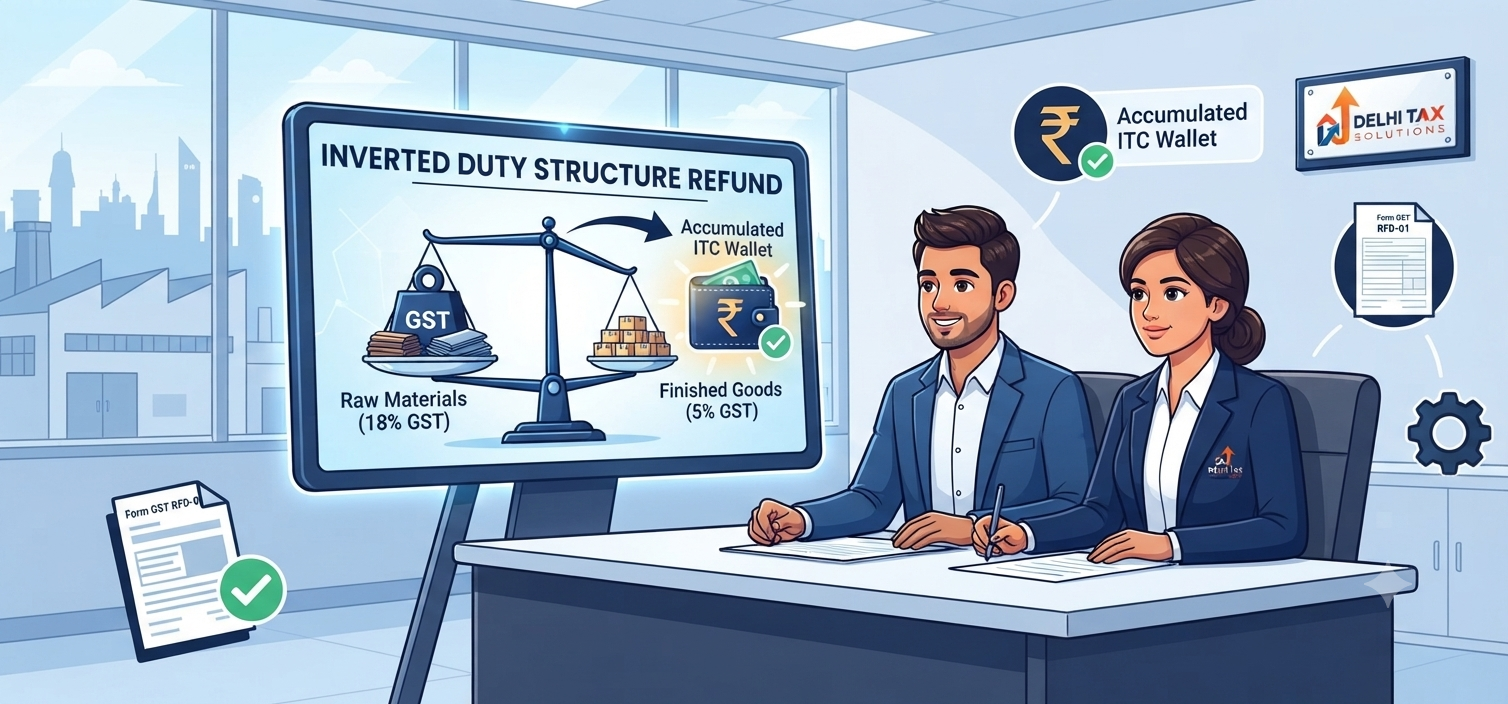
💡 Key Takeaways: Inverted Duty Structure
- An inverted duty structure occurs when the GST rate on inputs (raw materials) is higher than the GST rate on outward supplies (finished goods).
- Section 54(3) of the CGST Act allows taxpayers to claim a refund of unutilized Input Tax Credit (ITC) that accumulates due to this inverted tax structure.
- Refunds are strictly limited to ITC on inputs (goods). Accumulated ITC on input services and capital goods cannot be claimed as a refund under this category.
- The formula under Rule 89(5) was recently amended to provide a fairer calculation by taking into account the proportion of ITC on inputs to the total ITC on inputs and input services.
- The refund application must be filed online using Form GST RFD-01 within 2 years from the due date of furnishing the GSTR-3B return for the relevant period.
Manufacturing and trading businesses often face a scenario where they pay 12% or 18% GST to their suppliers for raw materials, but their finished product is legally classified under a 5% GST tax bracket. Because the output tax liability is smaller than the input tax paid, an excess balance of Input Tax Credit (ITC) begins to pile up in their Electronic Credit Ledger. This phenomenon is known as an inverted duty structure.
Left unchecked, this blocked capital can severely cripple a company’s working capital. Fortunately, Section 54(3) of the CGST Act provides a lifeline, allowing businesses operating under an inverted tax structure to claim a cash refund of this unutilized ITC. However, calculating the exact eligible amount requires navigating the strict exclusions of Rule 89(5).
Inputs vs. Input Services: The Critical Exclusion
Before applying for the refund, it is crucial to understand exactly what part of your accumulated ITC is eligible for a refund. The GST law makes a strict distinction between the types of purchases you make.
| Type of ITC | Examples | Refund Eligibility |
|---|---|---|
| Inputs | Raw materials, packaging materials, trading goods | Yes, Eligible |
| Input Services | Rent, software subscriptions, consulting fees, freight | No, Excluded |
| Capital Goods | Machinery, computers, factory equipment, vehicles | No, Excluded |
This means if your ITC ledger has ₹10 Lakhs accumulated, but ₹3 Lakhs of that came from paying GST on your factory rent and accounting software (Input Services), you can only calculate your refund based on the remaining ₹7 Lakhs (Inputs).
The Revised Formula under Rule 89(5)
Historically, the formula for calculating this refund faced heavy litigation because it unfairly assumed that output tax liability was entirely paid out of the ITC on inputs, ignoring the ITC available from input services. To resolve this anomaly, the government amended the formula (Notification 14/2022) to ensure a proportional adjustment.
The revised formula to calculate the maximum permissible refund is:
{ (Turnover of Inverted Rated Supply × Net ITC) ÷ Adjusted Total Turnover }
MINUS
{ Tax Payable on such Inverted Rated Supply × (Net ITC ÷ ITC availed on Inputs and Input Services) }
Decoding the Formula Variables:
- Net ITC: The Input Tax Credit availed on inputs (goods) only during the relevant period.
- Turnover of Inverted Rated Supply: The total sales value of the goods/services where the output tax rate is lower than the input tax rate.
- Adjusted Total Turnover: The total aggregate turnover in the State/UT (excluding exempt supplies).
- Tax Payable: The actual output GST liability on the inverted rated supplies.
- Proportion Factor:
(Net ITC ÷ ITC availed on Inputs and Input Services)ensures that the tax payable is offset proportionally between inputs and input services, granting a higher refund amount to taxpayers than the older formula.
How to File the Refund on the GST Portal
Claiming your accumulated ITC requires precision in statement filing and return matching. Follow these steps on the GST Services Portal:
1. Reconcile GSTR-2B and GSTR-3B
Before filing for a refund, ensure that the ITC claimed in your GSTR-3B perfectly matches the auto-populated GSTR-2B. The tax officers will only sanction a refund for invoices where the supplier has filed their GSTR-1 and the tax has been paid to the government.
2. Download the Offline Statement 1A
Navigate to Services → Refunds → Application for Refund. Select the category “Refund on account of Inverted Duty Structure”. Download the Statement 1A Excel utility.
3. Enter Invoice-Level Details
In Statement 1A, you must provide document-level details of both inward supplies (purchases of inputs) and outward supplies (sales of inverted goods). Ensure you do not include details of input services or capital goods in the inward supply table. Validate and generate the JSON file.
4. Upload JSON & Enter Formula Values
Upload the Statement 1A JSON file on the portal. Once validated, enter the values for Net ITC, Turnover of Inverted Supply, Adjusted Total Turnover, and Tax Payable. The portal will automatically apply the Rule 89(5) formula and calculate the maximum eligible refund.
5. Enter Claim Amount & Attach Documents
Enter the amount you wish to claim (it cannot exceed the formula result or your actual ledger balance). Upload required supporting documents, and if the refund amount exceeds ₹2 Lakhs, upload the mandatory CA/CMA certificate in Annexure 2.
Unlock Your Blocked ITC with Delhi Tax Solutions
Segregating inputs from input services and reconciling Statement 1A with GSTR-2B can be a tedious and error-prone process. A single misclassification can lead to a Show Cause Notice and rejection of your refund.
Our dedicated team of Chartered Accountants specializes in complex Rule 89(5) calculations and full-service GST refund processing. Get your working capital flowing again by consulting our experts at Delhi Tax Solutions today.
Frequently Asked Questions (FAQs)
+ Q: Can I claim an inverted duty structure refund if my output is completely exempt from GST?
A: No. Section 54(3) specifically denies refunds in cases where the unutilized ITC is accumulated due to supplies that are fully exempt or nil-rated. The output must be taxable, just at a lower rate than the inputs.
+ Q: Does an inverted duty structure apply if I offer a trade discount that lowers the final tax amount?
A: No. The inverted tax structure is based entirely on the tax rates (e.g., Input at 18%, Output at 5%). It is not based on the actual tax amount paid due to commercial discounts or value additions.
+ Q: Are there any specific goods explicitly blocked from this refund?
A: Yes. The government has notified specific goods (under Notification No. 5/2017-Central Tax Rate) where an inverted duty refund cannot be claimed, even if the math applies. Common examples include certain woven fabrics, construction services, and railway wagons.
+ Q: What is the time limit to file Form GST RFD-01 for an inverted duty structure?
A: The application must be filed within 2 years from the due date of furnishing the return (GSTR-3B) for the period in which such claim for refund arises.
+ Q: Can a trader or retailer claim this refund, or is it only for manufacturers?
A: Both traders and manufacturers can claim the refund, provided the statutory conditions are met. For example, if a trader buys goods at 18% and sells the same goods at a government-mandated reduced rate of 5%, they are eligible for the refund.
About this article: Authored using statutory provisions of Section 54(3) of CGST Act, 2017 and the amended Rule 89(5) of CGST Rules. Last updated September 2026.
Disclaimer: This blog post is for educational purposes and does not constitute formal legal or tax advisory opinion.