
💡 Key Takeaways
- HRA exemption is governed under Section 10(13A) and Rule 2A of the Income Tax Act.
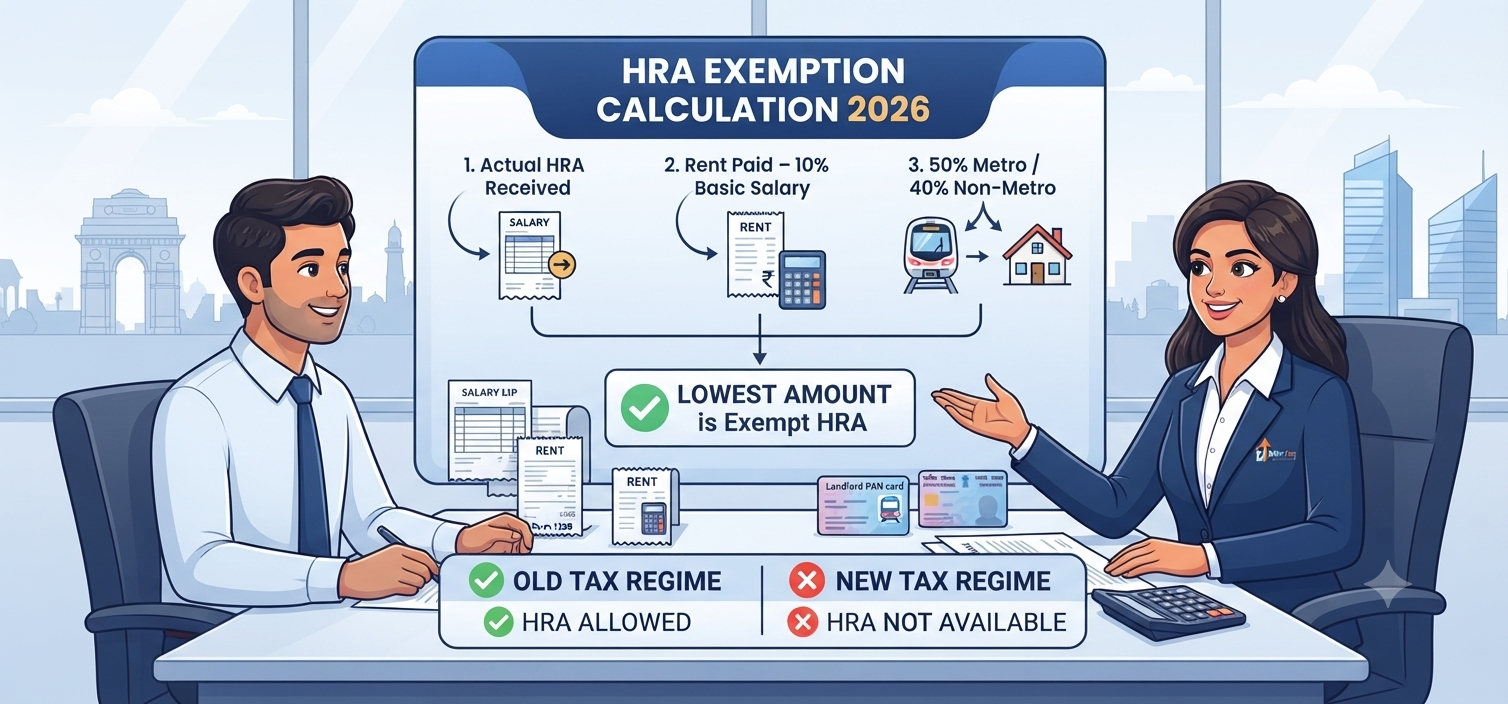
- Exemption equals the lowest of actual HRA, rent minus 10% basic salary, or 50%/40% of basic salary.
- Landlord PAN is mandatory if annual rent exceeds ₹1,00,000.
- Proper rent receipts and a formal lease agreement protect against tax notices.
Maximizing take-home pay requires mastering HRA exemption calculation before submitting financial proofs to your employer. Salaried taxpayers across Delhi and India frequently lose thousands of rupees in potential tax savings due to minor paperwork oversights. Claiming this allowance correctly involves understanding statutory formulas, maintaining valid rent receipts, and knowing when a landlord Permanent Account Number is legally required. Based on cases handled by our CA team at Delhi Tax Solutions, structured compliance eliminates end-of-year tax stress and prevents costly notices from the tax department.
Understanding Section 10(13A) and Rule 2A
Taxpayers must understand the statutory foundation governing House Rent Allowance before executing any calculations. Section 10(13A) of the Income Tax Act outlines the framework, while Rule 2A prescribes the exact limits. HRA exemption calculation relies strictly on three distinct financial variables evaluated simultaneously.
The Income Tax Department evaluates your salary structure to determine eligibility. Your employer divides your compensation into basic salary, dearness allowance, and specific perks. Only the basic salary plus dearness allowance component forms the mathematical base for your tax exemption computation.
According to guidelines issued by the Income Tax Department, employees must reside in a rented accommodation and actually pay rent to claim this benefit. Living in a self-owned property while claiming HRA simultaneously is legally impermissible and attracts severe penalties during scrutiny.
The Three Statutory Parameters
Determining your exact tax-free allowance requires computing three separate figures and selecting the minimum amount. The first parameter is the actual House Rent Allowance received from your employer through your monthly salary slip. The second parameter is the total annual rent paid minus ten percent of your basic salary plus dearness allowance. The third parameter is fifty percent of your basic salary for metro cities or forty percent for non-metro locations.
Metro Versus Non-Metro Limits
City classification dictates whether you qualify for the higher fifty percent threshold or the standard forty percent threshold. Delhi, Mumbai, Kolkata, and Chennai qualify strictly as metro cities under tax statutes. Taxpayers residing in urban hubs like Bangalore, Hyderabad, Pune, or Gurgaon fall under the non-metro forty percent rule, which often surprises working professionals moving within the National Capital Region.
Salary Component Breakdown
Your computation must isolate the exact numerical value of your basic salary and dearness allowance. Commissions, performance bonuses, and standard reimbursements are excluded from this base. Using inaccurate salary figures distorts the final exempt amount, leading to shortfalls when your employer reconciles tax deducted at source.
Step-by-Step Computational Framework
Executing an accurate calculation prevents discrepancies between your self-assessed tax and employer computations. Let us examine a practical case study of a software engineer earning a basic salary of ₹50,000 per month in Delhi. Annual basic salary totals ₹6,00,000, while actual annual HRA received from the employer equals ₹2,40,000. The employee pays an annual rent of ₹3,00,000, amounting to ₹25,000 monthly.
Step one evaluates the actual HRA received, which is ₹2,40,000. Step two calculates the rent paid in excess of ten percent of basic salary, resulting in ₹3,00,000 minus ₹60,000, giving ₹2,40,000. Step three calculates fifty percent of the basic salary since Delhi is a metro city, equaling ₹3,00,000. Comparing these three figures reveals that the lowest amount is ₹2,40,000.
Consequently, the entire HRA received is fully exempt from taxation. If the rent paid were higher, the exemption would cap out at the lowest computed threshold. As per the Income Tax Department portals, maintaining exact computational records ensures smooth processing during ITR filing.
âš¡ In a Nutshell: HRA Exemption Rules
- Lowest of Actual HRA, Rent minus 10% Basic, or 50%/40% Basic is tax-free.
- Metro cities include Delhi, Mumbai, Kolkata, and Chennai only.
- Landlord PAN is mandatory for annual rent exceeding ₹1,00,000.
Evaluating Actual HRA Received
Your employer specifies the exact monthly allowance on your salary structure. Check your Form 16 Part B to verify the exact exempt allowance reported by your payroll department. Any mismatch between your investment declaration and Form 16 requires direct reconciliation before filing your return.
Computing Rent Minus Ten Percent
Multiply your monthly basic salary by twelve to arrive at the annual basic figure. Calculate ten percent of this annual basic amount and subtract it from your total annual rent paid. If you paid rent for only eight months due to job relocation, prorate both the rent and the basic salary denominator accordingly.
Applying Metro Percentage Caps
Apply the fifty percent multiplier only if your residence is located within Delhi, Mumbai, Chennai, or Kolkata. For all other Indian cities, apply the forty percent multiplier. Misclassifying your residential city is a frequent error flagged by automated scrutiny systems.
Documentation: Rent Receipts and Landlord PAN
Proper paperwork safeguards your tax deduction against departmental scrutiny. Taxpayers must compile monthly rent receipts bearing revenue stamps where cash transactions exceed ₹5,000. Each receipt must display the tenant name, landlord name, property address, rental period, and exact amount paid.
Submitting a formal rent agreement executed on stamp paper establishes legal tenancy. When annual rent payments surpass ₹1,00,000, providing the landlord Permanent Account Number is a strict statutory requirement. Failing to provide this number invalidates the exemption claim entirely, converting your tax-free allowance into taxable income.
If your landlord refuses to share their PAN, obtain a signed declaration explaining their exemption from taxation or submit Form 49A application proof. According to updates by our tax advisory team at Delhi Tax Solutions, landlords who do not possess a PAN must provide a formal written declaration with their contact details and [Aadhaar Redacted].
Compiling Valid Rent Receipts
Rent receipts must be sequentially numbered and signed by the property owner. Digital rent transfers via bank statements complement paper receipts, providing dual verification. Ensure the receipt dates align perfectly with the financial year under audit.
Landlord PAN Compliance Rules
The ₹1,00,000 annual threshold applies per rental property, not per month. If your annual rent totals ₹1,20,000, collecting the landlord PAN is non-negotiable. Tax authorities cross-verify landlord PAN details against Form 26AS and Annual Information Statement records.
Form 12BB Submission Protocol
Employees must submit Form 12BB to their employer before the financial year closes. This formal statement details rent paid, landlord particulars, and investment proofs. Missing employer submission deadlines forces you to claim the exemption directly while filing your income tax return.
Old Tax Regime Versus New Tax Regime Comparison
Taxpayers face a critical choice between opting for the traditional tax regime or migrating to the concessional tax regime. Under the concessional tax regime introduced in recent budgets, exemptions such as House Rent Allowance, Leave Travel Concession, and Section 80C deductions are entirely surrendered in exchange for lower tax slab rates.
Evaluating which regime saves more money depends heavily on your rent outlays and housing loan interest deductions. High rent payers living in metro cities often save significantly more under the old tax regime despite higher slab rates. Conversely, individuals paying minimal rent or living in ancestral homes benefit more from the simplified tax slabs of the new regime.
| Feature | Old Tax Regime | New Tax Regime |
|---|---|---|
| HRA Exemption Claim | Allowed under Section 10(13A) | Not Available |
| Section 80C Deductions | Available (up to ₹1.5 Lakhs) | Not Available |
| Tax Slab Rates | Standard progressive slabs | Concessional lower slabs |
| Best Suited For | High rent payers & loan holders | Low deduction claimants |
Evaluating Your Rental Outlay
Calculate your total annual tax savings by factoring in your rent outlays against your gross taxable income. If your annual rent exceeds thirty percent of your total compensation, the old regime typically yields superior tax outcomes. Use professional calculation tools or consult experts at Income Tax Services to run a dual comparison.
Home Loan Co-existence Rules
Taxpayers can claim both home loan interest deductions under Section 24 and HRA exemption simultaneously under specific circumstances. You must own a residential property in one city while working and paying rent in another city due to employment requirements. Documenting your employment posting and property location prevents disallowances during tax audits.
Making the Annual Selection
Salaried employees can switch between regimes each financial year when filing their return, whereas business owners have limited switching options. Assess your projected deductions every April to instruct your payroll department accurately. Proper planning prevents sudden tax liabilities during annual reconciliation.
Common Mistakes to Avoid During ITR Filing
Taxpayers frequently commit avoidable errors that trigger automated scrutiny notices from the tax department. One major mistake involves claiming HRA while living in a property owned by a spouse. Tax tribunals have repeatedly ruled that rent paid to a spouse lacks commercial substance, resulting in complete disallowance of the exemption.
Another frequent error involves submitting inflated rent amounts using fabricated receipts. Modern data analytics utilized by the Income Tax Department match tenant expense claims against landlord income disclosures in Annual Information Statements. Discrepancies immediately flag accounts for verification, leading to penalty notices and interest charges.
For business owners and corporate entities expanding operations alongside personal tax filings, maintaining clean corporate compliance is equally vital. Explore Company Registration or review business compliance via Business Licenses to ensure your overall financial portfolio remains audit-proof.
Paying Rent to Family Members
Paying rent to parents or adult children is legally permissible provided genuine tenancy exists. The recipient must report the rental income in their respective income tax return, and actual fund transfers must occur through banking channels. Cash payments to close relatives raise immediate red flags during tax assessments.
Ignoring Employer Proof Deadlines
Missing your corporate payroll investment proof deadline results in heavy tax deductions in your final months. While you can claim the exemption independently while filing your ITR, recovering deducted TDS involves waiting for income tax refunds. Timely submission avoids unnecessary cash flow crunches.
Reconciling Form 26AS Discrepancies
Always cross-verify your landlord PAN declarations against your Form 26AS and AIS data before submitting tax returns. Ensuring complete harmony across government databases protects you against unwarranted compliance notices. When in doubt, partner with our tax advisory team at Start Your Business Hub for comprehensive compliance support.
Frequently Asked Questions (FAQs)
Q: How is HRA exemption calculated under the Income Tax Act?
A: HRA exemption under Section 10(13A) is calculated as the minimum of three values: actual HRA received from your employer, rent paid minus 10 percent of basic salary plus dearness allowance, and 50 percent of basic salary for metro cities or 40 percent for non-metro locations. Accurate calculation requires isolating your exact basic salary component from your monthly compensation structure and maintaining valid monthly rent receipts.
Q: Is landlord PAN mandatory if my annual rent exceeds 1 lakh rupees?
A: Yes, providing your landlord Permanent Account Number is strictly mandatory if your total annual rent payment exceeds ₹1,00,000. According to CBDT guidelines, failing to furnish the landlord PAN results in the complete disallowance of your HRA tax exemption claim. If the landlord does not possess a PAN, you must obtain a formal signed declaration detailing their residential address and reasons for non-possession.
Q: Can I claim HRA exemption if I live with my parents and pay rent to them?
A: Yes, you can claim HRA exemption by paying rent to your parents, provided a formal rental agreement exists and you actually transfer rent funds via bank banking channels. Your parents must report this rental income in their individual income tax returns under income from house property. Cash transactions or fabricated arrangements without genuine property ownership by parents will be disallowed by tax authorities.
Q: What documents are required to claim HRA tax exemption from my employer?
A: To claim HRA tax exemption from your employer, you must submit signed rent receipts for every payment period, a stamped rental agreement outlining monthly rent and tenancy terms, and the landlord Permanent Account Number if annual rent exceeds ₹1,00,000. These documents must be submitted through Form 12BB before your employer finalizes your annual tax deducted at source calculations.
Q: Can I claim both home loan tax benefits and HRA simultaneously?
A: You can claim both home loan tax deductions under Section 24 and HRA exemption simultaneously only if your owned property is located in a different city from your place of employment, or if your owned property is rented out to a third party while you reside in a rented accommodation for work. Claiming both for the same residential property without verifiable employment relocation is illegal.
About this article: Researched using official government sources and Delhi Tax Solutions’ in-house tax advisory team. Last updated September 2026. This article is for general informational purposes and is not a substitute for personalised professional tax advice.