
? Key Takeaways
- Filing ITR after switching jobs requires collecting and merging Form 16 certificates from all employers.
- Consolidated income must be reported accurately to prevent automatic tax department notices.
- Reconciling Form 26AS and AIS eliminates potential Tax Deducted at Source credit discrepancies.
- Failing to disclose previous salary earnings leads to short-deduction notices and financial penalties.
- Professional chartered accountant guidance ensures error-free annual tax return filing and faster refunds.
Switching corporate careers offers rewarding salary upgrades, but navigating annual tax filings with multiple employers creates complex paperwork hurdles. Knowing exactly how to file ITR after switching jobs prevents costly computation errors and protects taxpayers from automated scrutiny by tax authorities.
As professionals across urban centers like Delhi NCR transition between organizations, managing separate tax withholding certificates requires meticulous attention to detail. Each employer deducts tax based solely on what they pay, often leaving a shortfall when cumulative earnings push the taxpayer into a higher tax bracket.
This comprehensive guide details the exact steps required to merge multiple income streams, reconcile tax credits, and submit error-free returns for FY 2025-26.
What is the exact process of how to file ITR after switching jobs?
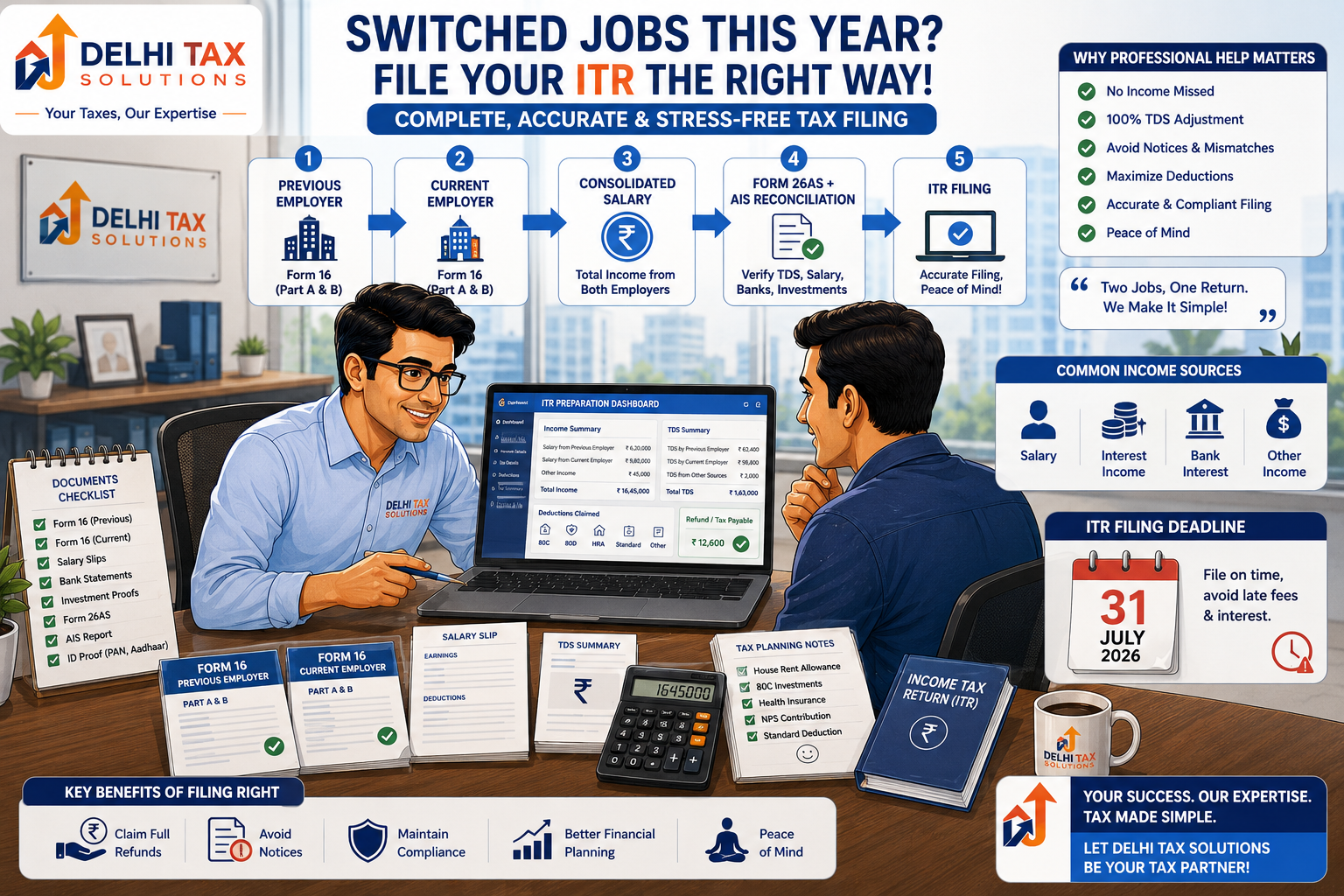
To file your income tax return successfully after changing employers during the financial year, you must gather Form 16 documents from every company you worked for, compute your total aggregated salary, verify your tax credits against the Annual Information Statement, and report all income under the salary head in the correct ITR form before the July 31 deadline.
How do you manage multiple Form 16 ITR filing requirements?
Executing a seamless multiple Form 16 ITR filing starts with collecting Part A and Part B certificates from your previous and current employers. Official guidelines published by the Income Tax Department mandate that taxpayers must aggregate all earnings rather than filing separate returns for each job.
When you transition between organizations, your new employer calculates tax withholdings without factoring in past earnings unless formally declared using statutory disclosure forms. Managing corporate compensation setups through Company Registration compliance helps employers issue precise certificates.
Furthermore, monitoring payroll deductions via regulated TDS mechanisms prevents severe tax shortfalls at year-end.
Collecting certificates from all employers
Former employers are legally obligated to issue Form 16 reflecting earnings and tax deducted up to your last working day.
Reporting cumulative gross salary
Taxpayers must sum up basic salary, allowances, and perquisites from all employment periods into a single gross figure.
How do taxpayers handle consolidated income multiple employers?
Calculating consolidated income multiple employers requires merging salary figures while accounting for standard deductions and chapter VI-A tax exemptions across all entities. Official reviews published by the Press Information Bureau indicate that claiming standard deductions twice by mistake is a frequent error made by job switchers.
The standard deduction of ?50,000 or enhanced limits under current rules can only be claimed once per financial year, regardless of how many companies employed you during that period.
Taxpayers must also reconcile these combined earnings with overarching Income Tax filing obligations.
Claiming the standard deduction once
Ensure that the fixed standard deduction is applied only once in your aggregate income computation schedule.
Consolidating tax-saving deductions
Sum up investments made under Sections 80C, 80D, and other provisions across all employment tenures up to statutory maximum limits.
How can you fix a TDS mismatch job switch error?
Resolving a TDS mismatch job switch involves cross-checking your Form 16 certificates against Form 26AS and the Annual Information Statement. Financial analyses published by the Reserve Bank of India emphasize that automated tax processing systems flag any variance between reported tax credits and deposited amounts.
If a previous employer deposited tax under a different TAN or delayed filing their quarterly returns, the credit may not reflect automatically, requiring manual correction before submission.
Corporate human resources departments regulated by the Ministry of Corporate Affairs assist former employees in filing revised TDS statements when discrepancies arise.
Reconciling Form 26AS and AIS
Verify that every rupee of tax deducted by all employers matches the entries reflected in your government tax ledger.
Filing rectification requests for missing credits
Contact your former employer’s payroll team immediately if tax deductions are missing from your official tax credit statement.
| Filing Parameter | Single Employer Scenario | Multiple Employers Job Switch |
|---|---|---|
| Form 16 Documentation | Single certificate issued by current employer | Multiple certificates issued by each employer served |
| Standard Deduction Claim | Claimed once on annual salary | Must be restricted to a single claim across all jobs |
| TDS Withholding Accuracy | Fully synchronized with annual tax slab | Prone to short-deduction due to fragmented tax slabs |
| Reconciliation Requirement | Standard Form 26AS verification | Rigorous matching across multiple TANs and AIS data |
? Quick Summary
Aggregating income from multiple employers requires combining Form 16 certificates, claiming standard deductions only once, and reconciling tax credits against Form 26AS.
What are the compliance risks of underreporting transition salaries?
Failing to report earnings from a previous job creates severe compliance vulnerabilities and triggers automated scrutiny notices. Business owners managing commercial enterprises must also ensure that related entity compliances, such as GST Registration, remain current alongside personal tax returns.
Avoiding statutory deficiency notices
The tax department issues mismatch intimations under Section 143(1) when reported income differs from data collected through third-party financial reporting channels.
Preventing interest and penalty liabilities
Unpaid self-assessment tax resulting from fragmented tax deductions attracts penal interest under Sections 234B and 234C.
How do expert CAs streamline multi-employer tax returns?
Engaging professional tax experts simplifies the complexities of multi-employer returns. Our CA advisory team at Delhi Tax Solutions helps salaried executives and professionals consolidate multiple Form 16 documents accurately.
Talk to a Delhi Tax Solutions expert to get your ITR filed and transition taxes optimized professionally today.
About this article: Researched using official government sources and Delhi Tax Solutions’ in-house tax advisory team. Last updated August 2026.
This article is for general informational purposes and is not a substitute for personalised professional tax advice.
Frequently Asked Questions (FAQs)
Q: How do I file ITR when I have switched jobs twice in one financial year?
A: When you switch jobs twice in a single financial year, you must collect Form 16 certificates from all three employers. Calculate your total aggregate gross salary by summing the earnings from each tenure, claim the standard deduction only once, and report the combined figures under the salary income schedule in your annual income tax return.
Q: What should I do if there is a TDS credit mismatch between multiple Form 16s and Form 26AS?
A: If a TDS credit mismatch occurs, you must first verify your Form 26AS and Annual Information Statement (AIS) to identify which employer’s tax deposit is missing or mismatched. Contact the payroll department of the respective company immediately to have them correct and revise their quarterly TDS statement filed with the tax authorities.
Q: How do I combine income from previous and current employers while filing my tax return?
A: Combining income involves merging the gross salary, allowances, and professional deductions reported in Part B of all Form 16 documents received during the financial year. Enter these consolidated values into the appropriate fields of your ITR form, ensuring that tax deducted by each employer is correctly allocated against your total tax liability.
Q: Is it mandatory to disclose previous employer income if TDS was already deducted?
A: Yes, disclosing income from all previous employers is legally mandatory even if full tax was deducted at source by each company. Failing to report past earnings results in tax underreporting because individual employers only apply tax slabs to the specific salary disbursements made under their own payroll systems.
Q: What are the tax consequences of failing to report multiple job incomes during ITR filing?
A: Failing to report multiple job incomes leads to automated mismatch notices under Section 143(1), recalculation of tax liabilities, imposition of penal interest under Sections 234B and 234C for short-payment of advance tax, and potential penalty proceedings for underreporting income during income tax assessments.
