
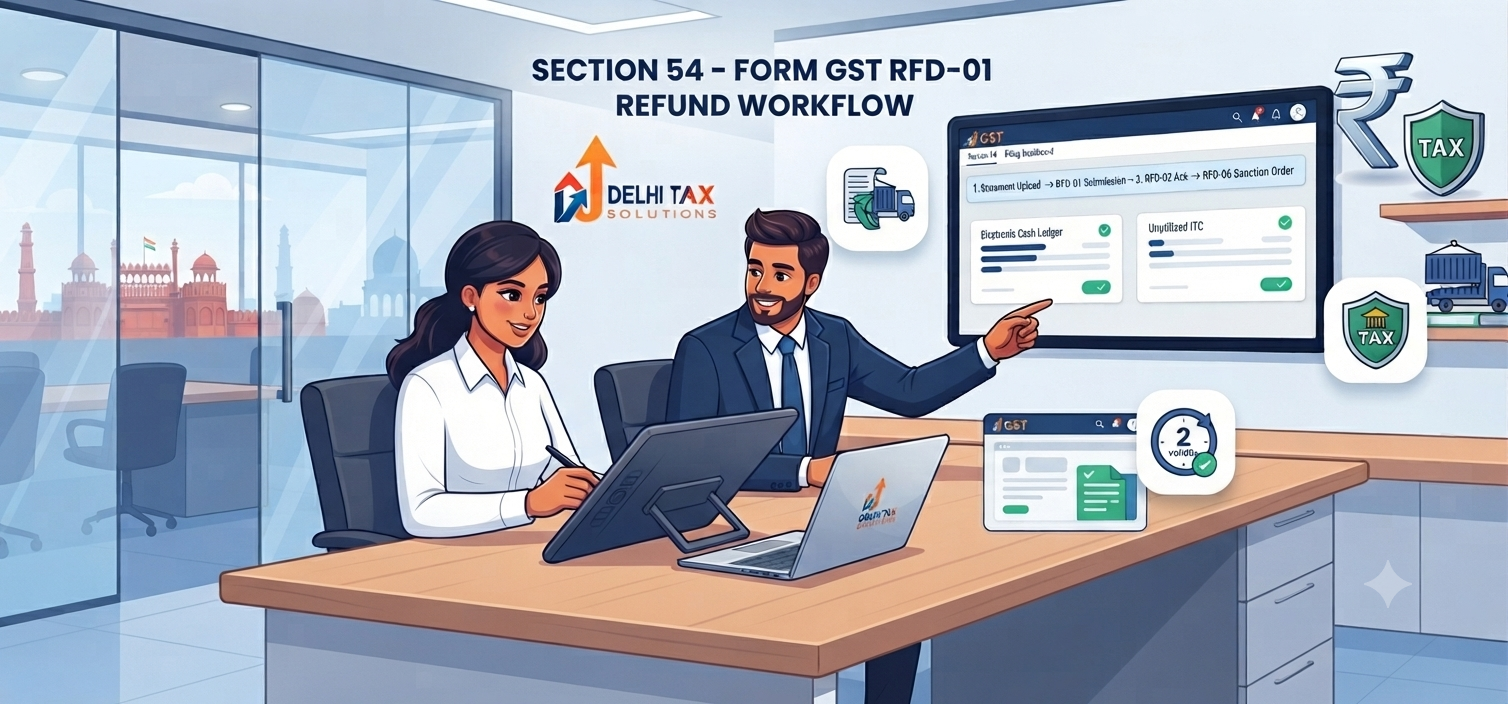
💡 Key Takeaways
- Section 54 of the CGST Act governs all types of GST refund claims, including unutilized Input Tax Credit (ITC) and excess cash ledger balances.
- Applications must be filed online using Form GST RFD-01 on the GST Common Portal within 2 years from the “Relevant Date”.
- Taxpayers exporting goods or services under LUT/Bond without payment of tax can receive a 90% provisional refund in Form RFD-04 within 7 days of acknowledgment.
- Refund of unutilized ITC is legally permitted in only two scenarios: Zero-rated supplies without tax payment and Inverted Duty Structure.
- A Chartered Accountant (CA) or Cost Accountant certificate (Annexure 2 of Form RFD-01) is mandatory if the total refund claim exceeds ₹2 Lakhs to disprove unjust enrichment.
Accumulating blocked capital in your GST ledgers can create severe cash flow constraints for businesses. Whether your working capital is tied up due to higher input tax rates than output tax rates or unutilized credit from zero-rated exports, claiming a gst refund is a statutory right under Section 54 of the CGST Act, 2017.
However, the online refund filing mechanism involves strict mathematical formulas, mandatory document attachments, and rigorous verification by tax officers. A single error in statement filing can lead to a Show Cause Notice (RFD-08) or complete rejection. This guide breaks down the complete process of filing rf 01 on the portal to successfully claim itc refund or cash balances.
Major Categories of GST Refund under Section 54
Under Section 54 of the CGST Act read with Rule 89 of the CGST Rules, a registered taxpayer can apply for a GST refund under the following primary grounds:
| Refund Ground | Governing Provision | Key Condition / Formula |
|---|---|---|
| Zero-Rated Exports without Tax Payment | Sec 54(3)(i) read with Rule 89(4) | Refund of unutilized ITC based on Net ITC to Turnover proportion (LUT/Bond). |
| Inverted Duty Structure | Sec 54(3)(ii) read with Rule 89(5) | Tax rate on inputs is higher than tax rate on output supplies (excluding capital goods). |
| Excess Balance in Electronic Cash Ledger | Sec 54(1) read with Rule 89(1) | Direct withdrawal of excess cash paid via TDS, TCS, or overpaid tax. |
| Exports of Goods with IGST Payment | Sec 54(1) read with Rule 96 | Processed automatically via Customs ICEGATE system once GSTR-1 & GSTR-3B match. |
| Tax Paid on Deemed Exports / SEZ Supplies | Sec 54(3) read with Rule 89(2) | Supplies made to SEZ units/developers or notified deemed export scenarios. |
Understanding the 2-Year Time Limit (“Relevant Date”)
According to Section 54(1) of the CGST Act, any refund application must be filed within 2 years from the Relevant Date. If you cross this statutory deadline, your claim becomes permanently time-barred. The Relevant Date varies based on the nature of the transaction:
- Goods exported by sea/air: Date on which the ship or aircraft leaves India.
- Goods exported by road: Date on which the goods cross the land customs border.
- Services exported: Date of receipt of payment in convertible foreign exchange (BRC/FIRC) OR invoice date (if payment was received in advance).
- Inverted Duty Structure: Due date of filing the GSTR-3B return for the relevant tax period.
- Deemed Exports: Date on which the return relating to such deemed exports is furnished.
- Excess Cash Ledger Balance: Can be claimed at any time within 2 years from the date of payment.
Step-by-Step Guide to Filing Form GST RFD-01
To file your refund application online, follow this detailed procedural workflow on the GST Services Portal:
Step 1: Navigate to Refund Services
Log in to the GST Portal using your credentials. Go to Services → Refunds → Application for Refund.
Step 2: Select the Refund Ground & Tax Period
Choose the appropriate category (e.g., “Refund of unutilized ITC on account of exports without payment of tax” or “Refund on account of Inverted Duty Structure”). Select the financial year and tax period for which you are claiming the refund.
Step 3: Download and Prepare the Statement Template
Download the official offline Excel tool for the relevant Statement (e.g., Statement 3 for export of services, Statement 1A for Inverted Duty Structure). Fill in invoice-wise details, input credit values, shipping bills, or FIRC details, and generate the JSON file.
Step 4: Upload JSON & Validate Data
Upload the generated JSON file on the portal. The system will auto-validate the entries against your GSTR-1 and GSTR-3B returns. Ensure there are no validation errors.
Step 5: Fill Auto-Populated Refund Tables
Enter your Turnover Details and Net ITC. The GST portal will automatically calculate the maximum permissible refund amount based on the statutory Rule 89 formula. Enter the exact refund amount you wish to claim (which cannot exceed the available balance in your Electronic Credit Ledger).
Step 6: Bank Account Selection & Document Upload
Select your validated bank account for credit disbursement. Upload supporting documents (such as copy of LUT, FIRCs, Annexure 1, and CA Certificate if claim exceeds ₹2 Lakhs).
Step 7: Verification & Filing via EVC / DSC
Select the declaration checkbox, choose the authorized signatory, and sign the application using Electronic Verification Code (EVC) or Digital Signature Certificate (DSC).
⏱️ Statutory Timelines for Tax Officer Processing
- Acknowledgment (Form RFD-02): Issued within 15 days of application filing if all documents are complete.
- Provisional Refund (Form RFD-04): In zero-rated export claims, tax authorities must sanction 90% of the claimed amount provisionally within 7 days of issuing Form RFD-02.
- Deficiency Memo (Form RFD-03): If errors exist, a deficiency memo must be issued within 15 days. Filing a fresh RFD-01 is required thereafter.
- Final Order (Form RFD-06): Final sanction order must be passed within 60 days from the date of receiving a complete application. Delayed payouts attract 6% annual interest under Section 56.
CA Certificate Requirement (Unjust Enrichment)
To ensure that the tax burden has not been passed on to the buyer (principle of unjust enrichment), Section 54(5) requires proof. If your total refund claim for a tax period is ₹2,000,000 (₹2 Lakhs) or less, a self-declaration by the applicant suffices.
However, if the refund claim exceeds ₹2 Lakhs, you must upload a certificate issued by a practicing Chartered Accountant or Cost Accountant in Annexure 2 of Form GST RFD-01 certifying that the tax incidence has not been passed on to any other person.
Unblock Your Working Capital with Delhi Tax Solutions
Filing Form GST RFD-01 requires precise invoice matching, Rule 89 formula validation, and CA certification to avoid deficiency notices or long delays.
At Delhi Tax Solutions, our senior tax specialists handle complete GST refund processing—from statement reconciliation to officer liaisoning and CA certification. Get in touch with our team via our GST Compliance & Refund Services today.
Frequently Asked Questions (FAQs)
+ Q: Can I claim a GST refund on unutilized ITC accumulated due to capital goods?
A: No. Under Section 54(3) for Inverted Duty Structure claims, refund of ITC accumulated on capital goods and input services is excluded. Only ITC on inputs (raw materials/goods) is eligible under Rule 89(5). However, for zero-rated exports without payment of tax, ITC on input services is eligible.
+ Q: What happens if I receive a Deficiency Memo (Form RFD-03)?
A: When a Deficiency Memo in Form RFD-03 is issued, the original application is closed and the debited ITC is re-credited to your ledger. You must correct the errors highlighted and file a fresh Form GST RFD-01 on the portal.
+ Q: How is the 2-year limitation period calculated for service export refunds?
A: For service exports, the 2-year period starts from the date of receipt of payment in foreign currency (BRC/FIRC date). If payment was received in advance before issuing the invoice, the 2-year count starts from the invoice date.
+ Q: Can I claim a refund of excess balance in the Electronic Cash Ledger at any time?
A: Yes. You can claim a refund of excess cash ledger balance directly while filing GSTR-3B or by filing Form GST RFD-01 under the category “Refund of excess balance in Electronic Cash Ledger”.
+ Q: What is the threshold limit for claiming a GST refund?
A: Under Section 54(14) of the CGST Act, no refund shall be paid if the total refund amount claimed is less than ₹1,000.
About this article: Authored using statutory provisions of Section 54 of the CGST Act, 2017, Rule 89 of CGST Rules, and practical filing guidelines from Delhi Tax Solutions. Last updated September 2026.
Disclaimer: This blog post is for educational purposes and does not constitute formal legal or tax advisory opinion.