
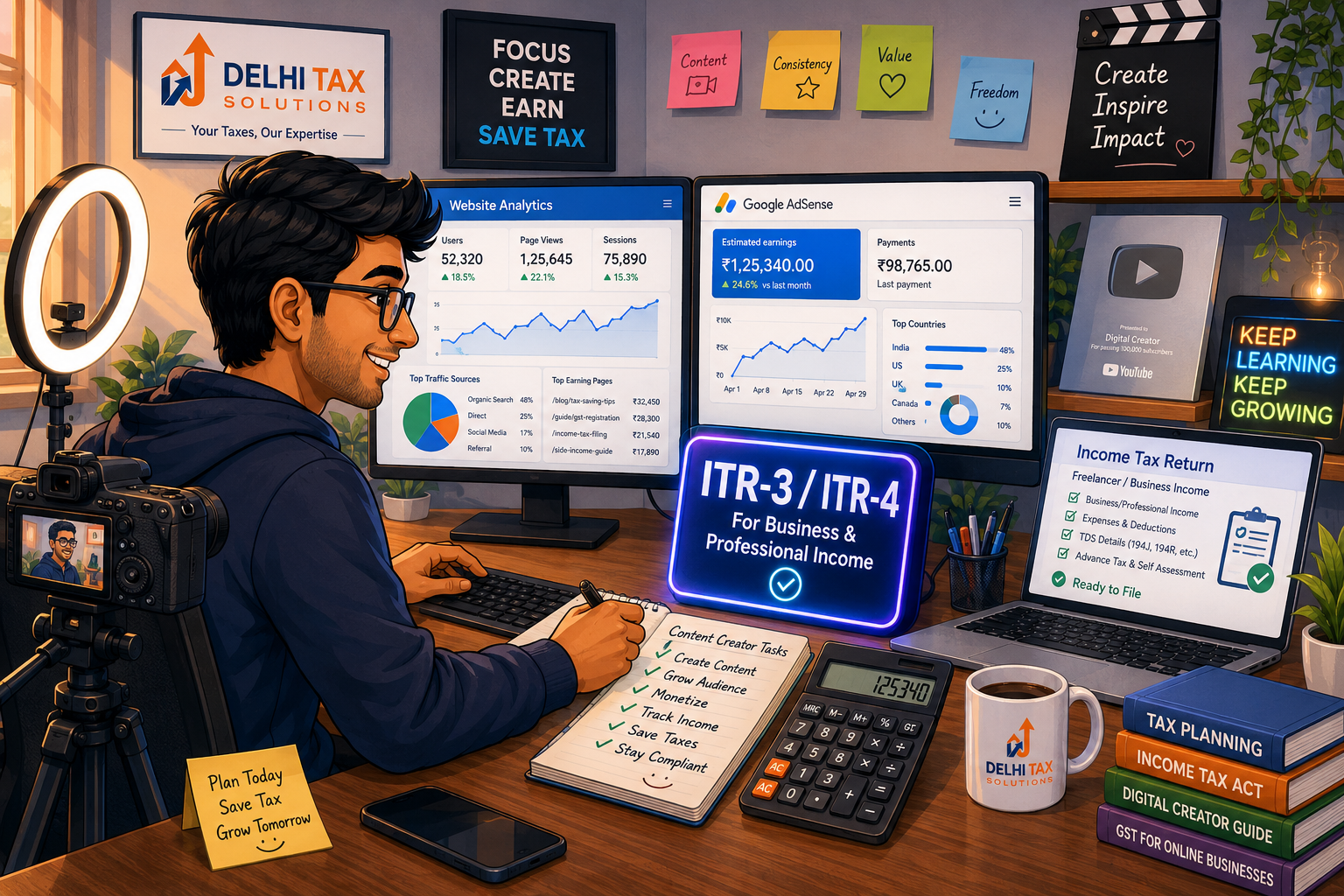
💡 Key Takeaways
- Earnings from Google AdSense, Amazon Associates, and brand deals are taxed as business income under PGBP rules.
- Bloggers and digital creators can file under ITR-3 or opt for presumptive tax under ITR-4.
- Eligible professionals earning up to ₹75 Lakhs can declare 50% net profits using Section 44ADA provisions.
- Foreign inward remittances require Foreign Inward Remittance Certificates (FIRC) and mandatory Schedule FA disclosures in your return.
Over 60% of Indian content creators and digital publishers accidentally underreport international ad revenues, exposing themselves to penalty notices from tax authorities. Managing income tax filing for bloggers and affiliate marketers requires a solid grasp of how Indian tax laws categorize online revenues. Digital earnings from Google AdSense, affiliate networks, sponsored reviews, and display ads are not casual income. The Income Tax Department categorizes them under Profits and Gains from Business or Profession (PGBP).
Understanding your tax filing responsibilities ensures you avoid severe interest penalties while taking advantage of legal expense deductions. In this guide, you will learn how to choose the right tax form, deduct hosting and ad expenses, handle foreign wire transfers, and meet GST compliance thresholds for Tax Year filings. Every digital creator can verify official filing procedures on the Income Tax Department Portal. Let us explore how you can streamline your annual tax returns with full confidence.
What is Income Tax Filing for Bloggers and Affiliate Marketers?
Income tax filing for bloggers and affiliate marketers is the statutory process of reporting digital revenue streams under Profits and Gains from Business or Profession (PGBP) in India. Creators report revenues from Google AdSense, Amazon Associates, sponsored content, and direct ad sales using either ITR-3 (detailed business return) or ITR-4 (presumptive tax return). Taxpayers deduct operational costs such as web hosting, software subscriptions, domain renewals, and freelancer fees to arrive at taxable net income.
Which Blogging Income ITR Form Should Digital Publishers Choose?
Selecting the correct return form prevents processing delays and defect notices from the Centralized Processing Centre (CPC). Digital creators can choose between two main return forms depending on their record-keeping practices and business structure.
ITR-3 vs ITR-4 Selection Matrix for Online Creators
Your choice of blogging income ITR form depends on whether you maintain full double-entry book accounts. Filing ITR-3 allows you to deduct actual operational expenses rupee for rupee, carry forward business losses, and report complex asset depreciations. On the other hand, filing ITR-4 simplifies compliance by offering a fixed profit percentage model without requiring detailed expense ledgers.
Eligibility Under Section 44ADA Presumptive Taxation Scheme
The presumptive taxation scheme for bloggers under Section 44ADA allows eligible technical and creative professionals with annual gross receipts up to ₹75 Lakhs (where cash receipts do not exceed 5%) to declare 50% of gross receipts as taxable profit. If your blogging activity is structured as a trading business, Section 44AD allows declaring 6% (digital receipts) or 8% (cash receipts) as net profit on gross turnover up to ₹3 Crores.
| Feature | ITR-3 (Detailed Business Return) | ITR-4 (Presumptive Scheme) |
|---|---|---|
| Applicable Tax Provisions | Normal Business Tax Provisions | Section 44ADA / Section 44AD |
| Gross Receipt Limit | No Upper Limit | ₹75 Lakhs (44ADA) / ₹3 Crores (44AD) |
| Presumptive Profit Margin | Not Applicable (Calculated via Books) | 50% (44ADA) or 6%/8% (44AD) |
| Expense Book Keeping | Mandatory Expense Bills & Invoices | No Detailed Books Required |
| Loss Carry-Forward | Allowed up to 8 Financial Years | Not Allowed |
How Does Affiliate Income Tax India Apply to Domestic and Brand Sponsorships?
Managing taxes on domestic affiliate commissions involves tracking both gross payments and tax deductions made by affiliate networks. Understanding these withholding mechanisms ensures accurate reconciliation at year-end.
Taxability of Local Commission Streams and Brand Deals
Commissions earned from domestic networks like vCommission, CueLinks, or Amazon India are taxable income. Under Section 194O, e-commerce aggregators deduct 1% TDS on gross sales facilitated through their platforms. Furthermore, Indian brands paying professional fees cross-check payments under Section 194J at 10% or 2% rates. All local affiliate income tax India payments must be reconciled with tax statements before filing.
Claiming Deductions for Digital Business Expenses
Under Section 37(1) of the Income Tax Act, bloggers filing ITR-3 can deduct all expenses incurred wholly and exclusively for business purposes. Valid deductions include web hosting, domain purchases, SEO software, content writer payments, digital ad spend, and office equipment depreciation. For expert assistance in maximizing legitimate deductions, explore our Income Tax Filing Services Hub.
What Are the Rules for Foreign Affiliate Payment Tax and Remittances?
Foreign payouts from international affiliate networks, YouTube, or Google AdSense US require strict compliance with foreign exchange regulations and tax reporting norms.
Handling International AdSense and Network Earnings
International earnings arriving via bank transfer or PayPal are fully taxable in India. Indian tax laws tax resident creators on worldwide income. When foreign ad platforms deduct local withholding tax (e.g., US IRS tax under W-8BEN forms), creators can claim Foreign Tax Credit (FTC) under Section 90 by filing Form 67 online before submitting their annual return.
FIRC Requirements and Schedule FA Disclosure
Every foreign inward remittance received through banking channels must be supported by a FIRC issued under Reserve Bank of India framework guidelines. Taxpayers receiving foreign payouts must also disclose foreign bank accounts or holding balances in Schedule FA when filing ITR-3. [LINK GAP — no live page found: suggested topic: Foreign Remittance and FEMA Compliance for Digital Creators]. Paying careful attention to foreign affiliate payment tax rules prevents asset concealment notices.
When Does GST Registration Become Mandatory for Bloggers and Affiliate Marketers?
Goods and Services Tax (GST) rules apply to online content publishers independently of income tax provisions. Crossing turnover thresholds creates an immediate obligation to obtain a 15-digit GSTIN.
Threshold Limits and Export of Service Provisions
For bloggers offering services within India, GST registration is mandatory when total annual turnover exceeds ₹20 Lakhs (₹10 Lakhs for special category northeastern states). Services supplied to overseas clients—such as foreign affiliate networks or Google AdSense Ireland—qualify as “Export of Services.” To learn more about obtaining your tax registration, visit our GST Registration & Advisory portal.
Letter of Undertaking (LUT) for Zero-Rated Exports
Exporting services is classified as a zero-rated supply under GST law. Creators can export services without paying 18% IGST by filing an online Letter of Undertaking (LUT) on the official Official GST Portal India. Managing income tax filing for bloggers and affiliate marketers India alongside GST compliance protects digital businesses from severe non-filing penalties.
How Can Bloggers Avoid Common Penalties and Tax Notices?
Automated cross-matching between bank statements, GST returns, and tax certificates makes compliance transparency essential. Following systematic verification routines protects creators from unexpected scrutiny.
Matching Form 26AS, AIS, and TIS Financial Data
Before submitting returns, bloggers must verify their Annual Information Statement (AIS) and Form 26AS for bloggers entries. Discrepancies between reported revenue and automated bank receipts trigger computerized defect notices. Payers deducting TDS must issue Form 16A certificates, which creators can review alongside our TDS Compliance & Filing Services Hub guide.
Advance Tax Calculations Under Section 208
If your estimated tax liability after deducting TDS exceeds ₹10,000 in a financial year, paying advance tax in four quarterly installments (June 15, September 15, December 15, and March 15) is mandatory under Section 208. Defaulting on advance tax payments attracts monthly interest charges under Section 234B and Section 234C. Using Section 44ADA for bloggers helps estimate net advance tax payments accurately.
⚡ In a Nutshell
Blogging and affiliate income are taxable under PGBP rules. Choose ITR-3 for full expense deductions or ITR-4 (Section 44ADA) for simplified 50% profit reporting. Secure FIRC for foreign earnings, file LUT for GST zero-rated exports, and pay quarterly advance tax to maintain complete compliance.
Mastering income tax compliance allows bloggers and affiliate publishers to build scalable, sustainable digital media businesses. Deciding between detailed expense bookkeeping under ITR-3 and simplified presumptive taxation under ITR-4 depends on your profit margins and operating costs. Creators receiving overseas payouts must secure FIRC documents, file LUTs for GST zero-rated exports, and pay advance tax on time. Reach out to Delhi Tax Solutions’ experienced Chartered Accountants today to file your returns, optimize tax liabilities, and protect your digital assets with confidence.
About this article: Researched using official government sources and Delhi Tax Solutions’ in-house tax advisory team. Last updated August 2026.
Disclaimer: This article is for general informational purposes and is not a substitute for personalised professional tax advice.
Frequently Asked Questions
Q: Which ITR form should bloggers and affiliate marketers file in India?
A: Bloggers and affiliate marketers should file either ITR-3 or ITR-4. If you keep detailed financial records and want to claim actual operating expenses like hosting, software, and freelancer payments, file ITR-3. If your gross receipts are under ₹75 Lakhs and you prefer claiming presumptive tax under Section 44ADA without maintaining detailed books, file ITR-4.
Q: Is Section 44ADA applicable to affiliate marketing income in India?
A: Yes, Section 44ADA applies to bloggers and content creators providing technical, consultancy, or creative professional services. Eligible taxpayers with total receipts under ₹75 Lakhs can declare 50% of gross earnings as taxable income. However, if your affiliate operations resemble pure commission agent trading, tax authorities may require filing under Section 44AD (6% or 8% profit model) instead.
Q: How to report foreign affiliate earnings from Amazon and Google Adsense?
A: Foreign earnings must be converted into Indian Rupees using RBI reference exchange rates and included in your gross business revenue under PGBP. If tax was withheld overseas, you can claim Foreign Tax Credit under Section 90 by filing Form 67 online. Additionally, resident taxpayers must disclose foreign bank accounts or holdings in Schedule FA when submitting ITR-3 returns.
Q: Is GST registration mandatory for bloggers earning from foreign clients?
A: GST registration becomes mandatory once your total worldwide turnover exceeds ₹20 Lakhs in a financial year (₹10 Lakhs in special category states). Exporting services to foreign clients qualifies as a zero-rated supply under GST laws. By submitting an online Letter of Undertaking (LUT) annually on the GST portal, creators can legally export services without paying 18% IGST upfront.
Q: Can bloggers claim home office rent and internet bills as business expenses?
A: Yes, bloggers filing ITR-3 can claim proportionate deductions for home office rent, internet connections, and utility bills under Section 37(1). You must maintain proper payment receipts and establish that these expenses were incurred exclusively for running your digital publishing business. If filing under presumptive scheme ITR-4, individual expense claims are not allowed as the 50% deduction covers all operating costs.
