
💡 Key Takeaways:
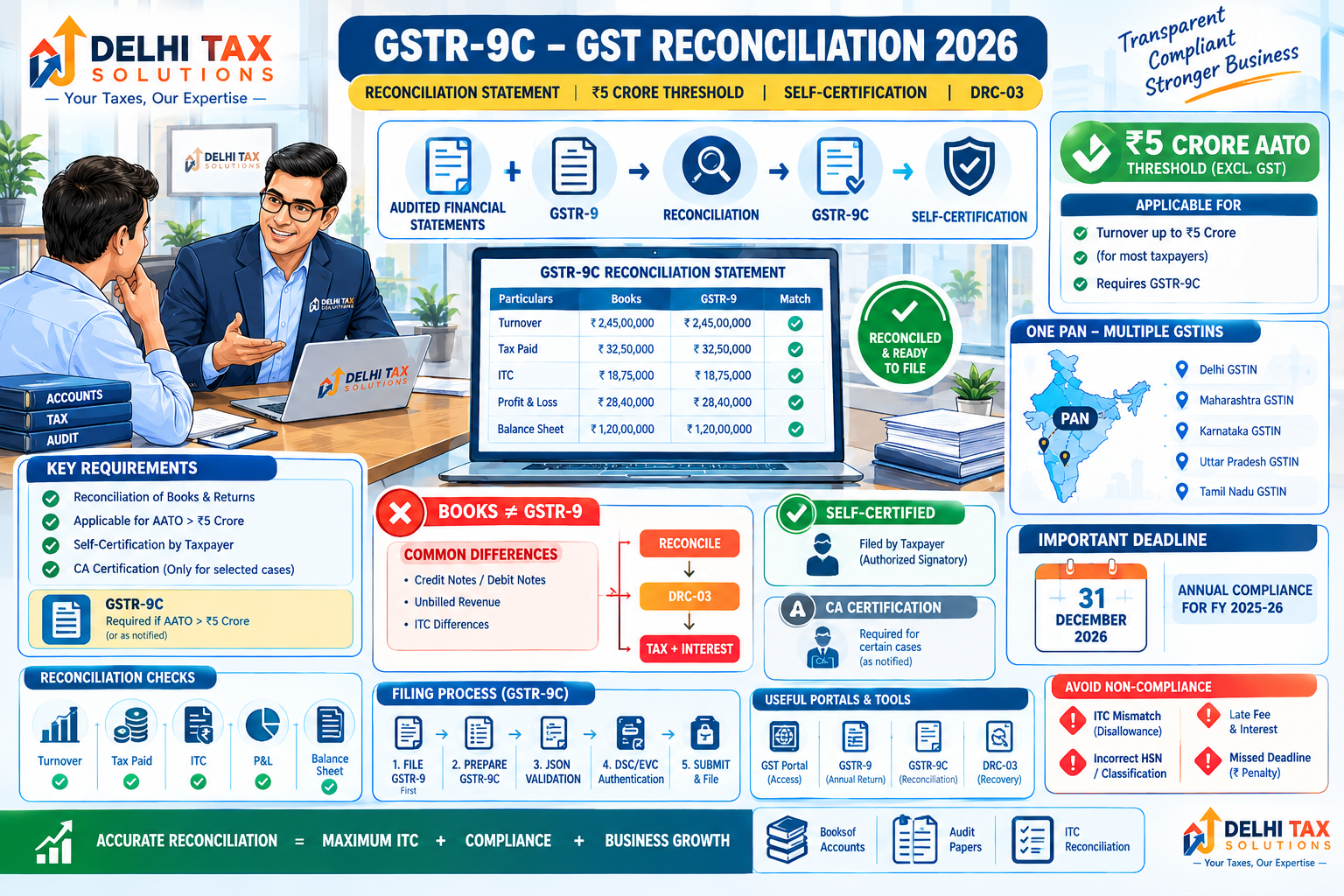
- Form GSTR-9C is mandatory for businesses with an aggregate annual turnover exceeding ₹5 crore.
- The statement requires formal self-certification rather than mandatory external Chartered Accountant sign-offs.
- Reconciliation bridges differences between audited financial statements and annual return data.
- Unreconciled tax liabilities must be cleared promptly using Form DRC-03 with 18% interest.
- The portal strictly prohibits filing GSTR-9C before the annual GSTR-9 return is accepted.
Navigating annual tax compliance requires total alignment between your company books and government filings. Overlooking minor mismatches can trigger automated departmental scrutiny. Business owners often scramble when year-end figures fail to mirror monthly ledger totals. For growing enterprises crossing critical financial milestones, understanding advanced compliance tools is essential. The compliance framework demands absolute precision as reporting standards tighten across India.
Our CA team regularly assists expanding businesses in reconciling complex turnover figures without facing administrative friction. This complete guide breaks down the statutory rules governing gstr 9c filings for FY 2025-26. You will learn how to calculate your threshold limits, execute self-certification accurately, and clear liabilities safely.
Whether you manage accounts internally or work with external advisors, mastering this reconciliation protects your corporate standing. Proper execution ensures your organization stays entirely compliant with current indirect tax mandates.
What Is Form GSTR-9C and Who Must File It?
Form GSTR-9C is a statutory reconciliation statement matching the figures reported in your annual GST return with your audited financial statements. Introduced to streamline regulatory oversight, it verifies that your turnover, tax payments, and Input Tax Credit (ITC) claims tie out cleanly. According to guidelines issued by the GST Council and the Central Board of Indirect Taxes and Customs (CBIC), filing this statement is compulsory for regular taxpayers whose aggregate annual turnover exceeds ₹5 crore. Entities registered under composition schemes are exempt from this requirement.
Understanding the INR 5 Crore Aggregate Turnover Threshold
Determining whether your enterprise crosses the statutory threshold requires calculating your Aggregate Annual Turnover (AATO) on a PAN-India basis. Many business owners mistakenly evaluate turnover state by state rather than summing all registrations tied to a single Permanent Account Number. Total turnover includes taxable supplies, exempt supplies, export sales, and interstate supplies. If your combined pan-India AATO crosses ₹5 crore in FY 2025-26, filing becomes mandatory.
For organizations expanding operations across multiple regions, tracking these numbers demands meticulous accounting. Failing to evaluate your pan-India revenue correctly leads to missed compliance obligations. Startups scaling rapidly should review their metrics quarterly to anticipate this threshold. Proper evaluation prevents abrupt regulatory notices and ensures timely filings. For structural guidance on scaling your operations, explore our resources on starting a business in India.
Step-by-Step Procedure to File GSTR-9C Online
Executing your annual filing requires downloading official offline utilities and following a structured sequence. The government portal processes these submissions via encrypted JSON file uploads. Follow these operational steps to complete your filing successfully:
Prerequisite Filing of GSTR-9
You cannot initiate your reconciliation statement until your standard GSTR-9 annual return is successfully filed and accepted. The portal locks out 9c limit validation modules until this prerequisite step clears. Ensure your annual summary is error-free before downloading offline tool packages.
Downloading and Preparing the Offline Utility
Visit the official GST Portal to download the latest offline utility tool. Import your GSTR-9 system data alongside your audited profit and loss statement and balance sheet. Part A of the utility covers detailed reconciliation tables, while Part B handles formal taxpayer self-certification.
JSON Validation and Final Upload
Run the error-check macro inside the utility tool to catch discrepancies before submission. Once validated, generate the final JSON file and upload it back to the returns dashboard. Authorised signatories must complete final verification using a Digital Signature Certificate (DSC) for corporate entities or an Electronic Verification Code (EVC) where applicable. For companies setting up new corporate structures, maintaining clean books from day one simplifies this workflow. Professional support during company registration helps establish these structured accounting practices early.
How to Handle Reconciliation Differences and Pay Shortfalls
Reconciliation frequently exposes discrepancies between book revenue and reported turnover due to differing accounting treatment of credit notes, advance receipts, and unbilled revenue. Identifying these variances transparently is the primary objective of a thorough gst audit preparation. When differences reveal unpaid tax liabilities, prompt remediation is required.
| Compliance Feature | Form GSTR-9 | Form GSTR-9C |
|---|---|---|
| Primary Document Nature | Annual Summary Return | Reconciliation Statement |
| Statutory Turnover Trigger | Compulsory for all regular taxpayers | Mandatory above ₹5 Crore AATO |
| Certification Standard | Self-filed by registered taxpayer | Self-certified by taxpayer |
| Prerequisite Status | Independent submission | Must follow GSTR-9 acceptance |
If the reconciliation statement highlights an underreported liability, taxpayers must pay the due amount using Form DRC-03. This payment must include an 18% annual interest charge calculated from the original due date. According to notifications by the Ministry of Corporate Affairs and the GST Council, self-certification replaces the older mandatory external CA reconciliation signature requirement. However, maintaining impeccable documentation remains vital. Businesses must keep their foundational permits and licenses updated to support seamless financial reporting. Securing proper business licenses prevents operational disruptions that impact year-end audits.
Common Pitfalls and Penalties for Non-Compliance
Failing to file reconciliation statements within statutory deadlines invites severe financial consequences. The standard due date is December 31 following the close of the financial year. While the reconciliation form itself does not carry a separate standalone late fee, delays in the prerequisite annual return attract penalties of ₹200 per day under the CGST Act, capped at 0.5% of the turnover. Furthermore, missing these filings invites automated scrutiny notices from the tax administration.
Another frequent error involves miscalculating Input Tax Credit (ITC) reversals required for invoices unpaid beyond 180 days. Overstating credits without matching books triggers immediate departmental flags. Taxpayers should conduct quarterly internal reviews to ensure their monthly return filings align perfectly with yearly summaries. Proactive monitoring prevents last-minute filing bottlenecks and protects working capital. Ensuring your routine filings are precise simplifies every stage of compliance. Proper management of regular submissions directly supports streamlined reporting. For ongoing operational efficiency, maintaining structured GST return filing processes is essential.
What Our CA Team Sees in Practice: Avoiding Departmental Notices
Experiencing tax scrutiny is stressful for any growing enterprise. Based on cases handled by our CA team, the most common trigger for departmental notices is a failure to reconcile electronic credit ledger balances with audited balance sheet figures. Tax authorities utilize advanced data analytics to flag variances between GSTR-2B statements and financial ledger expenses instantly. When discrepancies arise, officers frequently issue inquiry letters before formal audits begin.
To insulate your business from these risks, maintain a detailed reconciliation working paper alongside your financial statements. Document every variance—such as depreciation differences or provisions—clearly within Part A of your filing. According to Press Information Bureau advisories and CBDT/CBIC coordination frameworks, data transparency significantly reduces litigation risks. If your business requires specialized assistance with regulatory filings, partnering with seasoned professionals ensures complete accuracy. Proper guidance keeps your enterprise secure and fully compliant.
Managing annual compliance demands rigorous attention to detail and thorough data verification. Tracking your pan-India turnover threshold guarantees you never miss mandatory filing deadlines. Reconciling your financial books against annual returns safeguards your working capital from unexpected liabilities. Handling these complex statements internally can stretch your resources thin. Talk to a Delhi Tax Solutions expert to get your annual filings managed professionally within days. Take control of your corporate compliance today.
About this article: Researched using official government sources, real-time competitor and search-trend analysis, and Delhi Tax Solutions’ in-house tax advisory team. Last updated September 2026.
Disclaimer: This article is for general informational purposes and is not a substitute for personalised professional tax advice.
Frequently Asked Questions (FAQs)
Q: Is an external Chartered Accountant signature mandatory for filing GSTR-9C under current rules?
A: No, an external Chartered Accountant signature is no longer legally mandatory for certifying Form GSTR-9C. Amendments introduced by the GST Council shifted the requirement to self-certification by the registered taxpayer. Taxpayers must review their audited financial statements and independently verify the reconciliation statement before uploading the final JSON file using digital verification methods.
Q: How is the ₹5 crore aggregate turnover threshold calculated for businesses with multiple state branches?
A: The aggregate annual turnover threshold of ₹5 crore is calculated on a strict PAN-India basis. Business owners must combine the taxable, exempt, export, and interstate supplies across all distinct GST registrations linked to the same Permanent Account Number. If the combined national total exceeds ₹5 crore in the financial year, filing Form GSTR-9C becomes mandatory for every active state registration under that PAN.
Q: What exact steps should I take if my audited financial statements differ from my GSTR-9 annual return?
A: When financial statements differ from your GSTR-9 return, you must document the specific reasons inside Part A of Form GSTR-9C. Common valid differences include unbilled revenue, credit notes issued after financial year-end, or varying valuation treatments. You must provide clear explanatory notes for every variance to satisfy portal validation checks and prevent automated departmental scrutiny notices.
Q: How do I pay additional tax liabilities discovered during the GSTR-9C reconciliation process?
A: Any additional tax liability discovered during the reconciliation process must be paid using Form DRC-03 on the official GST portal. Taxpayers are required to deposit the shortfall amount along with statutory interest calculated at 18% per annum from the original due date. The reference number generated from Form DRC-03 must be quoted in the reconciliation statement before final submission.
Q: Can I file Form GSTR-9C before successfully submitting my GSTR-9 annual return on the portal?
A: No, the GST portal strictly prohibits initiating or filing Form GSTR-9C until your standard GSTR-9 annual return has been successfully filed and accepted. The reconciliation statement directly pulls baseline figures from your submitted annual return. Consequently, you must complete, verify, and file your GSTR-9 summary before unlocking the offline reconciliation utility.