
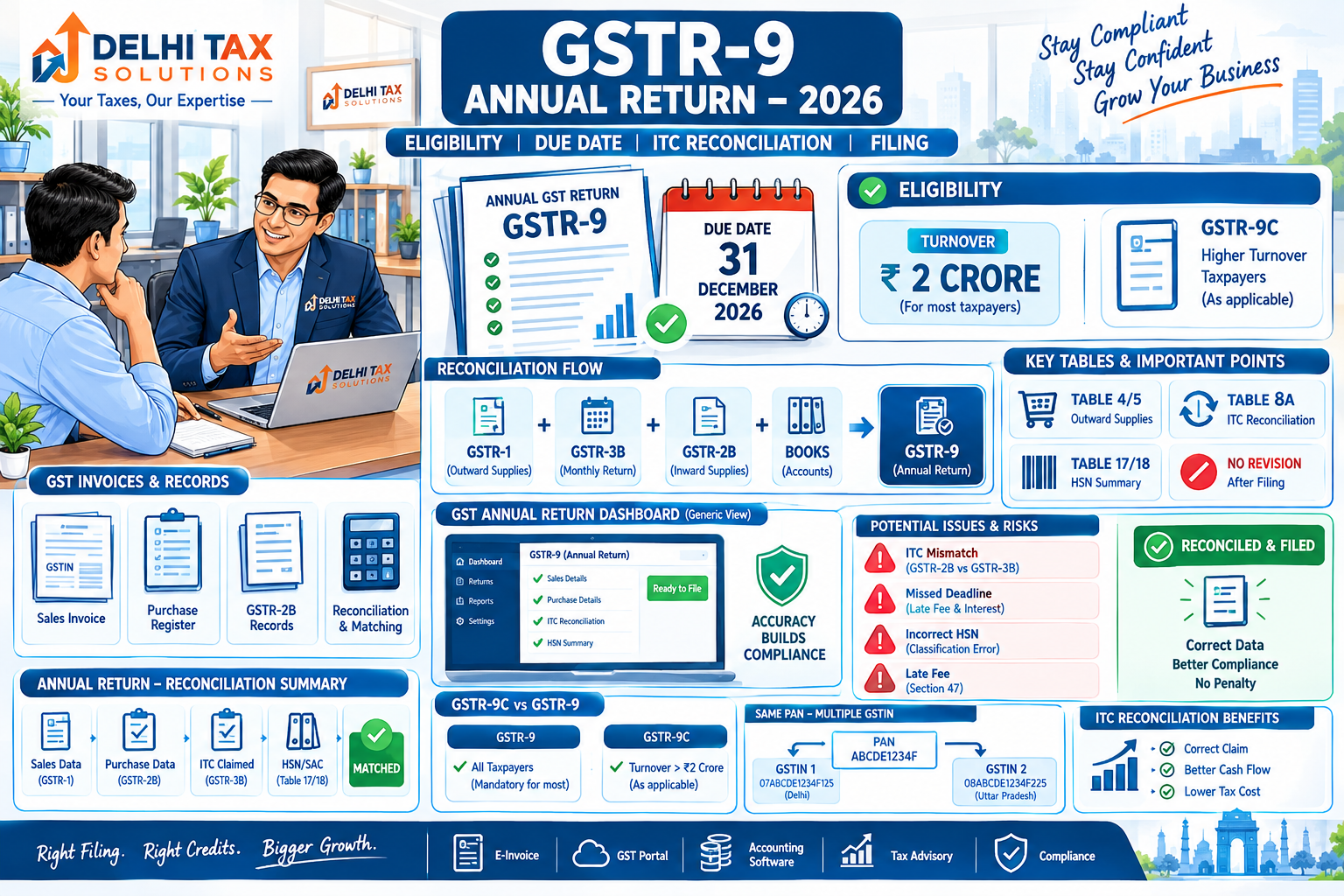
💡 Key Takeaways:
- Mandatory Threshold: GSTR-9 is required if annual turnover exceeds ₹2 crore.
- Due Date: December 31 following the financial year close.
- No Revision: Once submitted on the portal, GSTR-9 cannot be edited.
- Core Objective: Reconciles monthly GSTR-3B and GSTR-1 with audited books.
Filing your gstr 9 is one of the most critical compliance milestones for Indian businesses. Every year, regular taxpayers face the daunting task of summarizing thousands of transactions into a single consolidated form. Missing discrepancies between monthly filings and annual accounts can trigger departmental notices.
At Delhi Tax Solutions, our chartered accountant team handles hundreds of annual compliance cases. We see firsthand how minor bookkeeping oversights snowball into costly late fees or audit disputes. This guide breaks down everything you need to file accurately without stress.
Decoding GSTR-9 and Eligibility Rules
Form gstr 9 serves as the official annual return compiling all monthly or quarterly data submitted through periodic filings. According to guidelines issued by the GST Council, regular business entities registered under Goods and Services Tax must review their aggregate turnover across all states using their PAN.
If your aggregate annual turnover stays at or below ₹2 crore, filing remains optional. However, many small business owners opt to file voluntarily to maintain clean tax health records. For broader entity structuring advice, review our guide on company registration services.
Taxpayers crossing the ₹5 crore threshold face an additional requirement. They must submit form 9 alongside GSTR-9C, which is a self-certified reconciliation statement comparing audited financial statements with annual returns.
Deadlines, Late Fees and Penalty Structures
Timing is everything when managing your tax calendar. The statutory due date for filing your gst annual return is December 31 following the close of the financial year. For FY 2025-26, the deadline is December 31, 2026.
Delaying your submission attracts statutory late fees under the Central Goods and Services Tax Act. The standard late fee is ₹50 per day (₹25 CGST and ₹25 SGST) for taxpayers with turnover up to ₹5 crore, capped at 0.04 percent of state turnover.
To ensure your business maintains proper foundational compliance from day one, explore our specialized gst registration support. Proper initial registration minimizes downstream data errors during annual return compilation.
| Annual Turnover Bracket | Late Fee Per Day | Maximum Late Fee Cap |
|---|---|---|
| Up to ₹5 Crore | ₹50 (₹25 CGST + ₹25 SGST) | 0.04% of turnover in state/UT |
| ₹5 Crore to ₹20 Crore | ₹100 (₹50 CGST + ₹50 SGST) | 0.04% of turnover in state/UT |
| Above ₹20 Crore | ₹200 (₹100 CGST + ₹100 SGST) | 0.50% of turnover in state/UT |
Step-by-Step Online Portal Filing Process
Filing your annual return requires systematic navigation across multiple tables. Before logging in, ensure your periodic filings and books of accounts match perfectly. Check out our start business resources if you are setting up new operational workflows.
First, log into the GST portal using your credentials. Navigate to Returns Dashboard, select Annual Return, and choose the correct financial year. Click on Prepare Online to populate system-computed summaries.
Next, verify outward supplies in Table 4 and Table 5 against your filed GSTR-1 statements. Make sure all credit notes, debit notes, and unbilled supplies from the previous financial year declared later are captured accurately.
Navigating Table 8A and ITC Reconciliations
Table 8A is often the trickiest part of the annual return process. It auto-populates your eligible Input Tax Credit based on auto-generated GSTR-2B statements. Discrepancies between your purchase register and Table 8A frequently trigger notices from tax authorities.
Our CA team recommends matching your vendor invoice numbers and GSTINs monthly rather than waiting until year-end. If suppliers failed to upload invoices in time, you must reverse ineligible credits to avoid 18 percent interest liabilities under Section 50.
For additional regulatory and licensing compliances that affect your supply chain inputs, check our comprehensive licenses directory covering MSME Udyam and FSSAI registrations.
Common Mistakes and Expert CA Solutions
Taxpayers frequently make avoidable errors when compiling their annual filings. One major mistake is attempting to declare new transactions that were never reported in monthly GSTR-3B forms. Gstr 9 only summarizes past data; it cannot be used to pay fresh tax liabilities without reporting them first.
Another frequent pitfall is ignoring HSN summary requirements in Tables 17 and 18. Taxpayers with turnover above ₹5 crore must report 6-digit HSN codes for outward supplies, while those below ₹5 crore have relaxed digit requirements.
For regular tax updates and expert breakdowns, browse our main blogs hub. Staying informed throughout the fiscal cycle is your best defense against unexpected tax notices.
Conclusion and Professional CA Assistance
Filing your annual return demands absolute precision, rigorous data reconciliation, and deep familiarity with current tax notifications. Mastering form 9 protects your enterprise from costly penalties and unwarranted departmental audits.
Talk to a Delhi Tax Solutions expert to get your GST annual return filed accurately within statutory timelines. Let our experienced chartered accountants handle your complex reconciliations while you focus on growing your business.
About this article: Researched using official government sources, real-time competitor and search-trend analysis, and Delhi Tax Solutions’ in-house tax advisory team. Last updated September 2026.
Disclaimer: This article is for general informational purposes and is not a substitute for personalised professional tax advice.
Frequently Asked Questions (FAQs)
Q: Is gstr 9 mandatory if my turnover is below ₹2 crore?
A: No, filing Gstr 9 is strictly optional for regular registered taxpayers whose aggregate annual turnover is ₹2 crore or less, as per ongoing exemptions notified by the central board. However, many businesses choose to file voluntarily to maintain clean financial audit trails.
Q: What is the due date for filing gstr 9 for FY 2025-26?
A: The statutory due date for filing the annual return for financial year 2025-26 is December 31, 2026, unless explicitly extended by official notifications issued by the Ministry of Finance or the GST Council.
Q: Can we revise gstr 9 after submission on the GST portal?
A: No, once an annual return is filed and authenticated using digital signature certificates or electronic verification codes on the portal, it cannot be revised or edited. Taxpayers must ensure complete accuracy before final submission.
Q: What are the late fees for delayed filing of gst annual return?
A: Delayed filings attract a late fee of ₹50 per day (₹25 CGST and ₹25 SGST) for turnovers up to ₹5 crore, capped at 0.04 percent of state turnover. Higher turnover brackets attract steeper daily rates up to ₹200 per day.
Q: How do I resolve ITC mismatches between Table 8A and my purchase register?
A: You must perform a detailed invoice-level reconciliation comparing your internal purchase ledger against auto-populated GSTR-2B data, identifying missing vendor uploads, and reversing ineligible credits before finalizing your annual return figures.